
The shift began gradually in the late 1990s and early 2000s, but the decisive transformation occurred after Modi assumed office in 2014. His leadership marked a policy recalibration that removed earlier hesitations and emphasised open engagement based on national interest. The landmark 2017 visit to Israel by an Indian prime minister, the first ever, clearly demonstrated this change
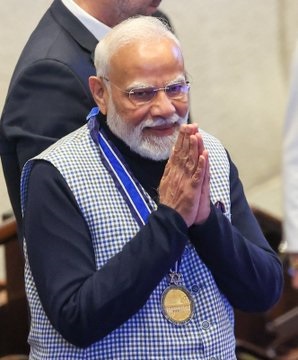
The conferment of the Medal of the Knesset on Narendra Modi represents a defining diplomatic moment in the evolving relationship between India and Israel. Awarded by Knesset Speaker Amir Ohana, the honour symbolises recognition not merely of bilateral cooperation but of a broader geopolitical shift that has taken place over the past decade. The award acknowledges Modi’s role in transforming India–Israel relations from a cautious engagement rooted in diplomatic sensitivities into a visible, multi-dimensional strategic partnership encompassing defence, technology, agriculture, and innovation. The symbolism is significant because parliamentary honours reflect institutional trust rather than purely executive diplomacy, thereby indicating a deep level of confidence between democratic systems.
The road from cautious engagement to strategic partnership
For decades after independence, India maintained a reserved approach toward Israel due to Cold War alignments, domestic political considerations, and solidarity with Arab nations. Formal diplomatic relations were established only in 1992, marking a late start compared with many other countries. Even after diplomatic normalisation, cooperation remained largely discreet, especially in defence procurement. The shift began gradually in the late 1990s and early 2000s, but the decisive transformation occurred after Modi assumed office in 2014. His leadership marked a policy recalibration that removed earlier hesitations and emphasised open engagement based on national interest. The landmark 2017 visit to Israel by an Indian prime minister, the first ever, demonstrated this change clearly. By separating India’s Israel policy from its Palestine policy rather than linking the two, the government signalled strategic autonomy. That shift laid the foundation for the recognition that followed years later.
Personal diplomacy as a catalyst for bilateral transformation
One of the defining characteristics of Modi’s foreign policy has been the emphasis on personal leadership and direct engagement with global counterparts. His rapport with Israeli Prime Minister Benjamin Netanyahu became emblematic of the new phase in relations. Personal diplomacy accelerated cooperation across sectors, including defence, intelligence sharing, agriculture technology, and innovation ecosystems. Leader-level trust often reduces bureaucratic delays and creates momentum for institutional collaboration. The Knesset’s recognition specifically referenced personal leadership, illustrating how individual relationships can reshape national trajectories. Such diplomacy also creates strong symbolic imagery that resonates with domestic audiences in both countries, reinforcing public support for bilateral ties.
Defence and security cooperation as the backbone
The core of India–Israel relations has long been defence and security cooperation. Israel has emerged as one of India’s most important defence partners, particularly in advanced technologies such as missile systems, unmanned aerial vehicles, electronic warfare capabilities, cybersecurity tools, and border surveillance solutions. Shared concerns about terrorism and regional instability have created natural strategic alignment. Intelligence cooperation has strengthened counter-terrorism capabilities for both nations. For India, Israeli expertise fills critical technological gaps; for Israel, India represents a large and reliable strategic partner. This defence dimension provides the structural foundation upon which broader economic and technological cooperation is built. It also explains why recognition from Israeli institutions carries strategic weight beyond ceremonial diplomacy.
Technology, innovation, and economic convergence
Beyond security cooperation, the partnership increasingly focuses on innovation and economic collaboration. Israel’s reputation as a global innovation hub complements India’s scale, talent pool, and market potential. Joint initiatives in water management, agricultural productivity, artificial intelligence, climate resilience technologies, and digital infrastructure demonstrate this synergy. Collaborative research programs, startup partnerships, and academic exchanges are expanding steadily. Economic engagement is no longer limited to trade; it now includes investment flows, joint ventures, and technology co-development. The honour bestowed by the Knesset therefore recognises not only past cooperation but also the anticipated trajectory of future partnership in high-technology domains that will define global competitiveness in the coming decades.
A rare diplomatic balance between Israel and Palestine
One of the most striking aspects of India’s diplomacy is its ability to maintain relationships with both Israel and Palestine. India has historically supported Palestinian statehood while simultaneously strengthening ties with Israel. This dual engagement reflects strategic pragmatism rather than ideological contradiction. Recognition from both sides underscores India’s credibility as a balanced actor in West Asia. Such diplomatic positioning enhances India’s potential role as a mediator or stabilising influence in regional affairs. Maintaining this balance requires careful navigation of geopolitical sensitivities, but it also provides India with diplomatic leverage and international respect.
India’s rise as a trusted global partner
The award also reflects India’s growing stature in global politics. Over the past decade, India has strengthened relations simultaneously with Western powers, Middle Eastern nations, Indo-Pacific partners, and major global actors while maintaining strategic autonomy. This multi-alignment approach differs from traditional alliance systems and allows India to maximise partnerships without entering rigid blocs. Israel views India as a democratic partner, a major market, and a technological collaborator, while India values Israel’s innovation capacity and defence expertise. Mutual trust has expanded beyond transactional cooperation into long-term strategic alignment. Recognition from Israeli parliamentary institutions therefore signals acknowledgement of India’s emergence as a significant global player.
Domestic political significance within India
International honours often carry domestic political implications. Recognition from a technologically advanced and strategically important nation reinforces Modi’s image as a leader capable of enhancing India’s global standing. International validation can strengthen narratives of national pride, decisive governance, and strong leadership. Such honours also resonate with citizens who perceive foreign recognition as evidence of India’s rising influence. The symbolic value is therefore both diplomatic and political, contributing to the broader narrative of India’s transformation on the world stage.
The geopolitical context of the award
The timing of the award coincides with major geopolitical changes in West Asia, including shifting alliances, regional security concerns, and new economic partnerships. Normalisation agreements between Israel and several Arab nations have altered the strategic landscape. India has cultivated strong ties with Gulf countries while deepening relations with Israel, positioning itself as a bridge between multiple regional actors. This ability to engage across geopolitical divides increases India’s relevance in regional stability frameworks. Israel’s recognition of Modi can thus be interpreted as an acknowledgement of India’s expanding regional importance.
Parliamentary diplomacy as a new frontier
The Medal also highlights the growing role of parliamentary diplomacy in international relations. Legislative institutions increasingly engage in diplomatic outreach to strengthen democratic solidarity. India and Israel share institutional similarities, including parliamentary governance, independent judicial systems, vibrant civil societies, and innovation-driven economies. These shared democratic characteristics create long-term stability in bilateral relations beyond changes in government leadership. Parliamentary recognition therefore symbolises institutional partnership rather than temporary political alignment.
The symbolism of shared civilisational narratives
Modi frequently emphasises civilisational connections in diplomacy, portraying India and Israel as ancient cultures with modern democratic identities. Such narratives create emotional resonance and cultural affinity between societies. Civilisational diplomacy reinforces legitimacy and strengthens public perception of partnership. It also frames cooperation as historically natural rather than purely strategic, thereby deepening long-term acceptance of bilateral engagement among citizens.
Strategic implications for the future
The honour signals expectations of future cooperation rather than simply celebrating past achievements. Defence co-development projects may expand, enabling joint manufacturing and technology transfer. Intelligence cooperation is likely to deepen, particularly in cybersecurity and counter-terrorism. Innovation partnerships between universities, research institutions, and startups could create new technological ecosystems. Trade and investment flows may grow through structured agreements that encourage private sector participation. India could also participate more actively in regional frameworks involving Israel and other partners across the Mediterranean and Indo-Pacific regions. These developments would elevate bilateral relations into a comprehensive strategic alliance.
India’s potential role in West Asian stability
India’s balanced diplomacy gives it credibility across competing regional actors. Its historical experience as a non-colonial civilisation and its large diaspora presence in the Middle East enhance its acceptance as a constructive partner. India could contribute to humanitarian initiatives, infrastructure development, economic partnerships, and diplomatic dialogue platforms. Such engagement would align with India’s aspiration to play a larger global role while supporting regional stability.
Challenges and limitations ahead
Despite optimism, challenges remain. Regional conflicts, shifting alliances, global power competition, and technology transfer restrictions could complicate cooperation. Domestic political sensitivities within India regarding Middle Eastern conflicts also require careful management. Economic uncertainties and protectionist policies may affect trade expansion. Successfully navigating these challenges will determine the depth and sustainability of future relations.
The evolution of India’s global recognition
The Medal of the Knesset adds to a series of international recognitions received by Modi from different regions. Collectively, these honours reflect acknowledgement of India’s diplomatic activism and strategic importance. They also illustrate a broader trend in global politics where rising powers receive increasing institutional recognition from established states. Such recognition reinforces India’s aspiration to play a larger role in shaping international norms and partnerships.
A broader narrative of leadership diplomacy
The award demonstrates the increasing importance of leadership diplomacy in modern international relations. Modi’s approach combines symbolism, public communication, strategic clarity, and personal engagement. This model has produced tangible outcomes across multiple bilateral relationships. The recognition from Israel illustrates how leadership style can influence geopolitical outcomes when aligned with national interests.
Beyond honour, towards a common goal
The Medal of the Knesset represents more than diplomatic appreciation; it symbolises convergence between two nations driven by shared interests, technological ambition, and security concerns. It reflects India’s evolution into a confident global actor capable of maintaining relationships across geopolitical divides. Most importantly, it points toward a future in which India and Israel collaborate not only bilaterally but also in shaping broader regional and global frameworks. The honour recognises past achievements, but its deeper significance lies in the expectations it creates, expectations that the partnership will continue expanding and that India will play an increasingly influential role in global affairs.