
Getting the unorganised labour force to become a stable tax-paying, semi-white-collar citizen — looks too much like a plan drafted in Delhi’s ivory towers by IAS clubs. The logical way would be to create more jobs with all goods and services tagged with 4% GST. Hey, that will be going against the socialist grain of the Supreme Soviet of India. Won’t it?
In late November 2025 the Union government activated sweeping labour-law reforms that consolidate decades of fragmented statutes into four new labour codes. The stated rationale is simple: modernise rules, extend social protection, bring clarity to employers and employees, and—crucially—drag a large slice of India’s informal workforce into the formal economy where they pay taxes, contribute to social security and are easier to regulate. But the reforms’ timing, technical design and political framing have exposed a deeper truth: this is as much about expanding the taxpayer base and formalising work relationships as it is about strengthening workers’ rights. Critics argue the push reads like a technocratic exercise drawn up by IAS “babus” in an ivory tower rather than a roadmap grounded in the messy realities of street-level informal work.
What the new codes do — and what they leave unsaid
The four codes—on wages, industrial relations, occupational safety & working conditions, and social security—replace 29 legacy laws and enact several major changes: a higher threshold for government approval on layoffs (from 100 to 300 workers), legal recognition for fixed-term employment and contractors to operate nationally, formalisation measures such as mandated appointment letters, and an explicit attempt to bring gig/platform workers into the social-security net. The government frames these as simplification and expansion of protections; opponents say the same measures institutionalise precariousness while making it easier for employers to scale up contractual hiring.
Two features matter for the taxpayer-expansion story. First, mandatory registration, formal job documentation and social-security enrollment create administrative touchpoints that can be linked to tax and benefit databases. Second, the codes are designed to make it simpler for small and medium firms to scale operations across states (single contractor licences, harmonised hours) — which in theory should encourage firms to register formally rather than operate informally to avoid regulatory friction. If those administrative touchpoints convert to fiscal footprints they will enlarge the number of citizens interacting with the tax state. The government is explicit about this: recent central policy documents and tax-policy discussions show a concerted push to broaden the tax base alongside digitalisation of records and compliance.
How big a prize is formalisation?
Consulting forecasts give a sense of the economic upside to formalisation. McKinsey’s long-range analysis for India suggests that sustained high GDP growth plus structural reforms could make formal jobs more abundant and productive, helping convert informal livelihoods into more gainful employment — but this requires 8–8.5% annual GDP growth over a decade, deep skilling, and reform across supply chains, not just statutes on paper. In other words: laws are necessary but far from sufficient to convert informal workers into regular taxpayers.
The welfare state can reach informal workers — with caveats
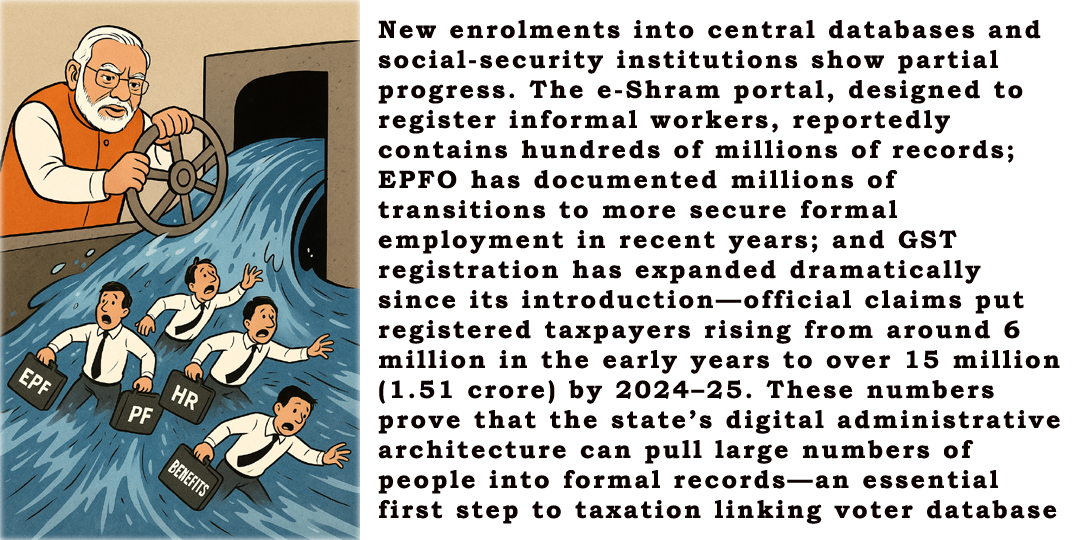
New enrolments into central databases and social-security institutions show partial progress. The e-Shram portal, designed to register informal workers, reportedly contains hundreds of millions of records; EPFO has documented millions of transitions to more secure formal employment in recent years; and GST registration has expanded dramatically since its introduction—official claims put registered taxpayers rising from around 6 million in the early years to over 15 million (1.51 crore) by 2024–25. These numbers prove that the state’s digital administrative architecture can pull large numbers of people into formal records—an essential first step to taxation linking individual citizens to voter databases.
But those same data sets expose limits. Registration does not always mean meaningful formal employment: many registered GST entities are small or dormant; e-Shram enrolments do not always equate to regular contributions; and EPFO coverage remains skewed toward certain sectors and geographies. A registration without steady pay, enforceable contributions, and employer compliance is a hollow victory for tax expansion.
Forecasts and consulting insights — what the models say
Where forecasts matter is in mapping the plausible revenue and social-protection gains from formalisation. Several consulting firms and think tanks point to a multi-year, phased conversion path:
- Short run (1–3 years): rapid administrative enrolment as companies comply with the new codes and central registries expand. Expect a spike in recorded employees and GST registrations as firms re-document work relationships and contractors seek formal licences. Government revenues from indirect taxes and recorded income will tick up modestly. (Supported by recent government and accounting-firm notes on code rollout and GST growth.)
- Medium run (3–7 years): conditional on growth and enforcement, a subset of formerly informal enterprises will adopt formal payrolls. Consulting models (e.g., McKinsey) indicate that if GDP growth accelerates and skilling/connectivity improve, formal employment can expand materially, boosting direct tax receipts and social-security inflows. But growth assumptions are the hinge: without robust GDP and sectoral transformation, the formalisation rate will be slow.
- Long run (7–15 years): full potential only unlocks with complementary reforms—labour market laddering, skilling, credit access and active enforcement across states. Think-tank scenarios show that with integrated policy action, India could materially lower its informality rate and raise both tax compliance and social-security coverage. But the size of the revenue prize is uncertain and contingent; even optimistic scenarios require investment in governance capacity.
Politics, capacity and the “ivory-tower” critique
Here is where the political economy bites. Critics from trade unions, opposition parties and worker collectives have mobilised en masse against the rollout, arguing both process and substance: consultations were inadequate and the codes tilt toward employer flexibility at workers’ expense. Protests since mid-November 2025 show the depth of political pushback. The “ivory tower” critique is not simply rhetorical: many informal workplaces—urban street vending clusters, rural agricultural contractors, domestic work—operate through local norms, cash flows and social networks that cannot be reshaped by high-level legal instruments alone. Laws designed in Delhi can miss enforcement realities on the ground where municipal officials, local contractors and informal associations hold power.
Administrative capacity also matters. The state can register millions of workers; can it ensure monthly employer contributions, run dispute resolution that reaches far-flung districts, and enforce minimum wages for tiny, seasonal employers? Experience shows mixed results. Digital records and portals reduce frictions, but they do not eliminate rent, non-compliance or the incentives for firms to circumvent obligations unless enforcement is credible and affordable for small firms.
Practical risks and unintended consequences
Policymakers should worry about two main unintended outcomes. First, the codes could accelerate contractualisation—making employment relationships legally flexible but economically precarious—if fixed-term and contractor models become the default. Second, if compliance costs rise without supportive measures (credit, chief inspector outreach, graded enforcement), small firms might either fall back to the unorganised economy or hand off employment to third-party agencies—both outcomes shrink taxable payrolls and intensify enforcement costs.
How to make the tax-expansion vision credible
If the government’s aim is genuinely to convert informal livelihoods into stable, tax-paying contributors, statutes must be paired with three pragmatic pillars:
- Incentives for compliance. Presumptive tax schemes, graded employer contribution schedules for micro firms, and temporary compliance relief with capacity-building support would lower the cost of formalisation. NITI and tax-policy consultative reports have advocated calibrated presumptive schemes to draw small firms into the tax net.
- Active enforcement focused on value chains. Inspectors and dispute resolution should target downstream buyers and contractors who create incentives for informality (e.g., construction, textiles, logistics). Linking procurement and credit access to documented compliance would create commercial pressures to formalise.
- Social-protection that actually pays off. If enrollment in e-Shram or a social-security regime does not translate into visible benefits—health access, portable pensions, or unemployment smoothing—workers will see registration as paperwork, not progress. The ILO’s calls for universal coverage with effective benefits remain salient here.
Ambition tempered by realism
The 2025 labour-code reforms are a tectonic policy move: they remap legal relations between employers and workers, modernise administrative touchpoints and, by design, create opportunities to expand the taxpayer footprint. But turning registrations and appointment letters into dependable tax receipts and secure livelihoods is a multi-decade project. The government’s architects can claim technical accomplishment; what remains is the far harder task of translating law into lived security for millions—and doing so without pushing workers further into precarious contractual traps. If the codes are to be more than a statist wish for broader revenues, Delhi must marry statute with incentives, enforcement, credible benefits and local governance redesign. Otherwise the “taxpayer expansion” will be little more than a bureaucratic tally: more names in a register, not more people with dignified, taxable, gainful work. Trade unions and activists have already signalled that social legitimacy will not be given freely. The state’s next move must be to demonstrate that formalisation brings visible value on shop floors and in homes—only then will the unorganised truly become semi-white-collar taxpayers rather than names in an ivory-tower experiment.