
Gliding requires no fuel but a glider cannot take off on its own or have short bursts to steer away from trouble. Gliders with a small jet engine for short bursts may be the ideal aircraft
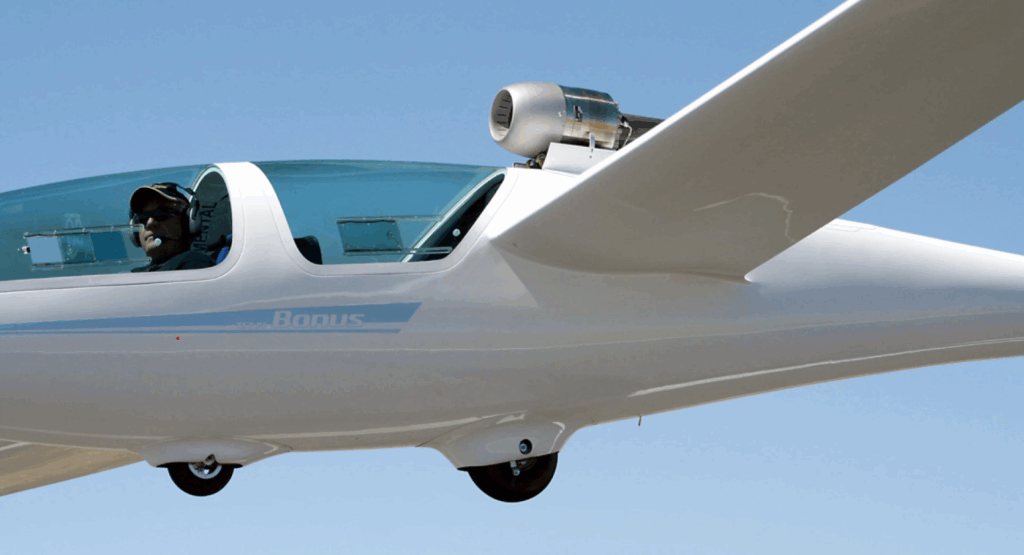
The BonusJet is based on the TST-14 ‘Bonus’ sailplane produced by TeST (a division of Comp_Let) in the Czech Republic. The Bonus was originally produced as an unpowered sailplane or with the option of a Rotax piston engine and propeller. The BonusJet has been modified by the addition of a PBS TJ-100 engine (also produced in the Czech Republic) in place of the original Rotax. The jet engine retract hardware and the jet conversion was designed and done in the U.S. by Desert Aerospace, LLC.
The original TST-14 ‘Bonus’ sailplane was produced as an LSA. As of this time, turbine (jet) engines are not allowed on LSA aircraft. It may be possible to get a waiver.
The BonusJet was designed as a self-launching sailplane. It has a much higher cruise speed than most other motorgliders, allowing it to reach good soaring conditions a fair distance away from the takeoff point. We routinely cruise 20 miles upwind of our airport to contact wave. While it is possible to cruise more than 150 miles, the relatively high fuel burn rate makes the BonusJet somewhat impractical for “airplane-style” cross country cruising.
With two people on board, the BonusJet has consistently demonstrated climb performance better than 1000 ft/ min (1200′ MSL, 80F). To date, most flights have been from our home airport located in Moriarty, New Mexico. The elevation at Moriarty is 6200′ MSL, and the density altitude often exceeds 10,000′. Climb performance at these conditions is still exceptional at approximately 700 ft/min. The BonusJet’s climb far exceeds any other motorglider we have compared with (Stemme, DG-505, ASH-26E). We anticipate conducting a complete flight test program in the future at a lower elevation to establish true climb performance numbers. Click here to learn more about the BonusJet’s technical specifications.
We estimate a sea level takeoff distance of approximately 500′. To date, most flights have been from our home airport located in Moriarty, New Mexico. The elevation at Moriarty is 6200′ MSL, and the density altitude often exceeds 10,000′. Takeoff distance performance at these conditions is still exceptional, at approximately 700′. We routinely launch mid-field with two persons while some other motorgliders are waiting for a tow, unable to self-launch in the hot & high conditions. The BonusJet’s takeoff requirements are considerably better than any other motorglider we have compared with (Stemme, DG-505, ASH-26E). We anticipate conducting a complete flight test program in the future at a lower elevation to establish true takeoff performance numbers.
With 24 gallons of fuel, the BonusJet can fly for approximately 1.5 hours, depending on climb duration and cruising speed. Typical cruise speed at 10,000 MSL is around 100 knots, giving it a range up to 150 nautical miles. The BonusJet was designed primarily as a self-launching soaring motorglider, not a cross-country cruiser. However, it is important to know the range and speed available for reaching good soaring conditions or a quick dash to return home if bad weather is looming. Fuel capacity may be reduced when carrying a passenger.
The cost is approximately $195,000 (USD), including jet engine, engine installation, basic instruments and trailer. The cost will vary somewhat depending upon exchange rate, instruments and accessories. Refer to the BonusJet page under Microjet Aircraft for what is included.
Two switches control all engine extend/retract/start functions. They are simply “Pylon” (up/down – momentary) and “Engine” (run/stop). Door actuation is handled automatically by a door/pylon sequencer when pylon commands are given.
Factory specifications show a max L/D of 39:1. Click here to learn more about the BonusJet’s specifications.
The advantages of jet power over conventional piston or propellers are numerous. The jet engine is extremely simple; and at 42 pounds, it is only about 1/3 the weight of equivalent piston engines. It does not require any belt drives, speed reducers, or massive pylons. It requires very little input from the pilot to start and does not require any prop positioning or “bumping” for retraction. When extended, the jet engine has about the same drag as a single Cessna 172 wheel pant. The jet engine also produces almost no vibration, eliminating the most significant cause of cracking and fatigue failures in all aircraft systems, including structure and avionics. Also looming on the horizon is the elimination of 100 LL (leaded) avgas. The BonusJet uses jet fuel, which does not contain lead.
At Moriarty, NM on a summer day (10,000′ density altitude), a typical launch to 2000′ with some loiter time to make sure the first thermal is centered uses about two gallons of fuel.
More testing needs to be conducted, but our initial test shows the following noise levels, measured 200 feet directly aft for Callair towplane and BonusJet (other aircraft shown for comparison)
Callair towplane : 74.2 Db
BonusJet at 90% RPM : 77.4 Db
BonusJet at 98% RPM : 82.6 Db
Small homebuilt airplane (takeoff – type unknown) : 84.2 Db
Cessna Citation B (taxiing) : 86.1 Db
Cessna Citation B (takeoff) : 95.1 Db
Noise level of the jet engine dissipates quickly with distance and does not carry as far as the “growl” of a towplane propeller.
A “glider with a jet engine,” also known as a jet sailplane, is a modified glider that incorporates a jet engine to provide self-launch capability, perform climbs for altitude, and achieve high speeds for extended flight or quick returns to an airfield. These specialized aircraft, such as Bob Carlton’s Super Sto and the Arcus Jet, combine the graceful, silent flight of a glider with the power of a turbine, enabling pilots to go from soaring to high-performance jet aerobatics, which are not possible with traditional gliders.
How it works
Self-launching:
The jet engine provides sufficient thrust for the glider to take off under its own power, eliminating the need for a tow plane.
Climbing to altitude:
After takeoff, the pilot can shut off the jet engine and use the glider’s exceptional aerodynamic performance to soar for extended periods.
Speed and range:
The engine allows the glider to reach high speeds for quick travel or to get back to a desired airfield.
Aerobatics:
Some jet-powered gliders, like the Super Sto, can perform powerful, low-level aerobatic maneuvers that would be impossible for a standard glider.
Examples
Bob Carlton’s Super Sto and Bonus Jet:
These are prominent examples of jet sailplanes, with Bob Carlton being a well-known pilot who performs and trains in these aircraft.
Arcus Jet:
A modified glider with a special jet engine that allows for self-launch and high-speed flight.
Jonker Sailplanes JS-1:
A high-performance glider that offers a jet-assist version, providing minimal thrust for sustaining flight in low-lift conditions.
Key features
Retractable engine:
Some systems, like the one used in the Arcus Jet, allow the engine to be retracted into the fuselage to reduce drag and improve glide performance.
Lightweight and powerful engine:
The engines used are small and light, weighing around 40-250 pounds, but they provide significant thrust for the glider.
Versatility:
A jet-powered glider can be used for the practical purpose of returning to base or for spectacular low-level airshows, offering a unique dual capability.