
Mohandas Karamchand Gandhi initiated partition to install his patron’s son Jawahar Lal Nehru on the PM seat and Jinnah was opposing it. Gandhi never had to turn the other cheek, which had been shone with goat’s milk fat. Gandhi was the unquestioned patriarch ruling as an autocrat with passive aggressiveness
Indian political memory has hardened into a morality play: Mohandas Karamchand Gandhi as the apostle of unity and peace, Muhammad Ali Jinnah as the architect of division and Partition. This binary has been repeated so often—in textbooks, speeches, films, and popular discourse—that it has acquired the sheen of unquestionable truth. Yet history, when stripped of myth-making, rarely conforms to such convenient simplifications. A closer reading of events, personalities, power structures, and political calculations between the 1920s and 1947 reveals a far more uncomfortable possibility: that Gandhi’s actions, far from being consistently unifying, often deepened divisions, sidelined democratic processes, and indirectly hastened Partition; while Jinnah, at several points, opposed Partition and sought constitutional safeguards within a united India. The idea that Gandhi was merely a saintly moral force standing above politics dissolves when one examines how power was exercised in practice—informally, unaccountably, and with devastating consequences.
The Congress movement under Gandhi functioned not as a modern democratic party but as a personality-driven organisation. Gandhi held no constitutional office, bore no administrative responsibility, and yet exercised veto power over decisions, leaders, and directions. This paradox—absolute authority without formal accountability—defined his political method. Gandhi did not need to be prime minister or president; he was the unquestioned patriarch. His moral authority substituted for institutional checks, and dissent was framed not as political disagreement but as ethical failure. In such an environment, unity was not built through plural accommodation but enforced through obedience.
This dynamic is essential to understanding the Congress split with Subhas Chandra Bose. Bose was not a marginal figure or a rebellious upstart. He was a mass leader, admired for his intellect, organisational skill, and uncompromising anti-imperialism. When Bose contested the Congress presidency in 1939 and defeated Gandhi’s preferred candidate, Pattabhi Sitaramayya, the verdict was clear: the rank and file of Congress had chosen Bose. In any democratic organisation, this would have settled the matter. Instead, Gandhi declared that Sitaramayya’s defeat was his own defeat, transforming a democratic outcome into a personal affront. What followed was not reconciliation but sabotage. Congress leaders loyal to Gandhi resigned en masse, paralysing the organisation and making Bose’s position untenable. Gandhi did not openly depose Bose; instead, he created conditions in which Bose was forced out. This episode exposes a crucial truth: Gandhi’s commitment to unity ended where obedience ended. A leader who could not be controlled could not be tolerated, even if he enjoyed popular legitimacy.
The Bose episode matters because it reveals the template Gandhi followed repeatedly. Unity, in Gandhian politics, was unity under Gandhi. Those who disagreed—whether Bose, Ambedkar, Jinnah, or even Patel at certain moments—were pressured, delegitimised, or morally cornered. Gandhi’s insistence on being the conscience-keeper of the nation meant that political disagreements were moralised. Bose was not merely wrong; he was reckless. Jinnah was not merely advocating minority rights; he was communal. Ambedkar was not challenging caste Hindu dominance; he was fragmenting Hindu society. This moral framing foreclosed genuine negotiation.
Nowhere were the consequences more severe than in the Hindu–Muslim question. The popular belief that Gandhi tirelessly worked to keep India united while Jinnah relentlessly pushed for Pakistan is historically inaccurate. Jinnah began his political career as a firm believer in Hindu–Muslim unity. He opposed separate electorates, worked closely with Congress, and was praised by none other than Gopal Krishna Gokhale as the “best ambassador of Hindu–Muslim unity.” Even into the late 1930s and early 1940s, Jinnah repeatedly demanded constitutional safeguards, parity, and federal autonomy within a united India. Partition, for Jinnah, was initially a bargaining counter, not a theological goal.
The real rupture came after the Congress swept the 1937 provincial elections and chose to govern alone, refusing to form coalition governments with the Muslim League. This decision, strongly endorsed by Gandhi, sent a clear signal to Muslims: Congress would rule as the natural party of power, and minorities would be accommodated only on Congress terms. The ministries that followed often behaved arrogantly, promoting cultural symbols and policies that alienated Muslims. Jinnah’s warnings that Muslims would be reduced to a permanent minority went unheeded. Gandhi, instead of acknowledging Muslim anxieties, framed them as misunderstandings or communal paranoia.
The Congress leadership’s insistence that it alone represented the nation left no constitutional space for pluralism. Gandhi’s moral absolutism compounded this. He believed that if hearts were changed, political problems would dissolve. But politics cannot function on moral exhortation alone, especially in a subcontinent marked by deep social, religious, and economic cleavages. By dismissing structural safeguards as divisive, Gandhi inadvertently strengthened the argument that Muslims needed a separate political destiny.
The question of Jawaharlal Nehru’s ascendancy further complicates Gandhi’s role. Nehru was not universally accepted as the natural leader of independent India. He lacked Patel’s administrative experience, Bose’s mass appeal, and Rajendra Prasad’s organisational depth. Yet Gandhi was determined that Nehru would be prime minister. When the Congress Working Committee was consulted in 1946 about leadership, a majority of provincial committees reportedly favoured Patel. Gandhi intervened, and Patel withdrew in deference to him. This was not an act of democratic choice but of moral pressure. Gandhi’s patronage over Nehru was decisive, and it shaped the political architecture of post-independence India.
Jinnah opposed Nehru not merely as an individual but as a symbol of majoritarian dominance cloaked in liberal rhetoric. Nehru’s statements about a strong centre, a modernist vision dismissive of religious identities, and Congress’s claim to speak for all Indians alarmed Muslim leaders. Gandhi’s unwavering backing of Nehru, combined with his refusal to accommodate Muslim League demands for parity at the centre, hardened positions on all sides. Partition increasingly appeared not as Jinnah’s obsession but as the only remaining exit from a political deadlock created by Congress’s insistence on unilateral authority.
It is here that the charge that Gandhi “initiated” Partition must be understood—not as a literal drafting of borders, but as the cumulative effect of choices that foreclosed alternatives. Gandhi opposed separate electorates in principle, but he accepted them when it suited Congress. He denounced power politics, yet wielded power more effectively than anyone else. He preached unity, yet undermined leaders who could have negotiated a federal, plural India. When the Cabinet Mission Plan of 1946 offered a last chance at a united India through a loose federation, Jinnah accepted it. Congress, encouraged by Nehru’s interpretation that provinces could later secede from groupings, effectively nullified it. Gandhi did not restrain Nehru; he stood by him. That moment arguably sealed Partition more than any speech by Jinnah.
Gandhi’s self-conception as the uncrowned king of India is not a hostile caricature but a logical description of how authority functioned. He rejected office precisely because office carried responsibility. As a private individual, he could issue calls for mass action, withdraw them at will, and escape accountability for the consequences. When movements like Non-Cooperation or Quit India erupted into violence, Gandhi could fast, mourn, and retreat, but the political damage remained. Leaders who held office had to manage the fallout; Gandhi remained morally unblemished. This asymmetry allowed him to dominate without being answerable.
The tragedy is that Gandhi’s moral authority was genuine and powerful. Millions followed him because he articulated a vision of dignity, sacrifice, and resistance that resonated deeply. But moral authority without institutional restraint is dangerous. It can silence debate, suppress dissent, and transform political disagreement into heresy. Gandhi’s shadow loomed so large that alternative paths—whether Bose’s militant anti-imperialism, Ambedkar’s constitutional radicalism, or Jinnah’s federal pluralism—were marginalised.
Revisiting these histories is not about replacing one hero with another villain. It is about recognising that Indian independence was not the outcome of a single will or moral vision. It was a contested process shaped by power struggles, egos, ideological conflicts, and missed opportunities. To portray Gandhi as the sole guardian of unity and Jinnah as the sole author of Partition is to infantilise history. It absolves Congress of its failures, obscures internal authoritarianism, and prevents honest reckoning.
Partition was not inevitable. It was the result of decisions taken by individuals who believed they were acting in the nation’s best interest. Gandhi was one of them. His refusal to share authority, his undermining of democratically elected leaders like Bose, his moral coercion within Congress, and his prioritisation of Nehru’s leadership over broader consensus all contributed to a narrowing of political possibilities. Jinnah, confronted with a Congress unwilling to accept genuine power-sharing, eventually chose separation over subordination.
To acknowledge this is not to deny Gandhi’s contributions or Jinnah’s flaws. It is to restore complexity to a history flattened by reverence and resentment alike. Nations mature not by worshipping their founders but by examining them honestly. India’s continued struggles with centralisation, dissent, and moralised politics suggest that the patterns established during the freedom movement did not end in 1947. They were institutionalised.
Breaking free from the myth that Gandhi stood unambiguously for unity while Jinnah stood unambiguously for division allows a more mature understanding of the past—and perhaps a more plural, accountable politics in the present.
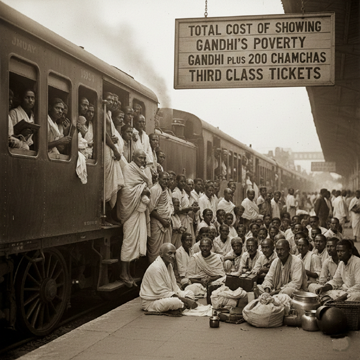
A further dimension often erased from the saintly portrait of Mohandas Karamchand Gandhi is the material and social insulation that allowed him to preach extreme personal sacrifice without bearing its costs in the way ordinary Indians did. Gandhi’s philosophy of non-violence and “turning the other cheek” was never tested under the raw conditions of poverty, hunger, or physical vulnerability that millions of Indians endured daily under colonial rule. His asceticism was real in form but not in consequence. Gandhi lived poor by choice, but never in insecurity. He had patrons, admirers, benefactors, and an entire organisational apparatus that ensured he was fed, housed, protected, and medically attended to at all times.
The oft-repeated quip that “it was very expensive to keep Gandhi poor” is not merely a cynical joke; it captures a structural reality. Gandhi travelled extensively, stayed in well-maintained ashrams, received constant donations, and was surrounded by devoted followers who absorbed the burdens of logistics, security, and sustenance. His loincloth symbolised poverty, but behind it stood a network of privilege. He never had to worry about eviction, starvation, or abandonment. He never faced a violent slap from which he was forced to literally turn the other cheek in helplessness. His non-violence was practised from a position of moral authority and physical safety, not from the exposed vulnerability of the powerless.
This insulation matters because moral philosophies acquire very different meanings depending on who bears their cost. When Gandhi called upon peasants, workers, and students to accept suffering without retaliation, it was they who faced lathi charges, imprisonment, hunger, and death. When movements were abruptly withdrawn on moral grounds, it was not Gandhi who returned to destitution or anonymity; it was the masses who paid the price of shattered momentum and repression. Gandhi could afford to stop a struggle; others could not afford to resume normal life so easily.
Moreover, Gandhi’s aristocratic upbringing and elite social access never truly left him. He was comfortable negotiating with viceroys, industrialists, and princes, even as he preached simplicity. Business houses funded Congress activities and ashrams, and wealthy patrons underwrote his campaigns. This was not hypocrisy in a crude sense, but it did mean that Gandhi’s vision of suffering was aestheticised and abstracted. Suffering became a moral instrument rather than a lived catastrophe.
This distance also shaped Gandhi’s intolerance of alternative strategies. Leaders like Subhas Chandra Bose, who believed that freedom required confrontation rather than self-purification, were dismissed as morally inferior or dangerously impatient. Yet Bose’s worldview emerged precisely from a recognition that colonial power does not yield to moral persuasion alone, especially when the moral appeal comes from those cushioned against its violence. Gandhi could afford to wait for the oppressor’s conscience to awaken; generations living under material deprivation could not.
In this light, Gandhi’s refusal to hold office gains a sharper edge. Without formal responsibility, he could demand sacrifices without accounting for outcomes. Without facing administrative consequences, he could advocate ideals insulated from their practical costs. This asymmetry—moral command without material exposure—reinforced his position as the untouchable patriarch of Indian politics. He asked others to turn the other cheek, but no hand was ever raised high enough, or close enough, to strike his own.
Recognising this does not require denying Gandhi’s personal discipline or sincerity. It requires acknowledging that his moral authority was sustained by privilege, and that his philosophy functioned differently for those who had nothing to fall back on. The tragedy of Indian nationalism is that its most powerful moral voice was also its most sheltered—able to preach renunciation while never truly facing the abyss that renunciation demanded of others.