
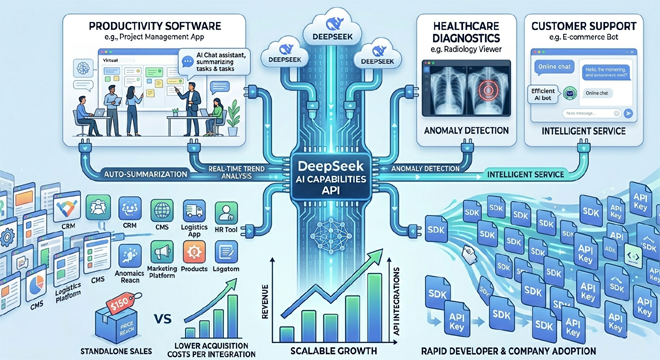
Rather than selling standalone products or licensing large-scale enterprise solutions, the company is expected to generate income by embedding its AI capabilities into third-party applications. This model not only reduces customer acquisition costs but also allows for scalable growth as more developers and companies integrate DeepSeek’s APIs into their platforms
DeepSeek’s emergence as a disruptive force in the global artificial intelligence landscape marks a pivotal moment in the evolution of cost-efficient, scalable AI systems. As the company expands its footprint into Singapore and the broader Southeast Asian region, its financial trajectory is expected to diverge significantly from traditional AI firms that rely heavily on direct enterprise licensing or consumer-facing subscriptions. Instead, DeepSeek appears poised to anchor its regional strategy in API-driven ecosystems, strategic partnerships, and localized AI solutions tailored to the economic and technological realities of Southeast Asia. This approach aligns closely with the region’s demand for affordable, adaptable AI infrastructure and reflects a broader shift toward modular, service-based monetization models in the AI industry.
The foundation of DeepSeek’s financial outlook lies in its “low-cost, high-efficiency” model, which has already demonstrated remarkable cost-to-profit potential, reportedly reaching ratios as high as 545%. This figure, while indicative of strong operational leverage, also underscores the company’s reliance on maintaining extremely efficient training and inference pipelines. Unlike Western competitors that invest heavily in massive computational clusters and proprietary ecosystems, DeepSeek has focused on optimizing resource utilization, enabling it to offer competitive pricing that appeals to cost-sensitive markets such as Southeast Asia. In Singapore, where technological sophistication coexists with pragmatic cost considerations, this model is particularly compelling for startups, mid-sized enterprises, and even large institutions seeking to integrate AI without incurring prohibitive expenses.
Another defining characteristic of DeepSeek’s anticipated financial structure in Singapore is its emphasis on API-based revenue streams. Rather than selling standalone products or licensing large-scale enterprise solutions, the company is expected to generate income by embedding its AI capabilities into third-party applications. This model not only reduces customer acquisition costs but also allows for scalable growth as more developers and companies integrate DeepSeek’s APIs into their platforms. In a region where digital ecosystems are rapidly expanding, this strategy positions the company to benefit from network effects, as each new integration potentially leads to further adoption across interconnected services.
The rise of API-driven AI monetization in Southeast Asia
The shift toward API-centric monetization represents a broader transformation in how artificial intelligence is commercialized, particularly in emerging and rapidly digitizing economies. In Singapore and Southeast Asia, businesses increasingly prefer flexible, pay-as-you-go models that allow them to experiment with AI capabilities without committing to large upfront investments. DeepSeek’s pricing structure, which emphasizes affordability and efficiency, aligns closely with these preferences and could accelerate its adoption across various industries.
API partnerships enable DeepSeek to integrate seamlessly into existing digital infrastructures, ranging from e-commerce platforms and logistics systems to healthcare applications and financial services. This integration-centric approach not only diversifies revenue streams but also reduces dependency on any single sector. For example, a fintech startup in Singapore might use DeepSeek’s natural language processing capabilities to enhance customer service chatbots, while a logistics company could leverage its predictive analytics for supply chain optimization. Each of these use cases contributes incrementally to the company’s revenue, creating a distributed and resilient financial model.
Furthermore, the API model facilitates rapid scaling across borders within Southeast Asia. Countries such as Indonesia, Vietnam, and Thailand are experiencing significant digital transformation, with increasing demand for AI solutions that are both cost-effective and adaptable to local languages and contexts. DeepSeek’s open-source orientation and efficient architecture make it particularly well-suited for these markets, where customization and affordability are critical factors. By enabling local developers to build on its platform, the company effectively decentralizes innovation while maintaining a steady stream of API-based income.
However, this model is not without its challenges. High usage volumes, particularly during peak periods, can strain infrastructure and lead to increased operational costs. DeepSeek has already experimented with off-peak pricing incentives to manage demand, offering significant discounts to encourage usage during less congested times. While this strategy helps optimize resource utilization, it also introduces variability into revenue streams and may impact overall profitability if not carefully managed. Balancing affordability with sustainable margins will be a key determinant of the company’s long-term financial success in the region.
Strategic partnerships as a cornerstone of regional expansion
In addition to API-driven revenue, strategic partnerships are expected to play a central role in DeepSeek’s financial growth in Singapore and Southeast Asia. Rather than pursuing a direct-to-consumer or direct-to-enterprise sales model, the company is likely to collaborate with regional technology firms, financial institutions, and even multinational corporations operating within Singapore’s dynamic business environment. These partnerships can take various forms, including co-development of AI applications, integration into existing platforms, and joint ventures aimed at specific industry verticals.
Singapore’s position as a regional hub for technology and finance makes it an ideal base for such collaborations. The presence of numerous multinational corporations, venture capital firms, and innovation-driven startups creates a fertile environment for partnerships that can accelerate DeepSeek’s market penetration. By aligning with established players, the company can leverage existing distribution channels and customer bases, reducing the need for extensive marketing and sales efforts. This not only lowers operational costs but also enhances credibility and trust among potential clients.
Chinese technology giants with operations in Singapore may also serve as key partners in DeepSeek’s regional strategy. These companies often have extensive experience in scaling digital platforms and navigating the regulatory landscapes of multiple countries. By integrating DeepSeek’s AI capabilities into their ecosystems, they can enhance their service offerings while providing the AI firm with access to a broader user base. Such symbiotic relationships can significantly boost revenue while minimizing the risks associated with entering new markets independently.
Moreover, partnerships with local startups and developers can drive innovation and create new revenue opportunities. Southeast Asia’s startup ecosystem is vibrant and diverse, with entrepreneurs constantly exploring new applications of AI across industries. By providing accessible and affordable AI tools, DeepSeek can empower these innovators to build solutions that address region-specific challenges, from language processing in multilingual societies to predictive analytics for agriculture and urban planning. Each successful application not only generates API usage but also reinforces the company’s position as a foundational layer in the region’s AI ecosystem.
Transforming Singapore’s financial sector through efficient AI
One of the most promising areas for DeepSeek’s financial growth in Singapore is the financial technology sector. As one of the world’s leading financial hubs, Singapore offers a highly sophisticated environment for the deployment of AI-driven solutions in banking, investment management, insurance, and regulatory compliance. DeepSeek’s high-efficiency models, which deliver strong performance at relatively low cost, are particularly attractive in this context, where institutions are constantly seeking to optimize operations and enhance decision-making capabilities.
In banking, AI can be used for a wide range of applications, including fraud detection, risk assessment, customer service automation, and personalized financial advice. DeepSeek’s models, with their emphasis on efficiency, enable banks to implement these capabilities without incurring the substantial costs associated with traditional AI systems. This is especially important for smaller financial institutions and fintech startups, which may lack the resources to invest in expensive proprietary solutions.
Investment firms can also benefit from DeepSeek’s capabilities in data analysis and predictive modeling. By processing large volumes of financial data in real time, AI systems can identify trends, assess risks, and generate insights that inform investment strategies. The affordability of DeepSeek’s models makes these advanced capabilities accessible to a broader range of market participants, potentially democratizing access to sophisticated financial tools.
In the insurance sector, AI can streamline claims processing, improve underwriting accuracy, and enhance customer experience. DeepSeek’s efficient models can handle large volumes of data with minimal computational overhead, enabling insurers to scale their operations while maintaining cost efficiency. Similarly, regulatory technology (RegTech) applications can leverage AI to automate compliance processes, reducing the burden on financial institutions and improving overall efficiency.
The widespread adoption of DeepSeek’s models in Singapore’s financial sector could have a significant impact on the company’s revenue streams. As more institutions integrate its APIs into their operations, the cumulative effect of usage-based pricing could generate substantial income. However, this also depends on the company’s ability to maintain reliability and performance under high demand, as financial applications often require real-time processing and high levels of accuracy.
Operational challenges and the economics of scale
Despite its promising prospects, DeepSeek faces several operational challenges that could influence its financial trajectory in Singapore and Southeast Asia. One of the most pressing issues is the management of infrastructure capacity in the face of rapidly growing demand. As more companies adopt its AI solutions, the strain on computational resources can increase significantly, potentially leading to performance bottlenecks and higher operational costs.
To address this challenge, DeepSeek has implemented dynamic pricing strategies, including discounts for off-peak usage. While this approach helps distribute demand more evenly, it also introduces complexity into revenue management. If a significant portion of usage shifts to discounted periods, overall profitability may be affected. Additionally, maintaining a balance between affordability and sustainability requires careful optimization of both pricing and infrastructure.
Another challenge lies in the competitive landscape. While DeepSeek’s low-cost model provides a strong advantage, it also invites competition from other AI providers seeking to capture market share in Southeast Asia. Established Western companies, as well as emerging regional players, are likely to adapt their strategies to compete on price and efficiency. This could lead to downward pressure on margins, making it essential for DeepSeek to continuously innovate and improve its offerings.
The reliance on low-cost training and inference is both a strength and a potential vulnerability. While it enables competitive pricing, it also means that any increase in computational costs or inefficiencies could have a disproportionate impact on profitability. Ensuring consistent performance while scaling operations will require ongoing investment in optimization and infrastructure.
Moreover, regulatory considerations in Singapore and other Southeast Asian countries may influence DeepSeek’s operations. Data privacy, security, and compliance requirements can vary across jurisdictions, necessitating tailored approaches for each market. While Singapore’s regulatory environment is generally supportive of innovation, it also imposes stringent standards that companies must meet to operate effectively.
Government support and the future of localized AI ecosystems
The role of government policy in shaping DeepSeek’s financial future in Singapore cannot be overstated. The Singaporean government has consistently demonstrated a strong commitment to fostering innovation and supporting the development of advanced technologies, including artificial intelligence. In this context, cost-effective and specialized AI models like those offered by DeepSeek are seen as valuable tools for building localized solutions that address the unique needs of the region.
By encouraging the adoption of affordable AI technologies, the government can help accelerate digital transformation across various sectors, from healthcare and education to transportation and public administration. DeepSeek’s open and efficient models align well with this vision, providing a foundation for the development of applications that are tailored to local languages, cultural contexts, and economic conditions.
Government initiatives aimed at supporting startups and innovation ecosystems can also benefit DeepSeek indirectly. As more entrepreneurs gain access to funding, mentorship, and infrastructure, the demand for affordable AI tools is likely to increase. This creates a virtuous cycle in which the growth of the startup ecosystem drives API usage, which in turn generates revenue for DeepSeek.
In the long term, the success of DeepSeek in Singapore and Southeast Asia will depend on its ability to navigate a complex interplay of factors, including technological innovation, market dynamics, regulatory environments, and competitive pressures. While its low-cost, high-efficiency model provides a strong foundation, sustained growth will require continuous adaptation and strategic execution.
Ultimately, DeepSeek’s expansion into Singapore represents more than just a regional growth opportunity; it reflects a broader shift in the global AI landscape toward more accessible and efficient solutions. By prioritizing partnerships, API-driven monetization, and localized innovation, the company has the potential to reshape how artificial intelligence is developed, deployed, and monetized in emerging markets. If it can successfully balance affordability with scalability and maintain its competitive edge, DeepSeek may well become a cornerstone of Southeast Asia’s evolving digital economy.