
The Euro was conceived as a political and economic unifier, but its lived history has exposed a fundamental flaw: a single monetary policy serving vastly different economies. The past two decades offer a sobering record. Greece, Spain, Portugal, Ireland and Cyprus were situations best avoided if Europe had been a political unit first and currency unit later
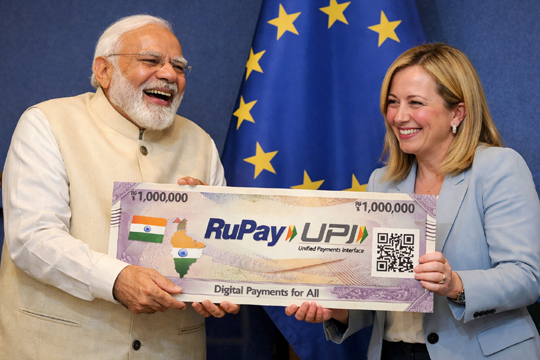
Europe is searching for growth at a time when its traditional economic levers are strained. Demographic stagnation, energy transitions, geopolitical fragmentation, and a structurally rigid monetary framework have limited the continent’s ability to rebound with the agility seen in the United States or emerging Asia. Against this backdrop, India has emerged not merely as a trading partner but as a systemic opportunity—one that extends beyond goods and services into the architecture of money itself. The proposed India–EU Free Trade Agreement (FTA), combined with Europe’s gradual openness to India’s RuPay and UPI payment systems, signals a deeper recalibration underway. This is not just about tariffs or tourist convenience; it is about how Europe might grow by loosening its overdependence on the Euro-Dollar axis and embracing a more multipolar financial ecosystem.
The Euro’s structural burden and the cost of one-size-fits-all money
The Euro was conceived as a political and economic unifier, but its lived history has exposed a fundamental flaw: a single monetary policy serving vastly different economies. The past two decades offer a sobering record. Greece’s government-debt crisis, Spain’s post-2008 financial collapse, Portugal’s prolonged recession, Ireland’s banking implosion, and Cyprus’s financial crisis were not isolated accidents. They were symptoms of a monetary union that stripped weaker economies of exchange-rate flexibility while denying them sufficient fiscal integration to compensate.
Countries locked into the Euro could not devalue to regain competitiveness, nor could they independently tailor interest rates to local conditions. Instead, austerity became the default response, often deepening downturns and eroding public trust. While Germany and a few northern economies benefited from export competitiveness under a relatively undervalued Euro, southern and peripheral states bore the adjustment costs. The lesson for Europe is not necessarily to abandon the Euro, but to recognize that growth requires external dynamism—new markets, new partners, and new financial channels that do not amplify existing constraints.
India–EU trade: Strategic convergence
India and the European Union are natural economic complements. Europe brings capital, advanced manufacturing, and regulatory sophistication; India brings scale, growth, labor, and an expanding consumer market. The India–EU FTA, long delayed but increasingly urgent, promises to unlock this complementarity. For Europe, India represents demand growth that its own internal market can no longer generate. For India, Europe offers technology transfer, investment, and market access that can accelerate industrial upgrading.
Yet the real transformation lies beneath the surface of trade flows. Settlement mechanisms matter. Traditionally, India–EU trade has been intermediated through the US dollar, exposing both sides to currency volatility, conversion costs, and geopolitical risk. A gradual shift toward rupee-based trade settlement, even if partial, reduces friction. For Europe, especially its crisis-prone economies, this diversification offers insulation from dollar liquidity shocks and the spillovers of US monetary policy. Growth, in this sense, is not just about exporting more—it is about paying less to move money.
RuPay and UPI: India’s export of financial infrastructure
India’s most underestimated export is not software talent or pharmaceuticals, but payment architecture. RuPay and UPI are not merely domestic success stories; they are alternative financial rails designed for scale, low cost, and interoperability. RuPay cards—particularly international, credit, and co-branded variants—are now accepted across a widening geography. Singapore, Bhutan, the UAE, Maldives, Mauritius, Nepal, France, Bahrain, and Saudi Arabia already support RuPay transactions at point-of-sale terminals, ATMs, and online platforms. Through partnerships with Discover and JCB, RuPay credit cards extend acceptance to over 190 countries, including Japan and South Korea.
UPI’s expansion is even more disruptive. Unlike card networks that rely on multiple intermediaries, UPI enables instant, account-to-account payments through QR codes, operating 24/7 at negligible cost. It is already directly accepted in Singapore, UAE, Mauritius, Nepal, France, Bhutan, and Sri Lanka. For Europe, accustomed to fragmented national payment systems layered over Visa and Mastercard, UPI represents a glimpse of a different future—one where payments are utilities rather than toll roads.
Europe’s economic incentives beyond Visa and Mastercard
European adoption of RuPay and UPI is not an act of charity toward Indian travelers; it is a rational economic choice. Transaction costs are the most immediate incentive. RuPay operates with lower merchant discount rates than Visa and Mastercard, easing pressure on small businesses already squeezed by energy prices and taxes. Banks benefit too, as RuPay’s fee structure is lighter, sometimes eliminating joining fees altogether.
Beyond costs lies control. Visa and Mastercard route transaction data through international servers, often outside Europe’s jurisdiction. RuPay transactions, by contrast, emphasize domestic or tightly governed bilateral processing. In an era where data sovereignty is increasingly treated as a strategic asset, this matters. Europe has spent years legislating privacy through GDPR; adopting payment systems that align with those principles is a logical extension.
There is also a geopolitical dimension. Reducing reliance on US-dominated financial networks offers Europe greater autonomy. This does not imply confrontation with the United States, but diversification—much as Europe has sought energy diversification after geopolitical shocks. Money, like energy, is infrastructure. Resilience comes from options.
Tourism, diaspora, and the economics of convenience
India is one of the fastest-growing sources of outbound tourists, students, and business travelers. Europe remains a top destination. Accepting UPI and RuPay converts this human flow into economic gain. When payments are frictionless, spending increases. QR-based UPI payments remove the psychological and financial barriers of foreign exchange conversion, card fees, and declined transactions.
France’s decision to become the first European country to accept UPI—beginning with iconic locations like the Eiffel Tower—is emblematic. It is a signal that Europe understands the link between payment convenience and tourist revenue. NPCI International’s ongoing work across the continent suggests this is not a one-off gesture but the start of a broader shift.
Italy’s cash paradox: Freedom, privacy, and structural evasion
Italy presents a fascinating counterpoint. Prime Minister Giorgia Meloni has openly defended cash as a matter of freedom and privacy, resisting a fully cashless vision. Her government has sought to raise the cap on cash transactions to €5,000, arguing that forced digital payments expose economies to control by US card companies such as Visa, Mastercard, and Amex. In this framing, cash becomes a symbol of sovereignty.
Yet Italy’s reality complicates this stance. Tax evasion exceeds €100 billion annually, with nearly a fifth of taxes due going unpaid as recently as 2019. Cash, while private, is also opaque. It enables evasion and illicit activity more easily than electronic payments. Meloni’s position reflects a deeper European tension: how to balance privacy and freedom with transparency and growth.
Interestingly, RuPay and UPI offer a middle path. They reduce dependence on US networks while preserving domestic control over data and fees. Unlike anonymous cash, they create traceable yet sovereign digital trails. Italy has not explicitly embraced RuPay, but the logic of Meloni’s critique of Visa and Mastercard aligns more closely with India’s payment philosophy than with a return to cash dominance.
The UK as a test case for Europe
The United Kingdom, despite Brexit, offers a preview of how Indian payment systems might integrate into European retail ecosystems. Through partnerships with fintech firms like PayXpert and PPRO, NPCI International has enabled UPI-based QR payments and RuPay card acceptance across UK merchants using Android POS devices. This initiative targets the half-million Indians who travel to the UK annually, including students, tourists, and professionals.
The rollout focuses first on QR-based UPI payments, with RuPay card integration expanding in parallel. For UK retailers, the benefit is immediate: higher conversion of Indian footfall into spending. For India, it validates the exportability of its payment infrastructure. For Europe, watching closely, it demonstrates that integration does not require ripping out existing systems—only layering new rails atop them.
Germany and the quiet institutional interest
Germany’s engagement with Indian payment systems is more understated but potentially more consequential. Collaborations involving global payment processors like Worldline are enabling UPI and RuPay acceptance, particularly through QR codes, in pilot contexts. Airports, tourist hubs, and major retail chains are typical entry points. Germany’s interest reflects its broader strategic reassessment of supply chains and trade partners in a post-China-centric world.
For Europe’s largest economy, the attraction lies not just in Indian tourists but in system resilience. A diversified payment ecosystem complements Germany’s emphasis on industrial robustness. It also aligns with the EU’s long-standing ambition to reduce dependence on non-European financial infrastructure—an ambition that has so far struggled to materialize internally.
Rupee trade and Europe’s growth equation
The adoption of rupee-based trade settlement amplifies the benefits of payment integration. Direct settlement between the Euro and the Rupee bypasses the dollar, cutting conversion costs and hedging expenses. For European firms operating on thin margins, especially SMEs, these savings matter. Over time, such efficiencies accumulate into measurable growth.
There is also a psychological shift. Engaging with the rupee as a trade currency acknowledges India not just as a market, but as a monetary pole. In a multipolar world, Europe’s growth will depend on its ability to operate across multiple currency ecosystems without friction. The Euro remains central, but it need not be solitary.
Data, security, and the architecture of trust
Security considerations further strengthen the case. RuPay’s PIN-based authentication is often considered more secure for in-person transactions than signature-based systems. UPI’s design minimizes intermediaries, reducing attack surfaces. For Europe, which treats consumer protection as a core value, these features resonate.
Moreover, domestic or bilateral data handling reduces exposure to foreign surveillance and extraterritorial regulation. As digital sovereignty becomes a strategic priority, payment systems move from the back office to the geopolitical front line.
A gradual but irreversible shift
Europe’s embrace of Indian payment systems will not be sudden or uniform. It will advance through pilots, tourism corridors, diaspora hubs, and bilateral agreements. Resistance will persist, rooted in legacy systems, regulatory inertia, and cultural preferences for cash or established brands. Yet the direction is clear.
India offers Europe something rare: growth without domination, technology without dependency, and partnership without asymmetry. RuPay and UPI are instruments of that offer, quietly reshaping how money moves between continents.
Growth through multipolar money
Europe’s future growth will not come from repeating the past. The Euro’s structural constraints, exposed by successive crises, demand external dynamism. India, through the India–EU FTA and the export of its payment infrastructure, provides that dynamism. Adopting RuPay and UPI is not about replacing existing systems overnight; it is about adding resilience, lowering costs, and reclaiming strategic autonomy.
In the long arc of economic history, growth often follows infrastructure. Roads enabled empires, railways powered industrialization, and digital networks reshaped globalization. Payment systems are the next frontier. By riding the India–EU trade corridor and embracing Indian financial rails, Europe positions itself not just to grow more—but to grow smarter, freer, and more securely in a multipolar world.