
Traditional drug enforcement focused largely on seizure and arrest under criminal law, but the growing recognition that organised trafficking is fundamentally a financial crime has shifted attention toward money laundering investigations
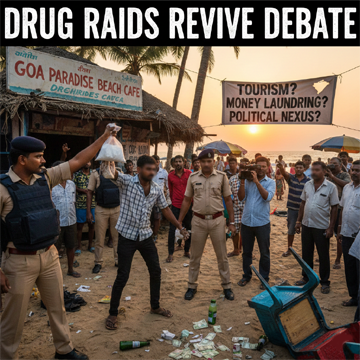
The seizure of more than ₹1.5 crore in cash and drugs valued at over ₹1 crore during coordinated raids by the Goa zonal office of the Enforcement Directorate (ED) and the Narcotics Control Bureau (NCB) has once again brought national attention to the persistent issue of narcotics trafficking in India’s premier coastal tourism state. Conducted under the provisions of the Prevention of Money Laundering Act, 2002 (PMLA), the raids were linked to alleged international drug trafficking networks and the laundering of illicit proceeds. While enforcement agencies framed the operation as part of a broader crackdown on organised crime, the developments have also reignited political controversy over long-standing accusations that elements within the political and administrative ecosystem in Goa have enabled, or benefited from, the drug trade.
The allegations themselves are not new. For years, opposition parties, activists, civil society organisations and sections of the media have claimed that a nexus between politicians, law enforcement officials and real estate interests has allowed narcotics networks to flourish. At the same time, official confirmations of direct financial links between elected representatives and drug trafficking remain limited, underscoring the gap between political rhetoric and prosecutable evidence. The latest seizures therefore represent not only a law enforcement milestone but also a moment to examine the deeper structural issues that continue to challenge governance, tourism and social stability in Goa.
The significance of the enforcement operation
The involvement of both the Enforcement Directorate and the Narcotics Control Bureau highlights the increasingly complex nature of narcotics crime in India. Traditional drug enforcement focused largely on seizure and arrest under criminal law, but the growing recognition that organised trafficking is fundamentally a financial crime has shifted attention toward money laundering investigations. By invoking the Prevention of Money Laundering Act, authorities signalled that the case goes beyond possession or distribution and may involve structured financial networks designed to conceal profits from illicit activities.
Money laundering investigations often require tracing cross-border transactions, shell companies, cryptocurrency flows, hawala channels and property acquisitions. In states with strong tourism economies such as Goa, real estate investments, hospitality businesses and nightlife venues can potentially become conduits for laundering funds. The coordinated raids therefore suggest an attempt to dismantle financial infrastructure rather than merely disrupt street-level supply.
Law enforcement officials have long argued that such integrated operations are essential to combating international narcotics syndicates. Drugs entering India frequently originate from multiple regions, including synthetic drug manufacturing hubs in Southeast Asia, heroin supply chains linked to Afghanistan’s historic opium economy, and cocaine routes connected to Latin America via maritime or air transport networks. Goa’s international tourist profile, ports and party culture make it a potential distribution node, although enforcement agencies maintain that trafficking networks operate across many Indian states.
Goa’s tourism economy and the drug problem
Goa occupies a unique place in India’s economic and cultural landscape. Its beaches, nightlife, music festivals and liberal social atmosphere have attracted both domestic and international visitors for decades. Tourism contributes significantly to the state’s revenue and employment, shaping policy priorities and public perception. However, the same factors that draw tourists—nightlife venues, seasonal influxes of visitors, and a perception of relaxed enforcement—have also contributed to the emergence of drug markets.
The state’s association with trance parties and electronic music culture dates back to the 1960s and 1970s, when foreign travellers and counterculture movements established alternative communities along the coast. Over time, this cultural reputation evolved into commercial nightlife tourism, with large events, clubs and private parties becoming major attractions. While the majority of tourism activity remains lawful, the nightlife ecosystem has occasionally intersected with narcotics distribution networks, creating enforcement challenges.
Authorities face a delicate balancing act: protecting the state’s image as a safe tourist destination while addressing crime that could damage that very reputation. Each major drug seizure therefore has implications not only for law enforcement credibility but also for economic confidence. Tourism stakeholders often express concern that negative headlines may deter visitors, while residents worry about social consequences, including youth addiction and criminal infiltration.
Allegations of political patronage and nexus claims
One of the most contentious aspects of the Goa drug debate involves allegations that political actors provide protection or patronage to trafficking networks. Leaders from opposition parties, including the Indian National Congress and the Aam Aadmi Party, have repeatedly claimed that elements within the ruling establishment enable the trade in exchange for financial or electoral benefits. These allegations typically centre on three themes: protection from enforcement action, influence over police postings and investigations, and connections between narcotics profits and real estate investments.
Such accusations are politically explosive because they imply systemic corruption rather than isolated misconduct. However, proving a direct financial relationship between elected officials and drug traffickers requires substantial evidence, including documented transactions, witness testimony or intercepted communications. In many cases, allegations remain part of political discourse without resulting in convictions. This gap between accusation and adjudication fuels public scepticism, with citizens divided between those who believe corruption is entrenched and those who view claims as partisan attacks.
Political patronage allegations are not unique to Goa. Across the world, organised crime has historically sought influence over political systems to secure protection, from Latin American cartels influencing local governments to organised crime syndicates in parts of Europe infiltrating municipal institutions. The challenge for democracies lies in ensuring investigative independence so that allegations can be examined without political interference.
Statements acknowledging widespread availability
Adding to public concern are statements by ministers and legislators acknowledging that drugs are widely available across Goa, including in villages, markets and areas near educational institutions. Such admissions are unusual in political discourse because they effectively validate public perception of a pervasive problem. They also highlight the limitations of enforcement strategies focused solely on high-profile raids without addressing local distribution networks.
The availability of drugs near educational institutions raises particular alarm because it suggests potential exposure of younger populations. Public health experts emphasise that narcotics issues must be approached not only through criminal enforcement but also through prevention, education and rehabilitation programmes. States that rely exclusively on punitive measures often struggle to reduce demand, leading to cycles of supply disruption followed by resurgence.
In Goa’s case, demographic factors—including migrant labour populations, seasonal employment and youth unemployment—may interact with drug markets in complex ways. Understanding these dynamics requires detailed sociological and economic research rather than purely law enforcement responses.
Law enforcement challenges and concerns of collusion
Another recurring theme in public debate involves allegations that some police officials have colluded with drug dealers. Past cases cited in court proceedings reportedly included evidence that traffickers paid for social events or hospitality expenses involving law enforcement personnel. While such incidents do not represent the entire police force, they contribute to perceptions of compromised enforcement integrity.
Collusion between criminals and enforcement agencies is a global phenomenon often linked to low salaries, high corruption incentives, political pressure or weak oversight mechanisms. In India, policing remains largely a state subject, with structural challenges including manpower shortages, heavy workloads and political influence over postings. These systemic issues can create vulnerabilities that organised crime seeks to exploit.
Concerns have also been raised about political pressure affecting investigations, particularly when cases involve individuals with influence or financial resources. Ensuring independence of investigative agencies is therefore crucial for credibility. Judicial oversight, media scrutiny and civil society activism often play important roles in maintaining accountability.
Government response and policy initiatives
The Goa government, led by Chief Minister Pramod Sawant, has publicly committed to making the state drug-free. Measures announced include the formation of an Anti-Narcotics Task Force, intensified surveillance, coordination with central agencies and inquiries into corruption allegations. Officials argue that enforcement actions demonstrate seriousness in addressing the issue rather than complicity.
Policy responses typically combine several reminding strategies: intelligence gathering, community policing, stricter licensing oversight for nightlife venues, awareness campaigns and rehabilitation services. The effectiveness of these measures depends heavily on sustained implementation rather than episodic crackdowns.
The creation of specialised task forces reflects recognition that narcotics networks operate across jurisdictions and require dedicated expertise. Such units often integrate officers from police, customs, financial intelligence and central agencies to improve coordination. However, their success depends on resources, training and political backing.
Real estate and money laundering concerns
The alleged connection between narcotics profits and real estate investment has attracted particular attention in Goa. Tourism-driven property markets offer opportunities for laundering funds through inflated transactions, shell ownership structures or hospitality ventures. International criminal networks frequently use real estate as a method to convert illicit cash into seemingly legitimate assets.
Investigations under the Prevention of Money Laundering Act therefore often focus on property records, corporate ownership and financial transfers. Authorities examine whether assets purchased by suspects are disproportionate to declared income or linked to suspicious financial flows. If proven, such cases can lead to asset attachment, confiscation and prosecution.
Real estate-related allegations also intersect with broader concerns about environmental regulation, coastal development and land use policies in Goa. Rapid development pressures sometimes create regulatory loopholes that can be exploited by illicit capital. Strengthening transparency in property transactions is therefore an important component of anti-money-laundering strategy.
The role of central agencies in state law enforcement
The involvement of central agencies such as the Enforcement Directorate and the Narcotics Control Bureau often carries political implications. Supporters argue that central agencies bring expertise, resources and independence necessary to tackle sophisticated crime. Critics sometimes allege selective targeting or political motivations. Maintaining credibility requires adherence to due process, transparency and judicial scrutiny.
India’s federal structure means that law enforcement responsibilities are shared between state police and central agencies depending on jurisdiction and legal provisions. Cooperative federalism is essential when crimes cross state or national boundaries, as is common with narcotics trafficking. Effective collaboration requires information sharing, joint operations and consistent legal frameworks.
The Prevention of Money Laundering Act provides central agencies authority to investigate financial aspects of crime regardless of state boundaries. However, coordination with local police remains critical because ground intelligence often originates at the state level.
Social consequences and public health dimensions
Beyond law enforcement and politics, the drug issue in Goa has significant social implications. Substance abuse can affect families, healthcare systems, education outcomes and community safety. Addiction treatment facilities, counselling services and awareness programmes play crucial roles in mitigating harm.
Public health experts emphasise that addiction should be treated as a medical condition as well as a legal issue. Countries that combine enforcement with rehabilitation often achieve better long-term outcomes than those relying solely on punitive measures. In India, stigma surrounding addiction sometimes prevents individuals from seeking help, highlighting the need for awareness campaigns.
Youth vulnerability is a particular concern because early exposure increases risk of dependency. Educational institutions, community organisations and parents all play roles in prevention. Government initiatives often include school outreach programmes and helplines to encourage early intervention.
Media narratives and public perception
Media coverage significantly shapes public perception of the drug problem in Goa. Sensational reporting can amplify fears, while investigative journalism can expose systemic issues. Balanced reporting is essential to avoid stereotyping the state while still highlighting genuine concerns.
Social media has added another dimension, with viral videos and posts sometimes spreading unverified allegations. This can create reputational damage and political pressure even before investigations conclude. Responsible communication from authorities and journalists is therefore critical to maintaining public trust.
Public perception also influences tourism. International travellers often rely on news and online reviews when choosing destinations. Ensuring that Goa is seen as safe and well-regulated is therefore important for economic sustainability.
Legal framework and prosecution challenges
Prosecuting narcotics and money laundering cases involves complex legal processes. Evidence must meet strict standards to secure convictions, particularly when cases involve financial transactions across jurisdictions. Defence lawyers may challenge procedural aspects, chain of custody or admissibility of evidence.
Money laundering cases require proving that assets originated from criminal activity, which can be difficult when funds move through multiple intermediaries. International cooperation may be needed when transactions cross borders, involving mutual legal assistance treaties and foreign law enforcement agencies.
The time required for investigations and trials can lead to public frustration. High-profile arrests may create expectations of swift justice, but legal processes often extend over years. Ensuring timely prosecution while protecting due process rights remains a major challenge.
Comparing allegations with proven cases
A key distinction in the Goa debate lies between allegations of political involvement and proven cases of criminal conduct. While accusations of patronage are widespread, documented convictions of elected representatives directly linked to narcotics trafficking appear limited. This discrepancy underscores the importance of evidence-based discourse.
Political rhetoric can sometimes overshadow factual developments, leading to polarised narratives. Supporters of the government may emphasise enforcement successes, while opponents highlight allegations of systemic corruption. Objective analysis requires separating verified information from speculation.
Judicial outcomes ultimately determine legal accountability. Until courts establish guilt based on evidence, allegations remain claims rather than confirmed facts. This principle is fundamental to democratic governance and rule of law.
Economic stakes and long-term implications
The outcome of anti-drug efforts in Goa has broader economic implications. Tourism revenue supports livelihoods across hospitality, transportation, retail and entertainment sectors. Persistent perceptions of drug-related crime could deter investment or visitor confidence, affecting employment and growth.
Conversely, effective enforcement and reputation management could strengthen Goa’s position as a safe destination. Many global tourist locations have faced similar challenges and successfully implemented regulatory frameworks balancing nightlife culture with law enforcement.
Economic diversification may also reduce vulnerability. Overdependence on tourism can create incentives for informal or illicit activities during off-season periods. Expanding sectors such as technology services, education or sustainable industries could provide alternative opportunities.
Governance, enforcement and community engagement
Addressing narcotics challenges in Goa requires a multi-dimensional approach combining governance reform, law enforcement efficiency, financial transparency and community participation. Strengthening police training, improving intelligence capabilities and enhancing oversight mechanisms can reduce risks of corruption or collusion.
Financial investigations targeting money laundering networks may prove more effective than focusing solely on low-level distributors. Disrupting profit channels reduces incentives for organised crime. Transparency in political funding and property transactions can also mitigate nexus allegations.
Community engagement is equally important. Residents, tourism operators, educational institutions and civil society organisations all play roles in prevention and awareness. Encouraging reporting of suspicious activity without fear of retaliation can improve intelligence gathering.
Enforcement action amid unresolved questions
The recent seizures of cash and narcotics by the Enforcement Directorate and the Narcotics Control Bureau represent a significant enforcement action against alleged international trafficking networks operating in Goa. They also serve as a reminder of the persistent challenges posed by organised crime in regions with vibrant tourism economies. While allegations of political patronage and systemic corruption continue to dominate public discourse, definitive legal conclusions depend on evidence and judicial processes.
The government’s stated commitment to making Goa drug-free, combined with specialised task forces and cooperation with central agencies, reflects recognition of the seriousness of the issue. However, long-term success will depend on sustained implementation, institutional integrity and public trust. Balancing tourism growth, economic development and social stability remains a complex task requiring coordination across multiple sectors.
Ultimately, the Goa experience illustrates a broader lesson relevant beyond one state: combating narcotics trafficking is not solely a law enforcement challenge but a governance challenge involving politics, economics, public health and societal values. The effectiveness of future actions will shape not only the state’s reputation but also the confidence of citizens in institutions designed to protect them.