
Pakistan, which can’t afford flour and vegetables for its people is buying the F16. Bangladesh, which faces a national crisis if it can’t exchange it’s catch of fish for Indian eggs, potatoes and onions is buying the EuroFighter Typhoon. India is truly saddled with morons as neighbours. In fact, Asim Munir and Muhammad Yunus have even begun to look and act similarly
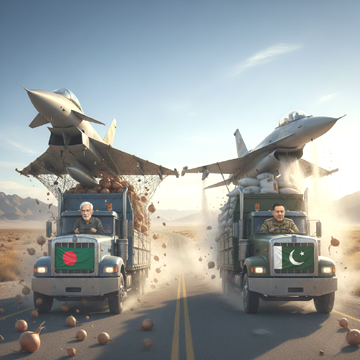
There is something deeply surreal about watching a nation argue over the price of onions while signing cheques for supersonic fighter aircraft. It is even more surreal when this happens not once, but repeatedly, across borders, as if South Asia were engaged in a silent competition to see who can most efficiently starve their people while polishing their wings for war. Pakistan, struggling to put flour and vegetables on the plates of its citizens, buys the F-16. Bangladesh, whose economy would wobble if it could not exchange fish for Indian eggs, potatoes, and onions, eyes the Eurofighter Typhoon. The absurdity is not accidental; it is structural. And it is enabled by leaders who seem less interested in governance than in cosplay—dressing up as statesmen while performing insecurity on a global stage.
Let us begin with Pakistan, because it offers the clearest, almost textbook, example of this pathology. A country perpetually on the brink of economic collapse, Pakistan lurches from IMF tranche to IMF tranche like a drunk leaning on lampposts. Inflation eats into wages, fuel prices fluctuate wildly, and basic staples become unaffordable to the very people whose taxes—direct and indirect—are meant to sustain the state. Yet amid this chronic scarcity, there is always money for the military. There is always money for jets, missiles, uniforms, and parades. Bread can wait. Vegetables can wait. The symbolism of power cannot.
The F-16 is not just an aircraft in Pakistan’s imagination; it is a talisman. It represents parity with India, relevance in Washington, and continuity of the military’s self-appointed role as guardian of the nation. Never mind that the aircraft is decades old. Never mind that maintaining it is ruinously expensive. Never mind that it contributes precisely nothing to the daily security of a shopkeeper in Lahore or a farmer in Sindh. The jet exists above economics, above accountability, above hunger. It flies in the rarefied air of national ego.
This is not new. Pakistan’s post-independence history has been defined by the dominance of the military over civilian life. The army is not merely a defence institution; it is a corporate entity, a political party, a real estate developer, and a moral arbiter rolled into one. In such a system, buying fighter jets is not a defence decision—it is a budgetary reflex. The army must remain visibly strong, even if the state beneath it is hollowed out. Flour shortages can be blamed on markets, hoarders, sanctions, or India. Jet purchases, however, are framed as destiny.
Across the eastern border, Bangladesh presents a different but equally troubling variation of the same disease. Unlike Pakistan, Bangladesh has made genuine economic strides over the last few decades. Its garment industry transformed the country into a major exporter; its fisheries sustain millions; its social indicators improved in ways that once made it a quiet development success story. And yet, this success remains fragile. Anyone who understands Bangladesh’s economy knows how dependent it is on regional trade flows—particularly with India—for food stability. Fish can only be eaten so many ways. Eggs, onions, and potatoes keep kitchens running and prices stable.
In such a context, the idea of buying the Eurofighter Typhoon—a high-end, maintenance-heavy, geopolitically loaded aircraft—is almost comical. This is not about defending Bangladeshi airspace from imminent invasion. No one is lining up to bomb Dhaka. This is about signaling. It is about asserting adulthood on the international stage, about saying “we too belong” in the club of nations that buy shiny Western toys. It is about leaders mistaking procurement for progress.
The tragedy is that defence spending, when misaligned with real threats, is not neutral. Every dollar spent on a Eurofighter is a dollar not spent on food security, climate resilience, healthcare, or education. Bangladesh is one cyclone away from devastation at any given moment. Sea-level rise threatens its very geography. These are existential threats. Fighter jets do not intercept floods. They do not shoot down rising seas. They do not stabilize food prices when supply chains snap. Yet they soak up political attention and fiscal space because they look impressive on paper and in photographs.
What links Pakistan and Bangladesh in this moment is not their history or their politics, but their leadership culture. In Pakistan, military chief, nation chief and Army Chief Asim Munir presides over a system that has perfected the art of blaming civilians while consuming civilian resources. In Bangladesh, Muhammad Yunus—once celebrated globally for microfinance and social entrepreneurship—now finds himself navigating, and increasingly resembling, the same top-down moral certainty. Both speak the language of national interest. Both frame their choices as unavoidable. Both seem curiously detached from the lived realities of ordinary people.
The comparison may feel harsh, but it is revealing. When leaders stop listening to markets, kitchens, and streets, and begin listening only to generals, diplomats, and foreign salesmen, they converge—regardless of background. They adopt the same tone, the same gestures, the same impatience with dissent. They begin to see the state as an abstract object to be managed, not a collection of households that must eat three meals a day.
India, inevitably, sits in the middle of this theatre—geographically, economically, and psychologically. It is fashionable to accuse India of arrogance, and often rightly so. But it is also true that India’s neighbours spend an extraordinary amount of energy defining themselves against it. Pakistan’s military doctrine is India-centric to the point of obsession. Bangladesh’s strategic flirtations often carry an undercurrent of wanting to demonstrate independence from Indian gravity. Fighter jets become props in this drama: proof that one is not merely a smaller, poorer neighbour but a sovereign equal.
This is where the real madness lies. Sovereignty is not demonstrated by hardware alone. A nation that cannot guarantee food affordability, energy stability, and basic welfare to its citizens is not strengthened by jets; it is weakened. Military power detached from economic strength is theatre. It looks intimidating from afar, but it collapses under scrutiny. History is littered with regimes that invested heavily in arms while neglecting their people, only to discover—too late—that tanks cannot suppress hunger forever.
India has its own bouts of procurement excess but there is a crucial difference. India’s economy, for all its inequalities and dysfunctions, generates enough internal momentum to absorb bad decisions without immediate collapse. Pakistan and Bangladesh do not have that cushion. For them, every extravagant purchase is a gamble with social stability.
Calling India “saddled with morons as neighbours” may sound crude, but it captures a frustration shared quietly by many in the region. It is exhausting to watch countries with shared histories, cultures, and vulnerabilities repeatedly choose symbolism over substance. It is exhausting to see leaders posture while markets tremble. It is exhausting to know that cooperation—on food, energy, climate, and trade—would deliver far more security than any fighter jet ever could.
The irony is that true regional security in South Asia will not come from air superiority but from agricultural resilience, open trade corridors, and political maturity. A stable Pakistan that feeds its people is safer for India than a hungry Pakistan with F-16s. A Bangladesh that invests in climate adaptation is a better neighbour than one that buys Eurofighters to impress distant capitals. Yet these truths are boring. They do not make headlines. They do not come with ribbon-cutting ceremonies or flypasts.
So, the jets will come. They will be photographed, debated, and celebrated by elites who do not queue for rationed flour or worry about vegetable prices. Meanwhile, ordinary people will adapt as they always do—by tightening belts, migrating, or simply enduring. This is the quiet cruelty of misgovernance: it rarely announces itself as cruelty. It arrives wrapped in the language of national pride.
Perhaps the most depressing aspect of this saga is not the waste of money, but the waste of imagination. South Asia could be the world’s most dynamic region if its leaders thought like administrators rather than performers. Instead, we get recycled insecurities, imported weapons, and the same old speeches. Asim Munir and Muhammad Yunus, despite their vastly different origins, now stand as symbols of this convergence—a reminder that when leadership loses touch with reality, it all starts to look the same.Jets over empty plates. That is the image that will define this era if sanity does not intervene. And history, as always, will be unsparing in its judgment.