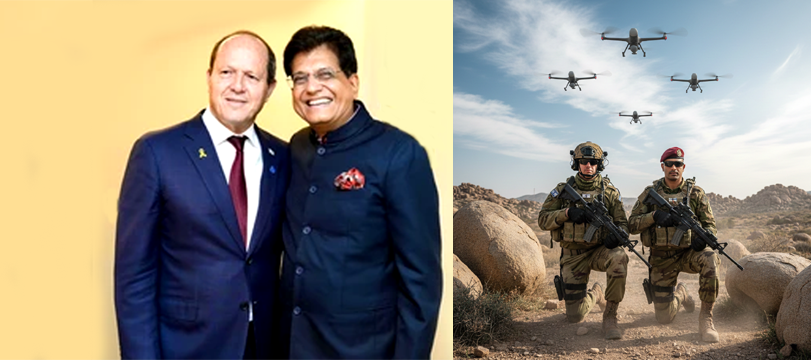
Signing on Terms of Reference for an FTA, will definitely lead to more defence related exports between the two democracies. This will lead to further consolidation in their respective regions
By Debasish Roy (CEO, Royalle Corporation, www.royalle.in)
In recent years, the strategic partnership between India and Israel has deepened dramatically—especially in the fields of defence, security, and intelligence. What began as a quiet, backchannel relationship has burgeoned into a full-scale, multi-domain alliance that increasingly aligns with rising economic interdependence. As bilateral talks on a Free Trade Agreement (FTA) move forward, the symbiosis between commerce, technology, and security underscores just how far these two democracies have come—and where they might be headed.
Setting the Stage: Economic Momentum
November 21, 2025, on this milestone day, India and Israel signed the Terms of Reference for negotiations on a Free Trade Agreement, announced by India’s Union Commerce & Industry Minister Piyush Goyal. Speaking at the India-Israel Business Summit in Tel Aviv alongside Israel’s Economy Minister Nir Barkat, Goyal declared that the two countries shared “unlimited possibilities and potential” to deepen economic engagement.
According to Goyal, sectors such as infrastructure, manufacturing, fintech, agritech, artificial intelligence, quantum computing, pharmaceuticals, space, and defence represent promising frontiers for collaboration. A bilateral investment treaty, once in place in tandem with the FTA, is expected to unlock new market access, streamline capital flows, and infuse predictability and stability into trade dynamics. Goyal’s 60-member business delegation to Israel signals the seriousness with which New Delhi approaches this moment. He underscored ten “Ds” — democracy, demographic dividend, decarbonisation, digitalisation, development, demand, diversity, decisive leadership, dependability, and determination — as pillars of India’s investable appeal. He projected growth of nearly 7 percent by March 2026, firmly above the global average.
This economic momentum is not separate from, but deeply intertwined with, the strategic ties—especially in defence and intelligence—between the two nations.
Intelligence Cooperation: RAW and Mossad in the Shadows
One of the foundational pillars of the India–Israel relationship has been intelligence cooperation. Long before their formal diplomatic ties began in 1992, India’s external intelligence agency, the Research and Analysis Wing (R&AW), had established a backchannel with Mossad, Israel’s foreign intelligence service. Indeed, when R&AW was created in 1968, R.N. Kao—its founding director—was reportedly advised by then Prime Minister Indira Gandhi to cultivate ties with Mossad. This move was seen in part as a counterbalance to Pakistan’s alliances with China and North Korea.
Because of the covert nature of intelligence work, much of the cooperation between Mossad and R&AW remains under the radar. Scholarly research and think-tank analyses suggest that the collaboration has included counterterrorism operations, threat analysis, and shared training. For example, after the 2008 Mumbai attacks—a watershed moment for India’s security establishment—the two agencies reportedly intensified coordination around Islamist extremism.
Some open-sourced accounts even allege that Mossad operatives have conducted interrogations in Kashmir in tandem with Indian security forces. In one testimony reported by MERIP, an individual claimed that his interrogators said they were working “with the Israeli intelligence agency, Mossad … on research in Kashmir.”
This collaboration, though often invisible, has been institutionalized over time. The 8th meeting of the India–Israel Joint Working Group on Counter-Terrorism, held in February 2013, brought together senior representatives of both countries’ security services. The continuity of this cooperation shows how much both sides value shared intelligence in confronting global and regional threats.
Military and Special Forces Ties: Matkal, Co-Development & Training
Beyond intelligence, the strategic relationship also extends into military cooperation, including training, R&D, and co-development. A significant recent milestone came in November 2025, when India and Israel’s defence ministries signed a Memorandum of Understanding (MoU) during their 17th Joint Working Group (JWG) meeting. This new MoU provides a policy framework to deepen cooperation in areas such as advanced research, AI, cyber-security, operational training, and co-production.
While public details on direct cooperation between Sayeret Matkal (Israel’s elite special forces) and Indian defence intelligence are scarce, analysts have long speculated that India’s interest in Israeli-style special operations capabilities draws inspiration from units like Matkal. As the Beeson Center’s research noted, India has eyed adopting Israeli special operations doctrines to bolster its anti-terror capacities. Indeed, the evolution of Indian counterterror doctrine—including its willingness to undertake surgical strikes—often echoes Israel’s own approaches.
Defence Trade: From UAVs to Missiles
On the hardware side, Israel has become one of India’s most trusted and high-tech defence partners. Over the last decade, bilateral defence trade has expanded significantly: as per Moneycontrol.com, it surged 33-fold from just US$5.6 million in 2015 to US$185 million by 2024.
According to India’s DRDO, purchases from Israeli firms in recent years include SkyStriker loitering munitions, Heron and Searcher UAVs, Derby beyond-visual-range air-to-air missiles, SPICE-2000 guided bombs, Spike anti-tank missiles, the Barak 8 air defense system, communications equipment, and more.
A particularly emblematic program has been the Adani–Elbit joint venture in Hyderabad, which manufactures Hermes 900 MALE (medium-altitude, long-endurance) drones. The Hermes has become central to both Indian and Israeli force structures. This technology transfer is not unidirectional; it reflects a co-development ethos, underpinned by deep operational trust.
Satellite and ISR Cooperation
Space cooperation is another dimension that blends intelligence, defence, and economics. India’s RISAT-2 (Radar Imaging Satellite-2), launched by ISRO in 2009, uses a synthetic-aperture radar (SAR) sensor manufactured by Israel Aerospace Industries (IAI). This satellite gives India all-weather, day–night surveillance capability, essential for border monitoring, maritime security, and counter-terror operations.
The roots of this cooperation go further: Israel’s TecSAR-1 (also called Ofeq-8) reconnaissance satellite was launched by ISRO in 2008 on a PSLV rocket under a commercial agreement. According to Indian sources, India has access to some of the TecSAR data stream—a highly sensitive capacity given how synthetic-aperture radar can see through clouds and observe changes on the ground.
This exchange is not just transactional: it builds mutual reliance. India helps Israel with launch capacity, while Israel provides advanced space-based ISR (intelligence, surveillance, reconnaissance) systems—a prime example of convergence between space commerce and national security.
Arms Exports and Ethical Concerns
The India–Israel defence-industrial relationship is not free from controversy. Some media and civil society voices have criticized India for allegedly exporting munitions to Israel, especially given the latter’s military operations in Gaza. Al Jazeera reported that ships carrying explosives, rocket engines, and propellants had sailed from Chennai to Israel.
On the flip side, some Indian defence sources claim that no significant deliveries of shells were made in the initial stages of hostilities, asserting that India took a “policy decision” not to supply certain ammunition types. The lack of transparency has prompted legal challenges; a petition filed in India’s Supreme Court argued that licensing such exports during Israel’s Gaza war may violate international humanitarian law.
Ultimately, public records remain murky, and both governments have maintained a largely discreet posture, citing national security and end-user agreements.
Broader Strategic Picture
The strategic case for India–Israel cooperation is grounded in mutual threat perceptions and complementary capabilities. Both nations face non-traditional, asymmetric threats—especially terrorism—and both value acquisition and co-development of cutting-edge technologies. Through intelligence collaboration (RAW–Mossad), operational exchanges, and joint R&D in drones, missiles, space, and cyber, the partnership has evolved into a highly integrated, trust-based relationship.
The freshly inked 2025 MoU on Defence Cooperation underscores a shared vision: co-production, technological innovation, and a united front against terrorism. Their cooperation in AI, cybersecurity, and space also shows foresight—both countries are preparing to anticipate not just 21st-century threats but 22nd-century warfare.
Future Vision
- Institutional Deepening
The 2025 MoU and recurring Joint Working Group meetings suggest that institutional cooperation will only intensify. We can expect more joint R&D projects, shared training between special forces, and perhaps a formalized intelligence-sharing architecture. - Industrial Co-Production
With Israeli firms embedded within India’s “Make in India” framework (through ventures like Adani–Elbit), co-development of next-generation drones, loitering munitions, and missile systems may increase. Joint lines of production could serve both markets, benefiting India’s defence industrial base and Israel’s export ambitions. - Space as a Strategic Frontier
Their shared capacity in space-based ISR could become a critical pillar of the alliance. Future collaborations might include constellation-based imaging radars, shared satellite downlink stations, or jointly developed secure data platforms for situational awareness. - Economic Integration
The FTA negotiations, coupled with a bilateral investment treaty, could unlock more defence-tech startups, dual-use AI firms, and cybersecurity ventures. These can further cement strategic trust while generating commercial returns. - Global Counterterrorism Leadership
As India and Israel affirm their “zero tolerance” stance on terrorism, they could co-lead international counterterror initiatives, leveraging their intelligence networks, joint capabilities, and geopolitical clout to influence global norms. - Balance and Autonomy
India’s balancing act—maintaining deep ties with Israel while sustaining relationships with other regional powers (including Iran)—will continue. But with enhanced cooperation, India may be better placed to manage its strategic autonomy, projecting influence while resisting overdependence.
The India–Israel partnership today is no longer a behind-the-scenes arrangement. Through intelligence sharing, defence co-production, and space collaboration, the two nations have woven a strategic tapestry that is tightly interlaced with commercial and economic ambition. As FTA discussions advance, and co-development deepens, the bond between New Delhi and Tel Aviv is set to become even more consequential—not just for the two countries, but for regional stability and global security. Once a discreet alliance built on shared threats, it is now evolving into a forward-looking strategic partnership—one where drones, missiles, satellites, and trade converge to create a powerful, resilient axis of cooperation.