
Infotech companies are also hiring engineers despite the training and skills having no connection to the requirement. For instance, civil engineers and chemical engineers being hired in IT firms make no sense but it is happening
The Indian government has made no secret of its ambition: it supposedly wants India to become a manufacturing superpower. Yet, while the slogans are loud and the targets are lofty, the ground reality tells a different story.
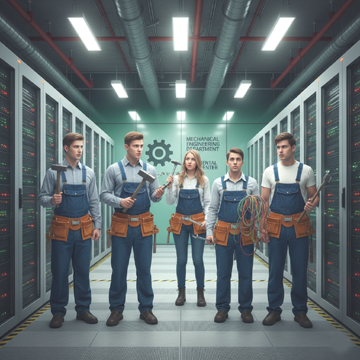
India, the fifth largest manufacturer globally, is paradoxically struggling to attract its own young engineers into the very sector it hopes will transform the nation’s economic destiny. Interviews with hundreds of engineering graduates across India reveal a startling trend: most prefer to join IT companies, even if it means earning less, than work in manufacturing. The reverse stupidity is also true. Infotech companies are also hiring engineers despite the training and skills having no connection to the requirement. For instance, civil engineers and chemical engineers being hired in IT firms make no sense but it is happening.
Their reasons go far beyond money — and reveal the fault lines in India’s economic vision.
Aspirations Over Applications
At a leading engineering college in Pune, final-year students in mechanical and civil streams line up for campus interviews. The companies visiting are a mix of local manufacturing firms, automobile companies, IT giants, and startups.
One might expect the mechanical engineers to crowd around the likes of Larsen & Toubro or Tata Motors. Instead, most are vying for entry-level IT coding jobs — even if those positions offer salaries ₹2–3 lakh lower than what a core mechanical role would pay.
When asked why, one student responded:
“What will I tell people I do? Saying I work for an IT company sounds more respectable. Manufacturing means dirt, shifts, and no air-conditioning.”
This perception isn’t isolated. Across India, out of every 100 engineering graduates, only 7 end up in core engineering roles, according to employability studies by the India Skills Report (2024). The rest gravitate toward IT, finance, civil services, or emigrate.
Even among graduates from elite institutions, the shift is evident. Batchmates from civil, electrical, and mechanical engineering branches are being recruited en masse into IT roles, often with minimal retraining. It’s not about skills — it’s about status.
India’s Manufacturing Potential: A $1 Trillion Opportunity
The irony is that India is the third most sought-after manufacturing destination globally, after China and the U.S., according to Cushman & Wakefield’s 2023 Global Manufacturing Risk Index. The country has the potential to export goods worth $1 trillion by 2030, powered by initiatives like Make in India and Production Linked Incentive (PLI) schemes.
For three decades, India’s manufacturing sector has grown at over 7% annually — respectable, but not transformational. By comparison, China’s manufacturing GDP grew at double-digit rates during its boom years (1990–2010), fuelled by aggressive infrastructure expansion, favorable business policies, and a societal pride in manufacturing work.
India has made progress, but the gaps are glaring. Despite being the fifth-largest manufacturer, the country’s manufacturing contribution to GDP hovers around 16–17%, far from the government’s stated goal of 25%.
And there’s an acute talent crunch. A senior HR executive at L&T revealed that the company needs 25,000 to 30,000 more skilled workers in 2025 alone to meet its project pipeline. But the graduates are simply not coming.
The Perception Problem
Sociologists point to a cultural hierarchy of professions. For decades, Indian families have equated “success” with white-collar, air-conditioned jobs — software, banking, medicine, or government services. Manufacturing jobs are viewed as “blue-collar”, even when they require high-end engineering skills.
This perception manifests in subtle ways. At social gatherings, parents boast about their children “working in IT in Bengaluru” far more proudly than “working in a steel plant in Jharkhand.”
Even the language reflects the bias: IT is “modern,” manufacturing is “dirty.”
This is compounded by workplace realities. Many manufacturing roles involve rotational shifts, remote plant locations, and physical presence on the shop floor. Compare this to IT jobs: work-from-home flexibility, urban postings, and global exposure.
“Young engineers prefer white-collar jobs because of what it sounds like at social gatherings. It is also to avoid the dirt and grime and sit in air-conditioned rooms,” said an HR head of a major automotive company.
The Pay Gap is Real — and Deep
While perception plays a role, economic incentives matter too. The pay gap between IT and manufacturing in India is stark.
A fresh IT graduate joining a services company might start at ₹4–6 lakh per annum. A manufacturing graduate, depending on the company, may start at ₹3–5 lakh. That’s not vastly different. But the divergence widens dramatically over time.
In 4–5 years, an IT professional can double or even triple their salary, moving into project management or overseas roles. A manufacturing engineer, by contrast, often sees incremental increases, reaching comparable figures only by retirement, if at all.
“What an IT professional earns in 4 to 5 years, a manufacturing employee earns over an entire career,” noted a senior academic from IIT Madras.
The inflation-adjusted lifetime earnings are therefore heavily skewed in favor of IT. With rising cost of living in urban India — where most opportunities lie — young engineers are making rational economic choices.
This disparity reflects the Lewis Dual Sector Model, an economic theory that explains structural transformation in developing economies. The model predicts that surplus labor from traditional sectors (like agriculture or manufacturing) will shift to modern sectors (like services) as wages rise there. In India’s case, the “modern sector” is IT, not manufacturing — an inversion of the classic industrialization path.
Infrastructure and Business Climate: A Drag on Manufacturing
The Ease of Doing Business rankings, despite improvements, hide deeper problems. While India climbed to 63rd position in the World Bank’s 2020 rankings, the on-ground reality for manufacturers remains challenging.
- Power Supply: Unreliable electricity continues to plague industrial belts.
- Land Acquisition: Legal disputes delay factory projects for years.
- Logistics: Despite the Dedicated Freight Corridor, India’s logistics costs remain 13–14% of GDP, compared to 8% in China.
- Regulatory Compliance: Manufacturers must navigate a labyrinth of environmental, labor, and tax regulations that vary across states.
This is why many multinational manufacturers, while eager to diversify from China, still hesitate to shift large-scale operations to India. Vietnam, Indonesia, and Mexico have emerged as attractive alternatives thanks to their simpler regulatory frameworks and lower costs.
Education: Producing Graduates, Not Innovators
Another challenge is the education template itself. India produces 1.5 million engineering graduates every year, but less than 25% are employable in core engineering roles, according to the National Employability Report.
Engineering curricula are often theoretical and outdated, with limited exposure to hands-on manufacturing processes or design thinking. Collaboration between academia and industry is weak.
“We need a correct template of education where manufacturing engineers innovate and work with design thinkers and customer-oriented teams,” said Prof. S. Subramanian, a manufacturing specialist. “Otherwise, we’re just producing paper engineers.”
The German dual-education model, where students split time between classroom learning and apprenticeships in industry, is a proven template that India has yet to scale meaningfully.
Why Manufacturing Still Matters
While IT gave India global recognition, manufacturing offers something far more fundamental: global dominance.
Every car on the road, every phone in your hand, every building you enter — manufacturing made it possible. But most of it is manufactured in China, not India.
When a country loses its manufacturing prowess, history shows that it eventually loses strategic depth. The U.K. post-industrial decline, or the U.S.’s hollowing out of manufacturing in the late 20th century, are cautionary tales.
Manufacturing has a high employment multiplier — every factory job supports 2–3 additional jobs in logistics, services, and retail. It’s also critical for exports and foreign exchange stability.
Bridging the Gap: Policy and Mindset
For India to truly become a manufacturing powerhouse, two things must change: policy and perception.
- Competitive Pay and Career Growth
Manufacturing salaries need standardization and competitiveness. Starting pay alone won’t suffice; career trajectories must offer real growth. Japan and South Korea succeeded in retaining talent by ensuring manufacturing offered prestige and prosperity. - Infrastructure and Ease of Doing Business
Without reliable power, logistics, and streamlined regulations, manufacturing will remain stuck. China’s rise was built on massive infrastructure investments and special economic zones that provided plug-and-play facilities. - Educational Reform
Curricula need to align with industry needs. Partnerships with manufacturing firms for apprenticeships, internships, and R&D can make the sector more attractive. - Cultural Rebranding of Manufacturing
National campaigns that celebrate engineers and factory innovators — much like ISRO scientists were celebrated — can change public perception. Pride in manufacturing must be cultivated.
Conclusion: A Dream Deferred
India stands at a crossroads. With both IT and manufacturing sectors brimming with potential, the choices of its young workforce will shape its future.
Right now, manufacturing is losing the talent war — not because it lacks importance, but because it lacks incentives, image, and infrastructure.
A country that ignores manufacturing risks economic stagnation and strategic vulnerability. As the world looks to diversify supply chains away from China, India’s moment is now. But unless it aligns its policies, pay scales, education system, and cultural mindset, that moment may slip away. Potential alone doesn’t build factories. People do.