
Half a century ago, the United States of America was the undisputed economic hegemon, wielding unparalleled influence over global trade and finance through the dollar. But the world has changed dramatically since then. Too bad India is not ready to benefit from this gap.
By Debasish Roy
CEO, Royalle Corporation (www.royalle.in)
This isn’t 1974 anymore, the year when US President Richard Nixon signed the petrodollar agreement with Saudi Arabia. The gist was to force every country buying Saudi oil to pay in dollars. Now, who had dollars to serve – the dollar country – US of A. It created a ready market for a US product – the US currency. Those days Saudi Arabia needed US technology, expertise and talent pool to extract their oil from the earth. Today, that need is no longer present. The Kingdom of Saudia can depend on other countries for the same without sacrificing an arm and a currency.
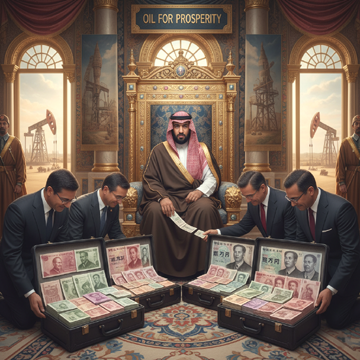
This captures a fundamental truth about the global economy. Half a century ago, the United States was the undisputed economic hegemon, wielding unparalleled influence over global trade and finance through the dollar. But the world has changed dramatically since then. Emerging economies have grown more resilient and diversified. China now stands as the world’s second-largest economy, with a consumer base of over 300 million middle-class citizens. India’s rapidly expanding economy represents another vast reservoir of demand and trade potential. Brazil remains a crucial commodities power, while a number of African nations—from Nigeria to Kenya—are becoming increasingly relevant in global trade networks.
Against this transformed backdrop, Saudi Arabia’s recent decision to move away from pricing its oil exclusively in U.S. dollars is more than a technical adjustment. It is a symbolic moment that underscores a deeper shift in the architecture of international finance. Although Riyadh did not announce a formal end to the petrodollar arrangement, its decision to price oil in its own currency, the riyal—and potentially in a future basket of currencies—signals the beginning of a more multipolar financial world.
Understanding the Shift
Saudi Arabia’s change does not mean that the kingdom will stop accepting dollars for oil purchases. Rather, the crucial difference is that oil will now be priced in riyals, and other countries will pay the equivalent in their home currencies based on exchange rates between the riyal and their currencies. Over time, this mechanism could evolve to include pricing in a basket of currencies, possibly aligned with the emerging BRICS payment frameworks.
Until very recently, Saudi Arabia priced its oil exclusively in dollars. For example, as late as 2023, China purchased Saudi oil priced in dollars per barrel, paying in renminbi (RMB) according to the RMB–USD exchange rate. Similarly, Saudi imports from China were priced in RMB, but payments were again intermediated through the dollar. In this arrangement, the Saudi riyal was never directly involved in transactions between Riyadh and Beijing. The same applied to India and many other trading partners: the riyals-to-rupees exchange rate effectively did not exist, even though trade volumes between these nations were substantial.
This dollar-centric system forced Saudi Arabia to keep its foreign assets—particularly oil revenues—in U.S. banks, often in the form of U.S. Treasury securities. These assets remained under the jurisdiction and regulatory authority of Washington, leaving Riyadh vulnerable to political risks, including potential asset freezes or sanctions. For decades, this was a trade-off Saudi Arabia accepted in exchange for security guarantees and economic stability. Now, however, the calculus has shifted.
By diversifying into currencies such as the RMB, ruble, real, and rupee, Saudi Arabia can store value outside of U.S. financial systems, trade directly with major partners, and reduce exposure to Washington’s economic leverage. It’s a strategic move rooted in history—but oriented firmly toward the future.
The Origins of the Petrodollar System: 1974
To understand the significance of this pivot, it’s essential to revisit 1974—the year the petrodollar system was born.
The early 1970s were tumultuous for the United States. The Vietnam War had strained the U.S. economy, leading to large fiscal deficits and high inflation. In 1971, President Richard Nixon famously ended the dollar’s convertibility to gold, effectively dismantling the Bretton Woods system of fixed exchange rates. Major currencies began to float in 1973. Then came the 1973 oil shock, when the Organization of Petroleum Exporting Countries (OPEC) cut oil production and embargoed shipments to the U.S. during the Yom Kippur War. Oil prices quadrupled, inflation soared, and the dollar’s global dominance seemed in peril.
Amid this geopolitical and economic uncertainty, the Nixon administration embarked on a diplomatic initiative that would reshape global finance. In 1974, Washington and Riyadh struck a historic agreement:
Saudi Arabia would price its oil exclusively in U.S. dollars.
In return, the United States would supply military equipment and offer security guarantees to the kingdom.
Saudi Arabia would reinvest its dollar revenues into U.S. Treasury securities, effectively recycling petrodollars back into the American financial system.
This arrangement anchored global demand for the dollar. Every country buying oil from Saudi Arabia needed dollars, ensuring a constant global appetite for the U.S. currency. Simultaneously, Saudi investments in Treasuries helped finance U.S. fiscal deficits. The petrodollar system became a cornerstone of American economic power and cemented the dollar’s status as the world’s dominant reserve currency.
A Changed World Order
Fast-forward fifty years. The global landscape looks nothing like it did in 1974.
The U.S. share of global GDP has fallen from about 40% in 1960 to around 25% today, according to World Bank data.
China’s economy has surpassed the United States in purchasing power parity terms, and its share of global trade has surged.
Many countries—including traditional U.S. allies—are developing alternative cross-border payment mechanisms to reduce their dependence on the dollar and insulate themselves from U.S. sanctions.
Moreover, the United States is no longer as dependent on Saudi oil as it once was. The shale oil revolution transformed the U.S. into the world’s largest oil producer by 2018. By 2019, the U.S. became a net exporter of petroleum for the first time since 1949. Imports from Saudi Arabia, once critical, have declined sharply. Meanwhile, China has become Saudi Arabia’s single largest oil customer, accounting for over 20% of the kingdom’s oil exports.
At the same time, Saudi Arabia has pursued a foreign policy diversification strategy. It has joined BRICS, engaged in the mBridge project (a multilateral central bank digital currency initiative involving China, the UAE, and others), and strengthened ties with countries outside the traditional U.S.–European sphere. Riyadh’s economic diplomacy today is driven less by Cold War-era security calculations and more by strategic hedging in a multipolar world.
The Dollar’s Dilemma: De-Dollarization in Motion
Saudi Arabia’s decision to diversify its currency use in oil sales represents a small but symbolically powerful step toward de-dollarization. Across the world, nations are increasingly experimenting with bilateral currency swap arrangements, national payment linkages, and even central bank digital currencies (CBDCs) to conduct trade in their own currencies.
For example: China has signed currency swap agreements with more than 40 countries, allowing local firms to settle trade in RMB.
India and Russia have used rupees and rubles for certain energy transactions since the start of the Ukraine conflict in 2022, bypassing dollar settlements to evade sanctions.
The European Union has promoted the euro as an international currency through mechanisms like INSTEX (Instrument in Support of Trade Exchanges), though with limited success so far.
The challenge in these local-currency transactions has historically been efficiency and liquidity. The dollar serves as a “vehicle currency” in global markets—its deep liquidity and universal acceptability make it a convenient intermediary between any two currencies. In contrast, direct trading between, say, the Saudi riyal and the Indian rupee involves less liquid markets and higher transaction costs. But technological advances are beginning to erode this advantage.
Tokenization—the use of blockchain-based digital representations of value, including CBDCs and stablecoins—could dramatically reduce the cost of such transactions. Instead of relying on commercial bank intermediaries, tokenized currencies can be exchanged instantaneously and securely. Although widespread adoption is still years away, these innovations point toward a future where local currencies can compete more effectively with the dollar in international trade.
The shift is already visible in global foreign exchange reserves. The dollar’s share of global reserves has fallen from 71% in 1999 to 58.4% today, according to the International Monetary Fund. The difference has been absorbed by currencies such as the euro, yen, pound sterling, and RMB.
Historical Echoes and Future Trajectories
History offers precedents for such transformations. The British pound sterling once served as the world’s dominant reserve currency during the 19th century, underpinned by London’s financial might and Britain’s colonial empire. After World War II, the pound’s supremacy gave way to the U.S. dollar, as the U.S. emerged as the global economic leader. The transition was not instantaneous—it took decades, accelerated by events like the 1956 Suez Crisis, which underscored Britain’s diminished geopolitical clout.
Similarly, the dollar is unlikely to be dethroned overnight. Its advantages are formidable: deep capital markets, trusted institutions, and the sheer scale of its usage. But, like the pound before it, its dominance can erode gradually, particularly if other credible alternatives emerge and if geopolitical actions—such as U.S. sanctions—encourage others to build parallel systems.
Saudi Arabia’s latest move must be viewed in this light: not as a revolution, but as an evolution.
A Multipolar Monetary Future
In the foreseeable future, the U.S. dollar will remain the world’s most important currency. Its role as the primary reserve, financing, and transactional currency is unlikely to disappear. However, the financial landscape is democratizing. Instead of a single hegemonic currency, the world may increasingly rely on a basket of major currencies, including the euro, the Chinese RMB, the Japanese yen, and potentially others.
Saudi Arabia’s approach to oil pricing and payments could serve as a harbinger of this new system, just as its 1974 agreement with the U.S. was a harbinger of the petrodollar era. As Riyadh explores new financial alignments, global energy trade may gradually become less dollar-centric, reshaping international capital flows in the process.
Conclusion
The world of 2025 is not the world of 1974. Emerging economies are stronger, technological innovation is accelerating, and geopolitical power is diffusing. Saudi Arabia’s currency pivot reflects this new reality. It doesn’t spell the end of the dollar, but it marks the beginning of a more pluralistic international financial order, where multiple currencies coexist and compete.
As history has shown, such transitions unfold slowly, often imperceptibly—until a crisis or a critical moment accelerates the shift. Whether the petrodollar era ultimately gives way to a petro-basket era or some other arrangement remains to be seen. But one thing is certain: the foundations of the global monetary system are evolving, and Riyadh’s move is a significant signpost on that journey.