
The sad state of Bihar’s universities and colleges. How Prashant Kishor’s new Jan Suraaj framework can help remove instances of student unrest, teacher strikes, lack of good teachers, lack of research facilities, late awards of degrees, infrastructure in shambles, criminal nexus and lack of job-related curriculum.
By Debasish Roy
CEO, Royalle Corporation (www.royalle.in)
I. Prolegomenon: The Crisis of Institutionalized Inertia
Bihar, the ancient seat of global learning that birthed institutions like Nalanda and Vikramshila, now faces a profound paradox: its contemporary higher education system is gripped by a structural crisis characterized by deep-seated institutional atrophy and chronic governance failure. This decline is not merely cyclical; it represents a comprehensive breakdown of administrative integrity and academic regularity. The state’s university ecosystem is trapped in what can be described as a “toxic triangle” of destructive political leadership, a susceptible population, and a permissive environment—a “soft state” where established countervailing forces resist any meaningful positive change.
The failure to maintain standards is visible in national performance metrics. For example, Bihar’s major state universities, outside of centrally funded technical institutions like IIT Patna and NIT Patna, consistently struggle to feature in the top ranks of the National Institutional Framework Ranking (NIRF). Patna University, historically one of the nation’s oldest and most prestigious universities, recently failed to even secure a place in the 51-100 rank band among state public universities, a position it held just a year prior. This severe, continuous descent into mediocrity, despite the state’s profound academic legacy, suggests that institutional neglect has become terminal, masking genuine administrative necrosis beneath ornamental pride in past achievements. The eight systemic failures observed—ranging from endemic corruption to curriculum irrelevance—are interconnected outputs of this fundamental crisis of governance and resource stewardship.
II. Academic Dyschronia: The Scourge of Session Delays and Student Alienation
One of the most immediate and crippling pathologies afflicting Bihar’s higher education system is the widespread failure to adhere to basic academic calendars, resulting in extreme session delays and the late award of degrees. This phenomenon, termed academic dyschronia, is not limited to isolated cases but plagues almost all major universities, including Magadh University, Jaya Prakash University, Veer Kunwar Singh University, BRA Bihar University, and Tilka Manjhi Bhagalpur University.
The severity of the backlog is such that the regularization of sessions requires direct, high-level intervention from state government bureaucrats, specifically the Education Department’s Additional Chief Secretary. These officials have been forced to command universities to furnish fresh academic calendars and bring delayed sessions back “on rails” within restrictive three-month deadlines, threatening punitive action against university officials responsible for delays. This required coercion by the state to police core functions like examination scheduling demonstrates a total collapse of institutional autonomy and accountability at the university leadership level. When administrators—Vice-Chancellors and Registrars—are either incapable or politically unwilling to fulfill their fundamental duties, the institution becomes functionally captured. Temporary and often desperate solutions, such as directing universities to arrange extra classes on Sundays and holidays to complete courses , address the symptom (incomplete coursework) but utterly fail to rectify the profound administrative failure at the root of the delayed examination and result processing system.
The consequence of this administrative malaise is the alienation of the student body. Delayed degrees translate into significant career setbacks, forcing students to miss opportunities for professional examinations or entry into the national job market. This profound frustration manifests as widespread student unrest, evidenced by mass protests, such as those demanding the immediate conduct of the State Teacher Eligibility Test (STET), highlighting the anxiety over career losses caused by administrative delays.
III. The Human Capital Crisis: Faculty Precarity and the Erosion of Quality
The quality of academic instruction is fundamentally compromised by a deep-seated human capital crisis characterized by pervasive faculty shortages and an exploitative reliance on a precarious temporary workforce. Universities depend heavily on guest faculty who often meet the University Grants Commission (UGC) eligibility criteria for assistant professors and teach against substantive posts.
This reliance has institutionalized precarity. Guest faculty members face acute financial instability, receiving a modest honorarium capped at ₹50,000 per month, paid only for 11 months of the year, with a mandated break before renewal that costs them a month’s pay, and no compensation during summer vacations. This arrangement, designed to keep the workforce low-cost and flexible, inevitably leads to teacher strikes and sustained resentment, disrupting the academic environment. Recent incidents include hunger strikes launched by affected guest faculty at Patna University, demanding service renewal. The termination of qualified guest faculty, often citing a spurious “lack of vacancies” despite them teaching against existing substantive posts, suggests a deliberate systemic design flaw. This structure may be intended to maintain a pliable workforce or to keep posts open for potentially corrupt permanent appointment processes managed by bodies like the Bihar State University Service Commission (BSUSC). A faculty perpetually focused on financial survival and job security cannot dedicate themselves to high-quality teaching, research, or student mentoring, directly contributing to the state’s research deficit and poor NIRF performance.
IV. Institutional Corrosion: Infrastructure, Research Deficits, and Physical Decay
The physical landscape and academic output of Bihar’s state universities reflect years of capital neglect and administrative failure, leading to both infrastructure in shambles and a chronic lack of research facilities. The failure of state universities to compete nationally is starkly evident in their negligible presence in NIRF rankings, contrasting sharply with the relative success of centrally funded institutions like IIT Patna, NIT Patna, and Central University of South Bihar (CUSB).
The physical decay is directly linked to profound blockages in the administrative pipeline responsible for capital expenditure. Major infrastructure projects face paralysis, as evidenced by the cancellation of construction tenders—such as those for residential school buildings and model prefabs—frequently due to reasons like “Single Tender” or “Single Bid” issues. This inability to secure competitive bids for public works is indicative of either administrative incompetence in tender management or, more worryingly, a pattern of pre-tender corruption designed to allow only politically or criminally connected single bidders to participate, directly reinforcing the link between corruption and physical decay.
Beyond the physical state, the absence of modern research infrastructure, well-stocked libraries, and advanced laboratories ensures that academic output remains stagnant. This deficit prevents institutions from achieving the necessary criteria for competitive NIRF scores, leaving the general university sector lagging severely. This institutional compromise has a long and documented history, symbolized by the infamous “annual ritual of cheating and chitting,” where photographs of parents scaling examination hall walls to pass answer sheets highlight a deeply eroded cultural sanctity of education that negates the very concept of scholarly rigor.
V. The Dark Nexus: Corruption, Administrative Capture, and Fiduciary Mismanagement
The most insidious cause of institutional failure is the widespread and sophisticated corruption that has captured the state’s university administration, effectively transforming academic institutions into state-sponsored revenue extraction vehicles. This criminal nexus operates at the highest echelons of leadership.
A notable example of institutionalized fraud involved the former Vice-Chancellor of Magadh University, Rajendra Prasad, against whom a special vigilance court issued an arrest warrant. Prasad was accused of corruption and siphoning approximately ₹20 crore between 2019 and 2021 through the fraudulent purchase of materials like e-books and OMR answer sheets. The investigation revealed that this operation involved “shell companies” based outside Bihar, indicating a planned, sophisticated mechanism for diverting public funds intended for educational resources.
Such incidents are not isolated; they represent a clear pattern of “corruption in appointments, misuse of funds”. Financial irregularities, such as the ₹75 crore scandal discovered at Maharana Pratap College, are so severe that the Governor’s office (Raj Bhavan) has been compelled to form special three-member inquiry committees composed of high-ranking academics (Vice-Chancellors and financial advisors) to investigate the loss of institutional financial control. The magnitude and sophistication of this fiduciary capture—where funds designated for digital resources and physical infrastructure are intentionally diverted—is the primary reason institutions are perpetually starved of the capital required to fund research, upgrade facilities, and employ permanent, well-compensated faculty. The criminal nexus directly causes the research and infrastructure deficits detailed previously.
VI. Curriculum Mismatch: The Employability Deficit
Bihar’s higher education system is fundamentally disconnected from the practical demands of the modern, skill-driven economy, leading to a severe employability deficit among graduates. The curriculum remains overly focused on narrow academic knowledge, neglecting crucial “generic skills” and “personal skills” that employers value highly, such as critical thinking, problem-solving, communication skills, judgment ability, and a strong work ethic.
This educational misalignment is responsible for two defining challenges of the state: mass unemployment and pervasive migration. Political activist Prashant Kishor has noted that migration, both for livelihood and higher studies, is not restricted to financially weak families but affects virtually every family in Bihar. This exodus is the ultimate indictment of a higher education system that fails to prepare its graduates for local or national economic opportunities.
The market has reacted to this failure by favoring alternative, practical educational pathways. The increasing popularity of polytechnic colleges, which offer diploma-level courses in fields like Civil, Mechanical, and Computer Science Engineering with a strong focus on practical learning and industry relevance , confirms that students are deliberately bypassing traditional university degrees in favor of job-oriented qualifications. Furthermore, the curriculum failure disproportionately reinforces social inequity. Students from marginalized communities, such as the Scheduled Castes, who are already severely underrepresented in higher education (5.7% enrollment) and who cannot afford to migrate for better opportunities, are left with non-marketable degrees, perpetuating cycles of economic marginalization.
VII. Structural Impediments to Equitable Access
Beyond institutional quality, severe structural inequalities persist, hindering the potential for social mobility through education. Despite the Scheduled Caste community constituting 19.65% of Bihar’s population , their representation in higher education is drastically low, making up only 5.7% of students and a near-identical 5.6% of faculty.
This disparity is critical, as education remains the “most decisive factor in empowerment”. The parallelism between low student enrollment and low faculty representation suggests that the problem goes beyond mere financial barrier; it indicates a persistent systemic blockage within the pipeline. This could stem from failures in the implementation of affirmative action policies, institutional bias, or corruption in the hiring process, which undermine meritocracy and equitable representation. The existing systemic failures—including chronic session delays and corrupt appointment systems—therefore disproportionately impact the already marginalized population seeking upward mobility, reinforcing the structural inequalities identified by organizations monitoring Dalit and Adivasi welfare.
VIII. Prognosis for Revival: The Jan Suraaj Policy Framework
The resuscitation of Bihar’s higher education system requires a radical departure from the status quo, focusing on institutional restructuring and rigorous accountability, aligning with the principles advocated by Prashant Kishor’s movement for governance efficiency (Jan Suraaj). Kishor’s core critique rests on the state’s failure to utilize available resources, citing that the government surrendered ₹51,000 crore in allocated funds due to non-utilization. Therefore, the reform blueprint must prioritize meticulous stewardship and efficient utilization of existing capital and administrative structures over simply demanding increased funding.
A. Immediate Academic Stabilization (Mission Regularity)
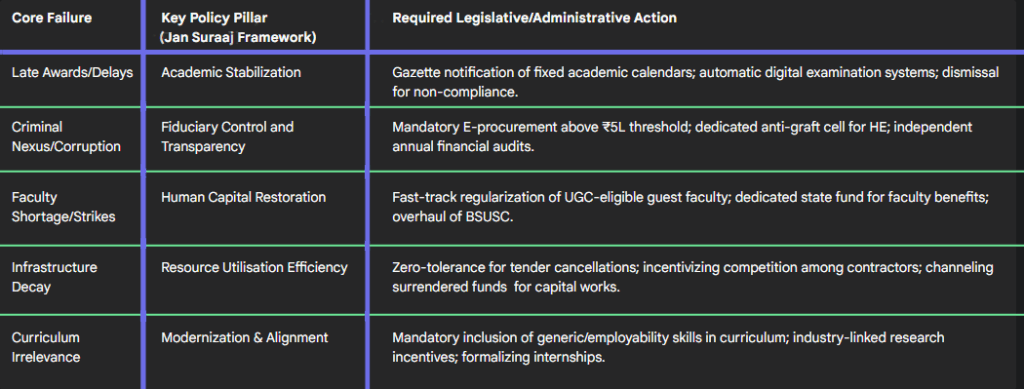
The foremost priority must be the restoration of the academic calendar. The policy demands the implementation of a non-negotiable, state-gazetted academic calendar for all institutions. To achieve this, a High-Powered Academic Monitoring Cell (HPAMC) must be established, reporting directly to the Raj Bhavan (Chancellor’s office), tasked solely with overseeing examination scheduling, paper assessment, and result processing. Furthermore, to combat the administrative inertia and ensure accountability, mandatory biometric attendance for all academic and non-teaching staff must be restored. University leadership (V-Cs and Registrars) must be made personally liable for non-compliance, with a clear ‘three-strikes’ policy leading to immediate dismissal for failure to adhere to the gazetted academic schedule.
B. Restoring Faculty Stability and Meritocracy
The current exploitative model of faculty employment must be dismantled to secure a motivated and high-quality academic workforce. The strategy involves the fast-track regularization or permanent absorption of all existing guest faculty who meet UGC eligibility criteria and have served for a predetermined period (e.g., three years) against substantive posts. Simultaneously, the Bihar State University Service Commission (BSUSC) must be overhauled to ensure recruitment processes are rapid, merit-based, and completely transparent, thereby eliminating the political incentive to rely on precarious ad-hoc staff. To stabilize the existing temporary staff during this transition, the state must mandate equitable pay and benefits, including compensation during summer breaks, until their permanent absorption is finalized.
C. Reforming Fiduciary Control and Transparency (Dismantling the Nexus)
To exorcise the cancer of the criminal nexus, a zero-tolerance approach supported by preventative financial controls is essential. The government must mandate the implementation of mandatory, real-time electronic procurement (E-procurement) for all university purchases exceeding a low threshold (e.g., ₹5 lakh). This immediately neutralizes the capability of university administrators to conduct fraudulent procurement using shell companies, as seen in the Magadh University case. Additionally, specialized anti-graft units must be granted enhanced investigatory powers to audit university finances and scrutinize suspicious tendering activity, particularly the frequent cancellations due to “Single Bid” scenarios. Swift prosecution of high-profile corruption cases is necessary to signal a clear shift in governance enforcement.
D. Curriculum Modernization and Industry Alignment
The education system must pivot from a model focused on mere degree production to one centered on skill acquisition and demonstrable employability. This requires mandating the integration of ‘Employability Skill Modules’ (ESM) into all undergraduate programs, focusing explicitly on critical skills such as negotiation, networking, self-management, and critical thinking. State funds, particularly the currently non-utilized allocations , should be strategically invested to establish Centers of Excellence in emerging, high-demand fields like Artificial Intelligence, Data Science, and Green Technologies. Finally, mandatory, relevant internships should be formalized as a requirement for degree conferral, linking theoretical knowledge directly to industry practice.
The implementation of this framework can be summarized by the following policy matrix:
E. Addressing Structural Inequality
Finally, the reforms must include targeted programs to address the profound structural inequalities in access. Mechanisms should be established for state-funded scholarships and robust mentorship programs specifically directed toward increasing the enrollment of SC students in higher education. Simultaneously, strict vigilance must be maintained to ensure transparent and fair implementation of reservation policies in faculty hiring to correct the severe underrepresentation of marginalized communities in academic leadership and teaching positions.
IX. Conclusion: From Systemic Failure to Institutional Renaissance
The sad state of affairs in Bihar’s universities and colleges is not merely a consequence of inadequate funding, but a complex outcome of institutional capture, administrative atrophy, and deliberate fiduciary mismanagement. The system has evolved into a “soft state” environment where corruption is institutionalized , resource utilization is negligible , and the academic mission has been subordinated to bureaucratic inertia and financial extraction.
The path to institutional renaissance demands a comprehensive, politically committed overhaul. A potential government led by Prashant Kishor must treat the higher education system not as an inevitable financial liability but as the critical engine of Bihar’s future human capital development. This requires moving beyond symptomatic treatments and focusing on the radical dismantling of the dark nexus that links corrupt administrators, political populism, and financial crime. Only by strictly enforcing academic regularity, professionalizing the faculty workforce, institutionalizing financial transparency, and aligning the curriculum with economic realities can Bihar’s universities move from being centers of student unrest and administrative delay to becoming genuine and equitable pathways for growth and development. The revitalization of this sector is intrinsically linked to the economic and social fate of the state.