
United Nations and Public Health Programmes in Africa were pilot projects for IPAC. Bihar could be a pilot project for the whole nation. Prashant Kishor works with an open mind and an open agenda. No big promises. No fake claims.
This article looks at Kishor’s strengths as a strategist — the ingredients of his method, the influences of his prior life in international development and professional organisations, the way he reads and manipulates the media environment, and most importantly, how those strengths could be marshalled for measurable improvement in Bihar’s fortunes. How PK is hanging out criminal politicians to dry.
Bihar goes to the polls in November 2025, amid a paradox: palpable economic momentum in places, but persistent structural poverty and weak public-service delivery across large parts of the state. For voters, that gap — between promise and experience — will be the axis of political choice. For political actors, it is a test of whether rhetoric, vote arithmetic and personality politics can be translated into durable institutional change. And for one man who has become synonymous with modern Indian political campaigning — Prashant Kishor — the Bihar election is less about spin and more about a proving ground: can the techniques of messaging, data and organisation that have changed elections elsewhere produce real social change at home?
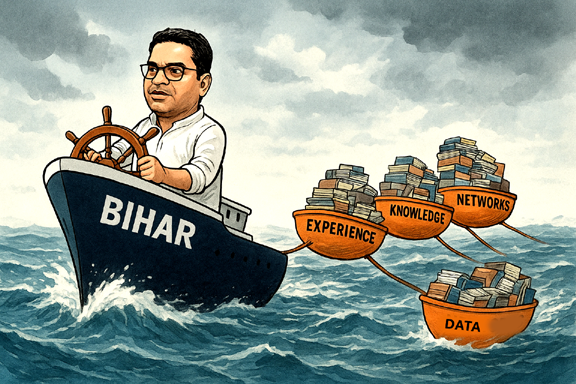
From public health to politics: an organisational grammar
Prashant Kishor’s route into politics is not the usual one. Trained and employed in public-health programmes supported by United Nations agencies for several years, Kishor developed capacities that are not commonly associated with Indian electioneering: project design, behavioural-communications work, monitoring-and-evaluation, and running teams under tight budgets and timelines. Those are not trivial footnotes: campaign planing at scale — micro-targeting messages, sequencing interventions, monitoring field performance — is operationally similar to the way public-health programmes are designed and executed. Kishor’s early career shaped his instinct for evidence-driven messaging, for piloting interventions before scaling them, and for designing feedback loops so strategy can be continuously adjusted.
That professional discipline shows up in how his organisations operate: rigorous seat-level mapping, rapid-survey feedback loops, and tight coordination between digital, ground and media teams. Kishor’s firms — the umbrella of groups often referenced as Citizens for Accountable Governance (CAG) earlier and later I-PAC — present themselves as campaign incubators and delivery units that import private-sector project management into political contests. The result is not only slick advertising; it is a systemic approach to campaign logistics that treats voters as consumers of policy propositions and delivery as a measurable output.
The rural intelligence — knowing the village
What distinguishes Kishor from many marketing-savvy strategists is his insistence that effective campaigns are rooted in deep, hyper-local knowledge. Bihar, with its mix of agrarian districts, small towns and dense village networks, rewards a granular approach: which crops matter where, which local grievances are acute, which civic service fails most often in a block. Kishor’s teams are known for conducting thousands of short, structured interviews across constituencies to build a picture far richer than standard opinion polls. That field-first orientation stems from his development-sector background — where program success depends on understanding the last mile — and from long experience in Indian states where caste, class and local institutions interact in complex ways. Several of the campaign techniques he popularised — person-to-person outreach, issue-specific local promises, and localized communication formats — are rooted in that village-level intelligence.
This matters for Bihar because change here has to be institutional, not merely symbolic. Fixing health indicators, improving school learning, and ensuring reliable electricity and roads are the levers that raise living standards. A campaign that only amplifies slogans will not persuade households who judge politicians by the speed at which rations arrive, water pumps work and ambulances respond. Kishor’s advantage is that he speaks the language of delivery metrics — and can design campaign promises in ways that are measurable and audit-able at the block level.
A cross-party résumé: playing across the political spectrum
One of the most frequently noted aspects of Kishor’s career is the diversity of political clients he has advised. From Chief Ministers and regional heavyweights to national leaders, Kishor has worked across ideological lines: his fingerprints are visible on campaigns for leaders from Narendra Modi’s 2014 national campaign to state-level victories in Punjab, Andhra Pradesh, West Bengal, Delhi and others. That record gives him three tactical assets.
First, credibility among political actors: having worked with a range of parties, he understands internal party dynamics, coalition management and the personal ambitions that shape political decisions. Second, tactical learning: strategies that work in one context can be adapted, not copied, in another; Kishor’s candy-box of tactics is large precisely because he has tried many permutations. Third, a comparative lens: by having seen systems that deliver (and those that don’t), he can better identify which reforms are politically implementable in a place like Bihar.
That cross-party résumé has been politically awkward at times — critics call it opportunism; supporters call it practical non-partisanship. For Bihar’s voters the question is pragmatic: will someone who has worked with many leaders bring a neutral, delivery-focused approach to governance, or will political ambition dilute the reform agenda? Kishor’s own move to organise publicly in Bihar — visible through padyatras and the Jan Suraaj initiative — indicates an appetite not just to advise but to be held accountable in his home state.
Reading weaknesses and building narratives
Successful strategists are diagnosticians of vulnerability. Kishor’s reputation rests on an unusually candid capacity to parse a politician’s weakness — whether it is an incoherent developmental record, a credibility gap on corruption, an inability to connect via modern media — and translate that into narrative levers that are both emotionally resonant and politically executable.
A campaign’s narrative is not mere spin; it is a set of propositions that must survive scrutiny. Kishor’s approach often begins with a behavioral hypothesis: why will a voter change their mind? From that hypothesis he builds messaging that addresses the barrier directly — e.g., information deficits, distrust in delivery systems, or apathy. The tactical consequence is that campaigns stop being about abstract national themes and become about specific, verifiable changes: a promise to ensure hospital ambulances reach a village within a fixed time, or to digitalise ration distribution so leakage falls. Those are promises voters can test, and that can be monitored post-election.
Mastering the media — turning interviews into advantage
In an age where media cycles are short and social platforms amplify every misstep, handling interviewers and controlling the narrative is a core competency. Kishor has shown a deftness with traditional television and emerging digital formats: he disciplines spokespeople, times message releases to dominate news cycles, and weaponises small policy wins into symbolic moments that sustain attention. Crucially, he also prepares leaders to face hostile interviews by reframing questions, moving to an affirmative policy story, and, when necessary, using data to blunt reputational attacks.
That media fluency matters for Bihar because public expectations are now shaped in urban and rural news ecologies simultaneously. A candidate who can turn a problematic headline into a focused policy rebuttal — and then push proof of delivery into the same conversation — reduces the longevity of negative stories and keeps attention on policy. It is a skill Kishor brings from campaigns that treated media not as an afterthought but as a field-operational tool.
Wikipedia
From campaign promises to social change: the accountability gap
The larger test is implementation. Political strategy can win elections, but turning victory into poverty-reducing policy requires institutional capacity and political will. Bihar’s development challenge is acute: it remains among the poorer Indian states in per-capita terms and in multidimensional poverty metrics, despite sharp reductions in extreme poverty nationally. Transformative change will depend on three connected things Kishor’s method can influence: clear, measurable promises; locally monitored delivery mechanisms; and a media-backed accountability regime that exposes failures and amplifies successes.
Kishor’s advantage is that his toolkit is engineered for measurable promises. If his teams design campaign commitments that are specific (for example, “every PHC in X district will have an ambulance within Y months”), and if they set up independent monitoring dashboards and citizen-feedback platforms, then voters will have a yardstick. The hard part is converting short-term campaign measurement into long-term bureaucratic practice: that means building capacity inside departments, securing budgetary commitments, and institutionalizing grievance redressal. A strategist can design the pilot and the publicity; the state machinery must sustain the program.
Risks, critiques and the politics of personality
No strategist is a panacea. Critics warn that an over-reliance on marketing and personality risks leaving governance to improvisation. Campaigns that prize short-term optics sometimes under-invest in longer, less-visible bureaucratic reform. There is also the democratic question: does the professionalisation of campaigning privilege those with money and organisational edge, making elections less about ideas and more about machinery?
For Bihar, where local political networks and caste-affiliations remain important, any outsider-driven campaign must demonstrate deep respect for local leadership and show how technocratic fixes will be locally owned. Kishor’s record suggests he understands this tension; his success has often depended on making local leaders the visible face while supplying the backbone of data, messaging and organisation.
A pragmatic conclusion: what success would look like
If Kishor’s involvement in Bihar leads to meaningful social change, we would expect to see:
Campaign promises framed as measurable delivery commitments, tied to timelines and specific service-level indicators.
An operational feedback loop: frequent rapid surveys, citizen helplines, and publicly visible dashboards showing progress at block or assembly-segment level.
Media strategies that sustain focus on delivery rather than transient controversies: narratives anchored in proof rather than assertion.
Early wins in health, schooling and connectivity that are independently verifiable — the smallest unit of social change is not a speech but a reliably working public service in a village.
Bihar’s problems are structural and long-term. No strategist, however brilliant, can substitute for sustained governance. But if electioneering becomes a vehicle for designing, promising, and — crucially — monitoring delivery, then campaigns themselves can become an accelerant for social change. Prashant Kishor’s mix — a development-sector mindset, organisational discipline, granular rural intelligence, a wide cross-party résumé, and media mastery — gives him the tools. The question for voters and civil society is simple: will the next electoral cycle translate those tools into systems that persist after the headlines fade? If it does, Bihar’s ballot will have been more than a contest for power — it will have been a blueprint for rebuilding public trust and lifting livelihoods.
Selected sources and reading
Profile and career overview of Prashant Kishor. Wikipedia
I-PAC (Indian Political Action Committee) and campaign work.
Reviews of Kishor’s campaign methodology and client list.
Data and reporting on Bihar’s poverty and development challenges.
www.ndtv.com, Bihar local channels.
Before he became a political strategist, Prashant Kishor worked as a public health expert for the United Nations for eight years.
Before leaving in 2011 to start his political strategy career, Kishor was based in Africa and focused on public health programs funded by the U.N..
His career as a political strategist includes the following notable achievements:
Founding the Indian Political Action Committee (I-PAC), which has worked for various political parties, including the BJP, JD(U), INC, AAP, and TMC.
Masterminding Narendra Modi’s successful 2014 Lok Sabha campaign.
Successfully leading election campaigns for multiple state-level parties.
Following his retirement from political strategy in 2021, Kishor announced the launch of his own political party, Jan Suraaj, in 2024, to contest the 2025 Bihar Legislative Assembly election.