Y2K was different. Y2K was a hungry India body-shopping one line of work at wholesale rates. Today, we are occupying thinking positions in various industries after individual choices of education and jobs in Europe and Japan. Passports are not processed in bulk and stacks by dalaals out of Nehru Place and Majestic bus stand. Today, visa websites are being explored individually
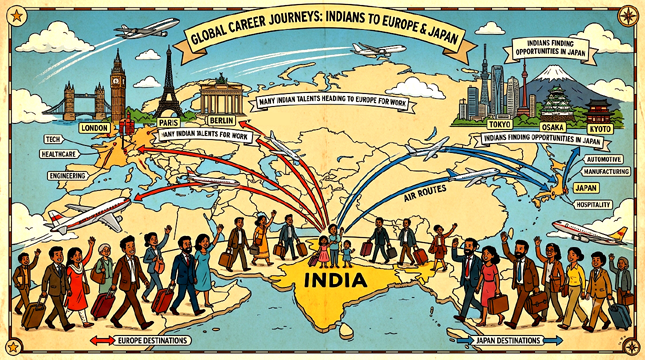
The international movement of Indian talent is undergoing a transformation that goes far beyond the familiar story of software engineers flying to the United States, doctors emigrating to Britain or ambitious students pursuing postgraduate degrees in Australia. India is increasingly becoming a source of professionals who can participate in the planning, management, research, technological development and physical operation of some of the world’s most advanced economies. At a time when international trade is being disrupted by geopolitical tensions, businesses are confronting uncertain growth prospects, and governments are struggling with ageing populations and shortages of skilled workers, Indian human capital has acquired a significance that extends well beyond the information technology industry.
The transformation is particularly interesting because the world is not experiencing an uncomplicated economic boom. The International Labour Organization’s World Employment and Social Outlook: May 2025 Update revised its forecast for global employment creation in 2025 downwards by approximately seven million jobs, reflecting weaker economic prospects, geopolitical tensions and disruptions to international trade. Its Employment and Social Trends 2026 report, published in January 2026, subsequently projected a global unemployment rate of 4.9 per cent while warning that job quality, inequality and the wider global jobs gap remained serious concerns. The implication is that the global labour market cannot be understood simply by looking at whether economies are growing or contracting. Particular countries may be experiencing unemployment, underemployment or declining industrial activity while simultaneously struggling to recruit workers with the specific qualifications and practical capabilities their employers require.
India occupies an increasingly consequential position within this contradiction. Its large working-age population, extensive higher-education system, established information technology industry, English-language capabilities and growing range of technical and professional qualifications provide a reservoir of talent from which international employers can recruit. But the story is not merely one of numbers. An engineer who understands manufacturing systems, a nurse trained to international standards, a software architect designing complex digital infrastructure, a financial specialist managing regulatory risks or a researcher developing new materials brings a different kind of value to an overseas employer from a worker recruited simply to fill an undifferentiated vacancy.
This is the distinction that separates the contemporary Indian professional from the stereotype associated with the early years of information technology outsourcing. India is no longer represented abroad exclusively by workers who execute tasks designed elsewhere. Increasingly, Indians are involved in deciding what should be built, how organisations should function, which technologies should be adopted and how complex projects should be managed. That does not mean every Indian migrant occupies a senior position, or that the country has suddenly become the world’s largest exporter of every category of professional talent. It means that the composition, destinations and ambitions of Indian migration are changing in ways that deserve to be recognised.
The developments surrounding the India–European Union negotiations in January 2026, followed by the establishment of a European Legal Gateway Office in New Delhi in February, offer a particularly revealing illustration. Japan’s expanding recruitment framework presents another. Both reflect a wider international reality: advanced economies increasingly need access to workers whose skills they cannot readily produce in sufficient numbers at home. India’s opportunity lies in turning this demand into a durable advantage for its professionals, its businesses and its national economy.
From Y2K body shopping to the export of professional judgement
To understand the magnitude of this change, it is worth returning to the turn of the millennium. The Y2K problem, which arose from the way many computer systems represented calendar years using two digits, created an extraordinary international demand for software specialists capable of modifying and testing legacy systems. Indian technology companies were well positioned to meet that demand. They possessed large pools of technically educated workers, competitive operating costs and the ability to deliver software services across geographical boundaries. For an industry in which a substantial amount of work could be specified, divided into manageable tasks and delivered remotely, India offered an attractive combination of price and technical capability.
The phrase body shopping became associated with a business model in which Indian technology consultancies supplied programmers and other specialists to overseas clients, sometimes placing them at the clients’ own offices for the duration of a project. The model generated employment, foreign exchange and valuable international exposure. It also helped establish professional networks through which subsequent generations of Indians entered the global technology industry. Nevertheless, it could leave Indian workers occupying positions defined by other people, implementing requirements that had already been formulated elsewhere.
That distinction is important, although the Y2K era should not be dismissed as merely cheap labour. Indian software engineers developed considerable technical expertise during this period, and the outsourcing industry subsequently moved into systems integration, product engineering, business consulting, cybersecurity, financial technology and increasingly complex enterprise services. The early model was a foundation, not a dead end.
The contemporary shift is that professional value increasingly depends on judgement, specialisation and the capacity to take responsibility for outcomes. A software engineer working in artificial intelligence may contribute to the architecture of a product rather than simply write code to a specification. A financial analyst may advise on risk management and capital allocation. An industrial engineer may redesign a manufacturing process to reduce energy consumption and improve productivity. A healthcare professional may participate in clinical decision-making within a system governed by demanding national standards.
The World Bank’s analysis of India’s economic prospects has repeatedly emphasised the importance of productivity, human capital, technology adoption and deeper integration into international markets. Its February 2025 report, India: Accelerated Reforms Needed to Speed up Growth and Achieve High-Income Status by 2047, argued that India must expand productive employment, improve workforce participation and develop the capabilities required for a more sophisticated economy. Its October 2026 India Development Update also highlighted India’s technical workforce, globally integrated IT industry and growing digital capabilities as important advantages in the development of artificial intelligence.
These developments help explain why the new Indian professional cannot be defined by nationality alone or by a narrow occupational label. The value of an internationally mobile worker increasingly lies in the combination of formal qualifications, practical experience, cultural adaptability and the ability to learn continuously.
This is also why the expression body shopping is no longer an adequate description of the entire industry. It remains relevant to some staffing arrangements, but it does not capture the diversity of Indian professionals who are now recruited into research teams, engineering departments, hospitals, financial institutions, universities and industrial organisations. Some will become managers; others will remain technical specialists. Some will eventually establish businesses, while others will build careers within multinational companies.
The transformation is not complete. India still faces uneven educational quality, graduate underemployment and substantial differences in access to professional opportunities. Yet the direction of travel is significant. The country is developing a reputation not merely as a place from which employers can purchase labour, but as a source of people capable of contributing knowledge, solving problems and assuming responsibility.
The European Union’s opening: A strategic opportunity, not an automatic visa
The India–European Union agreement announced in January 2026 provides an important illustration of the new environment. On 27 January, Prime Minister Narendra Modi and European Commission President Ursula von der Leyen presided over the conclusion of negotiations on what both sides described as a landmark free trade agreement. The European Commission presented it as a trade zone encompassing approximately two billion people, with the potential to strengthen economic cooperation at a time of geopolitical uncertainty. The negotiations also advanced a broader partnership involving mobility, technology and professional services.
A distinction is necessary, however. The January announcement marked the conclusion of negotiations, not the automatic entry into force of every provision. The European Commission’s published agreement texts explicitly state that legal revision, signature and completion of the parties’ internal procedures remain relevant to the agreement’s binding status. Similarly, the accompanying memorandum on mobility is a cooperation framework, not a blanket entitlement for Indian citizens to enter and work anywhere in the European Union.
That qualification does not diminish the significance of the development. It identifies where its practical value lies: in improving the institutional arrangements through which employers, qualified professionals and educational institutions can find and navigate legitimate opportunities.
The European Legal Gateway Office in India, launched in New Delhi on 18 February 2026, is a particularly important example. According to the European External Action Service, the pilot office is intended to provide Indian students, researchers and ICT professionals with information about mobility routes and the qualifications and skills required across the EU’s 27 member states. It is designed to make the process safer, clearer and better informed.
For an Indian professional, the practical obstacle to an overseas career is not always a shortage of jobs. It can be uncertainty about whether a qualification will be recognised, which visa category applies, whether an employer can sponsor the application, what language proficiency is required or how a family can relocate. A central information facility can help reduce those frictions, even though it cannot replace national immigration authorities or guarantee a successful application.
The economic logic is straightforward. Europe has a substantial base of sophisticated employers, universities and research institutions, but its labour markets do not always produce the skills required by its changing industries. Digitalisation, industrial modernisation, healthcare demand and the transition to lower-carbon energy all require people with specialised expertise.
McKinsey Global Institute’s 2024 report, A New Future of Work: The Race to Deploy AI and Raise Skills in Europe and Beyond, examined how technology, demographic change and economic restructuring are altering occupational demand. Its modelling suggested that demand for healthcare and STEM-related professions could rise by 17 to 30 per cent between 2022 and 2030. The report also warned that automation could reduce demand for certain repetitive and administrative activities. The lesson is that labour demand is changing in composition, rather than simply expanding uniformly across all occupations.
For India, this creates opportunities in engineering, software, research and healthcare, but only where qualifications and experience match the requirements of individual jobs. An Indian engineering degree does not automatically satisfy every European professional standard, and an ICT qualification does not remove the need to comply with immigration law. Doctors, nurses and other regulated professionals may face language examinations, registration procedures and supervised practice requirements.
The advantage of the new framework is therefore not that Europe has thrown open its borders without conditions. It is that the two sides have begun building a more organised architecture for mobility alongside a wider commercial relationship.
That architecture could become particularly valuable as Indian firms expand their European presence. When an Indian company establishes a European subsidiary, provides services to a European client or participates in a cross-border research project, it may need to move employees, contractual service suppliers or independent professionals. The FTA’s services and mobility provisions seek to provide greater predictability for specified categories of temporary professional movement, subject to the applicable conditions.
The resulting opportunity is broader than an individual securing a foreign job. It involves Indian companies becoming participants in international value chains, Indian universities establishing research relationships and Indian professionals building careers in organisations where technical decisions and commercial strategy are developed together.
Reading the opportunity across Europe and Japan
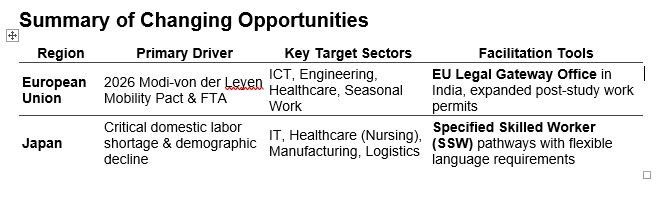
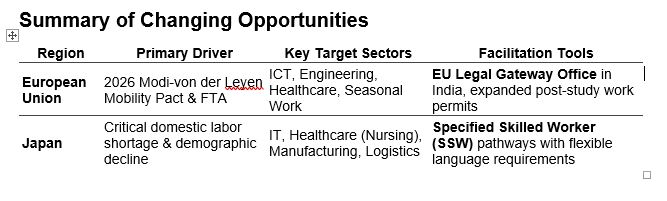
The accompanying summary of changing opportunities captures the central contrast between the European and Japanese approaches. Europe offers a large, diverse market with demand spanning technology, engineering, healthcare and selected seasonal occupations. Japan combines demand for highly specialised professionals with recruitment through occupationally defined programmes intended to address shortages in its domestic workforce.
The table summarises the policy direction. It does not imply automatic visa eligibility, unrestricted migration or guaranteed employment. Actual admission rules and occupational coverage depend on the relevant national programme.
The distinction between the two destinations matters because there is no single Indian professional migration market. Different people possess different qualifications, language capabilities, financial resources and career aspirations. A computer scientist seeking a research position in Germany has different needs from a nurse considering Japan or a manufacturing technician applying for a designated skilled-worker position.
Europe’s scale is an advantage. The EU contains multiple national labour markets, languages, professional licensing systems and industrial specialisations. An applicant may find a suitable role in one country even if another offers few relevant vacancies. But this diversity also creates complexity. A common European information service can explain options, yet the final decision will still depend on the rules and requirements applicable to the chosen destination.
Japan offers a different proposition. Its labour market is shaped by a combination of technological sophistication, industrial expertise and a demographic challenge that has become increasingly difficult to ignore. A country with a shrinking working-age population must consider how to maintain hospitals, factories, transport systems, construction activity and services for older residents. Raising domestic productivity can help, but productivity improvements alone may not eliminate every staffing shortage.
The Organisation for Economic Co-operation and Development’s International Migration Outlook 2025 documents how countries have been changing their migration policies in response to labour-market pressures. It reports that Japan’s Specified Skilled Worker programme has expanded in occupational coverage, while the Japanese government announced a target of 820,000 workers under the programme for 2024–2029, approximately twice the target for its first five years. The OECD also records increases in temporary foreign-worker recruitment outside Japan’s former Technical Intern Training Programme.
These changes are significant because they show that international recruitment is not restricted to elite professional occupations. It also extends to workers whose practical skills are essential to the operation of an advanced economy.
For Indian candidates, that distinction opens several career routes. Some may pursue research and engineering jobs requiring advanced degrees. Others may qualify for nursing care, manufacturing, construction, food services, building cleaning or transport-related occupations where designated programmes permit recruitment. Each route has its own conditions, and some require Japanese-language proficiency and occupational examinations.
It would be misleading to portray every vacancy as a high-paying professional position or to suggest that Japan’s recruitment programmes automatically provide permanent residence. Their conditions vary, and the Specified Skilled Worker categories have different rules concerning duration, renewal and family accompaniment. Nevertheless, a well-regulated pathway can offer a more structured alternative to informal recruitment or speculative migration.
The two destinations consequently represent complementary opportunities. Europe offers breadth, diverse institutions and a wide range of professional environments. Japan offers a distinctive combination of advanced industrial employment and demographic demand. Together, they demonstrate why Indian talent must be understood as a collection of different capabilities rather than a single export commodity.
Japan’s demographic crisis and India’s opportunity to build lasting careers
Japan’s recruitment strategy is driven by a structural challenge that cannot be resolved through short-term economic stimulus. Its population is ageing, the proportion of elderly citizens is rising, and many employers face difficulty replacing retiring workers. These pressures affect both highly technical industries and the everyday services on which Japanese society depends.
The Indian government has already recognised the strategic value of this relationship. In August 2025, following the India–Japan annual summit, the two countries announced an Action Plan for India–Japan Human Resource Exchange and Cooperation. It set an aspirational target of exchanging more than 500,000 personnel in both directions over five years, including 50,000 skilled personnel and potential talents moving from India to Japan.
This is an important development because it places professional mobility within a wider bilateral relationship. India’s engagement with Japan is not simply about supplying workers to Japanese companies. It encompasses educational exchanges, technical cooperation, cultural familiarity and the development of professional networks that can endure beyond an individual employment contract.
The Specified Skilled Worker programme is central to this opportunity. Japan established the system in 2019 to recruit foreign nationals with relevant skills in designated sectors. Its coverage has expanded over time, while the Japanese government has continued to develop information services and testing arrangements for prospective applicants. The official programme portal provides guidance on occupational eligibility, examinations, employment contracts and the steps involved in obtaining the necessary residence status.
For India, the challenge is to prepare candidates before they arrive in Japan. Language education is particularly important. A worker may be technically competent yet struggle to function effectively if unable to understand workplace instructions, communicate with colleagues or navigate everyday life. Healthcare and nursing care demand especially careful preparation because communication can affect the quality and safety of patient care.
Vocational institutions, employers and recruitment agencies therefore have a shared responsibility. Training should be linked to genuine vacancies, the relevant occupational examination and the actual conditions of employment. Candidates should receive accurate information about wages, accommodation, working hours, deductions and the possibility of changing employers under the applicable rules. Transparent recruitment is essential to prevent the costs of migration from becoming an excessive burden on workers.
There is also a strategic opportunity for Indian educational institutions. Rather than treating Japanese-language instruction and technical training as separate activities, they can develop integrated programmes for manufacturing, nursing care, industrial maintenance, hospitality and other eligible fields. Employers in Japan could contribute to curricula, practical training and assessment, while Indian institutions provide the foundation in technical skills and general education.
Such cooperation would benefit both countries. Japan could improve the availability of workers in sectors facing shortages, while Indian candidates could obtain internationally relevant experience and income. Some may eventually return to India with new expertise, supervisory experience and professional contacts. Others may establish long-term careers in Japan, depending on their eligibility and personal circumstances.
The important point is that successful migration requires more than a visa. It requires a reliable connection between education, employer demand, workplace integration and the rights of the worker. If that connection is designed properly, labour mobility can become a mechanism for transferring knowledge and building capabilities, rather than merely filling vacancies.
The global competition for Indian talent
The European and Japanese examples are part of a wider competition among economies seeking workers who can help them adapt to technological change and demographic pressure. Governments increasingly recognise that access to skills affects industrial competitiveness, the delivery of public services and the capacity to develop new technologies.
Consulting firm research helps explain the urgency. McKinsey Global Institute’s work on labour shortages and demographic change has argued that ageing populations, declining fertility and tighter labour markets could constrain growth across advanced economies. Its June 2024 analysis, Help Wanted: Charting the Challenge of Tight Labor Markets in Advanced Economies, estimated that economic output in the advanced economies examined could have been between 0.5 and 1.5 per cent higher in 2023 if employers had been able to fill excess vacancies.
The finding illustrates an important economic principle: a job vacancy is not merely an inconvenience for an employer. When the missing worker possesses a skill essential to production, research or service delivery, the vacancy can prevent an organisation from generating output that would otherwise be possible.
The same problem is visible in Europe’s technology sector. McKinsey’s more recent research on European workforce skills found that employers increasingly regard shortages of relevant capabilities as obstacles to business transformation. Technological change is altering the skills required in existing jobs, while organisations are struggling to train and recruit quickly enough to meet emerging needs.
India’s opportunity is to connect its expanding professional capabilities to these unmet needs. However, the competition is not simply between countries trying to recruit the largest number of Indians. It is also a competition between destinations trying to offer the most attractive combination of remuneration, professional development, personal security, family opportunities and long-term career prospects.
The United States remains a major destination for Indian professionals, but visa restrictions, uncertainty over immigration policy and long waits in some permanent-residency categories can influence individual decisions. Europe and Japan may consequently become more attractive to applicants who are willing to learn new languages, work within different professional cultures or pursue careers outside the traditional Anglo-American destinations.
That does not mean either destination is automatically superior. European professionals may face high housing costs, complicated recognition procedures and linguistic barriers. Japan offers employment opportunities but demands cultural adaptation and, in many occupations, meaningful Japanese-language competence. Salaries also need to be compared after accounting for taxes, living costs, working hours and social benefits.
The strongest candidates will make decisions based on the actual quality of the opportunity rather than the publicity surrounding a bilateral agreement. Governments can create pathways, but individual employers must offer credible jobs, and applicants must possess the skills those employers require.
There is also a geopolitical dimension. Trade agreements and labour mobility frameworks strengthen relationships by creating practical connections between economies. A software engineer working in Europe, a researcher collaborating with a Japanese university or an Indian nurse serving in an overseas healthcare system can become part of a durable professional network. These networks may support future investment, research partnerships and commercial relationships.
For India, the strategic objective should therefore be to diversify professional destinations without becoming dependent on any single country or industry. A wider network of opportunities would reduce exposure to abrupt policy changes in an individual destination while giving Indian professionals greater choice over their careers.
What India must do to turn mobility into national advantage
India cannot rely on its population size alone to sustain this opportunity. A large workforce becomes an economic advantage only when education, training and employment are aligned with productive demand. The World Bank’s February 2025 assessment of India’s long-term development prospects stressed the importance of stronger productivity, higher labour-force participation and the creation of more and better jobs. It also identified human-capital investment and integration into global markets as essential to the ambition of reaching high-income status by 2047.
That means reforming the domestic skills pipeline. Universities need stronger connections with employers, more opportunities for applied research and curricula that respond to changing technologies. Vocational institutions must deliver practical competence rather than certificates alone. Professional qualifications should be transparent, verifiable and, where possible, mapped to international standards.
India must also broaden access to these opportunities. International careers should not remain the preserve of graduates from a handful of prestigious institutions or people who can afford expensive private training. Students from smaller cities and less affluent families need access to reliable information, language instruction, scholarships and legitimate recruitment channels. Women, too, must be able to pursue international careers without facing unnecessary barriers to education, employment or safe migration.
The government can help by coordinating qualification frameworks, negotiating appropriate social-security arrangements and strengthening protections against fraudulent recruitment. The EU–India mobility framework’s emphasis on cooperation is useful, but the real test will be how effectively candidates can navigate actual job offers, qualification recognition and national immigration procedures.
Private companies also have a responsibility. Indian employers should view international assignments as opportunities to develop expertise rather than merely as ways to retain or temporarily deploy staff. Businesses can establish partnerships with European and Japanese counterparts, support employee training and create routes through which experience gained abroad contributes to innovation at home.
At the same time, India must avoid a simplistic celebration of every departure. When skilled doctors, nurses, engineers or researchers leave, their migration can benefit individuals and destination countries while creating shortages in India’s own institutions. This is particularly important in healthcare and education. The answer is not to restrict legitimate professional mobility, but to expand domestic training capacity, improve working conditions and make it attractive for skilled Indians to build careers at home as well.
Remittances are valuable, but they should not be the only measure of success. More important over the long term are the transfer of knowledge, professional networks, research collaboration, investment and the return of experienced workers who can strengthen Indian organisations. Circular migration, in which professionals move between countries at different stages of their careers, can be particularly beneficial when both destinations support the process.
The central lesson is that an effective talent strategy must serve the migrant, the destination country and India itself. If it does not, the apparent success of rising migration figures may conceal deeper problems of exploitation, unequal access or domestic skill shortages.
From exporting labour to shaping the global economy
The headline claim that India has become the world’s top exporter of professional talent should be understood as a description of an expanding strategic role, rather than a definitive statistical ranking across every category of skilled migration. International migration statistics distinguish between temporary workers, permanent migrants, international students, intra-company transfers and people employed in professional services. These categories cannot simply be added together to produce a single league table.
Nevertheless, the evidence points to a significant change in India’s position. The OECD’s International Migration Outlook 2025 identifies India as the leading country of origin for new migrants to OECD countries since 2020, excluding the effects of the Ukrainian crisis. It reports that approximately 600,000 Indian citizens moved to OECD countries in 2023. That figure covers migration more broadly and should not be confused with a count of professional workers alone, but it demonstrates the scale of India’s participation in international mobility.
The more consequential development is the diversification of destinations and occupations. Indian professionals can now pursue opportunities across a wider range of technological, scientific, industrial and service-sector environments. The European Union’s trade and mobility initiatives and Japan’s skilled-worker framework reflect different responses to the same underlying reality: economies need people whose capabilities match their changing requirements.
The Y2K generation helped establish India’s reputation for technical competence and reliable service delivery. Subsequent generations built global technology companies, research teams and professional networks. The next stage is to ensure that Indian talent is recognised not merely for its availability or cost, but for its contribution to innovation, productivity and institutional capability.
That transition will depend on the quality of India’s education system, the credibility of its qualifications, the strength of its domestic employment market and the ability of its professionals to adapt to different societies. It will also depend on whether destination countries create fair, transparent and workable routes for recruitment and integration.
Narendra Modi’s government’s trade diplomacy has helped place mobility alongside commerce in India’s relationships with major economic blocs. The January 2026 India–EU milestone and the ongoing India–Japan cooperation framework provide opportunities to build on that approach. But agreements are starting points, not substitutes for implementation. The decisive work lies in matching candidates to real jobs, protecting workers, recognising qualifications and ensuring that migration produces durable gains.
In a world marked by economic uncertainty, India possesses a valuable asset: a large and increasingly diverse pool of people capable of contributing to industries that require specialised knowledge and practical skill. Its challenge is to convert that potential into sustained professional achievement.
The old image of India supplying programmers at wholesale rates is no longer sufficient to describe the country’s place in the global economy. The more compelling picture is of Indian professionals participating in decisions, research, engineering, healthcare, management and industrial production across continents.
India’s greatest achievement will not be that more of its citizens work abroad. It will be that the world increasingly seeks Indian expertise, that Indian professionals have a genuine choice about where to build their careers, and that the knowledge they acquire strengthens India’s own economic and technological future.