
Public concern intensified because similar patterns appeared across multiple locations. While the circumstances differed from one area to another, recurring themes emerged. These included failures of information sharing between agencies, inadequate police investigations, insufficient support for victims and weaknesses in safeguarding systems
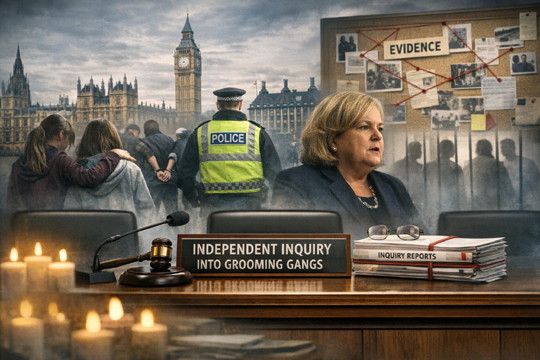
The issue of grooming gangs and child sexual exploitation has become one of the most sensitive and controversial public policy challenges in the United Kingdom. Over the past two decades, a series of criminal investigations, local reviews, media reports and national inquiries have exposed the horrific abuse suffered by thousands of children and vulnerable young people across different parts of England. These revelations have prompted questions not only about the actions of perpetrators but also about the response of public authorities, including local councils, police forces, social services, health agencies and central government.
The publication of the House of Commons Library briefing on the Independent Inquiry into Grooming Gangs marked another important chapter in a long-running national debate. The briefing explains how concerns about child sexual exploitation evolved from local scandals into a matter of national political significance, eventually leading to the establishment of a new statutory inquiry in 2026. The report also highlights the findings of earlier investigations, the recommendations made by experts and survivors, and the political disagreements that emerged regarding how best to uncover the truth and prevent future failures.
The origins of the controversy lie in repeated discoveries that groups of offenders had systematically targeted vulnerable children, often over many years. Victims were subjected to sexual abuse, violence, coercion, intimidation and exploitation. In many cases, evidence later showed that warning signs had been missed or ignored by institutions responsible for protecting children. Some victims reported that they were not believed when they disclosed abuse. Others said that authorities viewed them as troublesome teenagers rather than children in need of protection.
Public concern intensified because similar patterns appeared across multiple locations. While the circumstances differed from one area to another, recurring themes emerged. These included failures of information sharing between agencies, inadequate police investigations, insufficient support for victims and weaknesses in safeguarding systems. The resulting scandals damaged public trust and generated demands for accountability.
Over time, the debate expanded beyond criminal justice. Questions were raised about institutional culture, political leadership, resource constraints and the willingness of public bodies to confront difficult issues. Some commentators argued that authorities had been reluctant to investigate certain forms of exploitation because of concerns about community relations or accusations of racism. Others warned against simplistic explanations and stressed that child sexual abuse occurs across all ethnic, religious and social groups.
Against this backdrop, successive governments commissioned reviews, inquiries and investigations. The most significant of these was the Independent Inquiry into Child Sexual Abuse, which examined institutional responses to child sexual abuse across England and Wales. However, despite extensive work undertaken by previous inquiries, pressure continued to grow for a dedicated examination of grooming gangs specifically. Survivors, campaigners, politicians and sections of the media argued that unresolved questions remained about the scale of offending and the nature of institutional failures.
The House of Commons briefing describes how these concerns culminated in the decision to establish a new statutory inquiry. The document does not seek to reach conclusions about guilt or responsibility. Instead, it provides a factual account of the policy developments, reviews and political decisions that led to the inquiry’s creation. In doing so, it offers insight into one of the most contentious and emotionally charged issues facing modern Britain.
The legacy of earlier investigations and inquiries
Long before the announcement of the 2026 inquiry, concerns about child sexual exploitation had already been the subject of extensive examination. A number of local and national investigations uncovered serious failures by institutions responsible for safeguarding children. These investigations revealed not only the suffering experienced by victims but also weaknesses in the systems designed to protect them.
One of the most influential developments was the establishment of the Independent Inquiry into Child Sexual Abuse, commonly known as IICSA. Created in 2015, the inquiry was tasked with examining whether institutions had failed to protect children from sexual abuse. Its work covered a wide range of settings, including schools, religious organisations, local authorities and other public bodies.
IICSA conducted multiple investigations and heard evidence from thousands of survivors and witnesses. Its final report, published in 2022, concluded that child sexual abuse had been widespread and that institutions had too often prioritised their own reputations over the welfare of children. The inquiry made a series of recommendations aimed at strengthening safeguarding arrangements, improving victim support and enhancing accountability.
Alongside IICSA, several local reviews examined specific cases of grooming gang activity. Reports from areas such as Rotherham, Rochdale, Telford and other locations identified significant shortcomings in the response of local agencies. Victims frequently described experiences of being dismissed, blamed or ignored when they sought help. In some cases, authorities possessed information that could have prompted earlier intervention but failed to act effectively.
These investigations contributed to a growing recognition that child sexual exploitation required a coordinated response involving multiple agencies. They also highlighted the complexity of identifying and preventing abuse. Grooming often involves manipulation, coercion and psychological control, making it difficult for victims to disclose their experiences and for authorities to gather evidence.
The findings generated intense public debate. Some commentators focused on the failures of institutions to protect vulnerable children. Others emphasised questions regarding offender profiles and whether cultural factors had influenced offending patterns in certain areas. The discussion frequently became politically charged, reflecting broader tensions surrounding immigration, integration and community relations.
Despite the extensive work already undertaken, many campaigners argued that existing inquiries had not fully addressed concerns relating specifically to organised grooming gangs. They believed that important questions remained unanswered regarding the extent of offending, the consistency of institutional responses and the reasons why safeguarding failures had persisted over many years.
As a result, calls for a dedicated inquiry continued even after IICSA completed its work. Supporters of a new investigation argued that a focused examination could provide greater clarity and ensure that lessons were learned. Critics questioned whether another inquiry would add substantially to the evidence already available, suggesting that implementation of existing recommendations should be prioritised instead.
These differing perspectives shaped the political debate that unfolded during the following years. The challenge facing policymakers was how to balance demands for further investigation with the need to act on the findings of previous reports. The eventual decision to commission additional work reflected a belief that public confidence required a renewed effort to establish the facts and address unresolved concerns.
Baroness Casey’s audit and the renewed political debate
A major turning point came with the commissioning of a national audit led by Baroness Louise Casey. Her review was intended to examine the nature and scale of group-based child sexual exploitation and assess how effectively public authorities were responding to the problem. The audit emerged in response to persistent concerns that previous investigations had not provided a sufficiently comprehensive national picture.
Baroness Casey had previously gained a reputation for conducting hard-hitting reviews into complex social and institutional issues. Her involvement therefore attracted significant attention from politicians, journalists and advocacy groups. Expectations were high that the audit would offer an independent assessment capable of informing future policy decisions.
The audit examined evidence from a range of sources, including police data, safeguarding information and previous investigations. It sought to identify patterns of offending while also exploring the effectiveness of institutional responses. Importantly, it addressed the controversial issue of ethnicity and offender characteristics, an area that had generated intense public debate.
The publication of the audit reignited discussion about grooming gangs across the political spectrum. Supporters argued that it provided further evidence of serious institutional shortcomings and demonstrated the need for a dedicated inquiry. They pointed to findings suggesting weaknesses in data collection, inconsistencies in safeguarding practices and ongoing concerns about accountability.
The audit also highlighted problems associated with the quality and availability of information. In many cases, incomplete data made it difficult to draw definitive conclusions regarding offender demographics or national trends. This lack of reliable information contributed to disagreement among commentators about the extent to which particular patterns could be identified.
Political reactions reflected broader divisions regarding how the issue should be addressed. Some politicians argued that previous governments had failed to confront uncomfortable truths and that a new inquiry was necessary to restore public confidence. Others maintained that extensive evidence already existed and that resources should be directed towards implementing recommendations rather than conducting further investigations.
The debate was intensified by media coverage and public commentary. Survivors and campaign groups continued to press for greater recognition of their experiences, while policymakers faced growing pressure to demonstrate that lessons had been learned. Questions about transparency, accountability and institutional culture remained central to the discussion.
Ultimately, the audit played a significant role in shaping government policy. By drawing together evidence from different sources and identifying continuing concerns, it strengthened arguments for a new statutory inquiry. The government concluded that further examination was necessary to ensure that unresolved issues were addressed comprehensively and independently.
The significance of the audit extended beyond its specific findings. It illustrated the enduring difficulty of responding to child sexual exploitation in a way that commands public confidence while remaining grounded in evidence. The challenge was not merely to identify failures but also to create a framework capable of delivering accountability and reform.
Establishment of the independent inquiry into Muslim Grooming Gangs
The decision to establish the Independent Inquiry into Grooming Gangs represented the culmination of years of campaigning, political debate and public concern. According to the parliamentary briefing, the inquiry was established under statutory powers, giving it authority to compel evidence and require witnesses to cooperate.
The inquiry’s creation reflected recognition that child sexual exploitation remains an issue of exceptional public importance. By granting statutory status, the government signalled its intention that the investigation should operate independently and possess the powers necessary to examine institutional conduct thoroughly.
The terms of reference are designed to explore a range of interconnected issues. These include the nature and prevalence of organised child sexual exploitation, the effectiveness of safeguarding arrangements, the response of public authorities and the experiences of victims and survivors. The inquiry is expected to examine both historical and contemporary evidence in order to identify lessons for the future.
A central objective is to determine whether institutions responded appropriately when concerns were raised. This involves assessing the actions of police forces, local authorities, social services and other agencies involved in child protection. Particular attention is likely to be paid to decision-making processes, information sharing and accountability mechanisms.
The inquiry also aims to ensure that survivors remain at the centre of the process. Previous investigations demonstrated that victims often felt excluded from official proceedings or insufficiently supported when recounting traumatic experiences. Ensuring meaningful participation is therefore regarded as essential to the inquiry’s credibility and effectiveness.
Supporters of the inquiry argue that it provides an opportunity to establish a clearer understanding of what happened, why failures occurred and how similar abuses can be prevented in future. They believe that only a comprehensive and independent examination can deliver the level of scrutiny required.
However, the inquiry also faces significant challenges. Child sexual exploitation is a complex phenomenon involving multiple agencies, different forms of offending and varying local circumstances. Establishing clear causal explanations for institutional failures may therefore prove difficult. The inquiry must also navigate politically sensitive issues while maintaining public confidence in its impartiality.
Another challenge concerns expectations. Public inquiries often generate hopes that they will provide definitive answers to longstanding questions. In practice, inquiries can identify patterns, evaluate evidence and make recommendations, but they may not resolve every controversy. Managing expectations while conducting rigorous investigation will be an important task.
The parliamentary briefing emphasises that the inquiry forms part of a broader effort to strengthen child protection and safeguarding systems. Its ultimate significance will depend not only on the findings it produces but also on whether governments, public bodies and institutions act upon its recommendations. History has shown that identifying failures is only the first step; meaningful reform requires sustained commitment over many years.
The establishment of the Independent Inquiry into Grooming Gangs therefore marks both an ending and a beginning. It represents the culmination of decades of concern regarding child sexual exploitation and institutional accountability. At the same time, it opens a new phase in the search for understanding, justice and reform. Whether it succeeds in rebuilding public confidence and improving protection for vulnerable children will depend on the quality of its work and the willingness of institutions to confront difficult truths. The inquiry’s progress will be watched closely by survivors, policymakers and the wider public, all of whom share a common interest in ensuring that the mistakes of the past are not repeated in the future.