
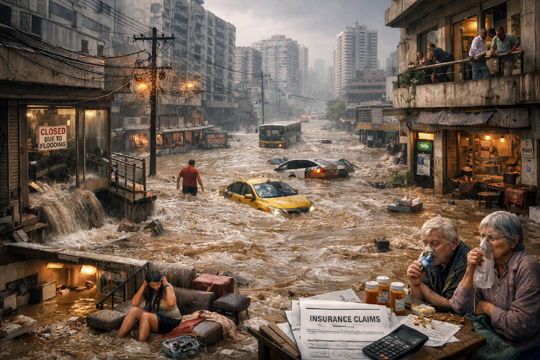
Streets become rivers after just a few hours of rainfall. Basements fill with water. Ground floors become uninhabitable. Electricity networks fail. Transportation systems collapse. Businesses lose revenue. Families suffer property damage and health risks. Insurance claims rise. Flats in a city without green belts, forests and water bodies leads to lifestyle diseases
The relentless construction of flats, housing colonies, shopping complexes, and commercial buildings on water bodies, wetlands, riverbanks, floodplains, and green belts is creating a disaster that manifests every monsoon season in the form of urban flooding and lifestyle diseases after monsoons. Many city planners, environmentalists, and residents are beginning to recognize this with increasing alarm
The problem is neither accidental nor entirely natural. Flooding in Indian cities is increasingly man-made. Every year, heavy rainfall is blamed for submerged roads, stranded vehicles, flooded homes, damaged infrastructure, and disrupted economic activity. However, rainfall itself is rarely the sole culprit. Rain has always been a part of India’s climatic reality. What has changed is the urban ecosystem’s ability to absorb, store, and safely channel water. Natural drainage systems that evolved over centuries are being replaced by concrete surfaces incapable of absorbing rainfall. Lakes are being filled to create residential projects. Wetlands are being converted into premium real estate. Green belts are disappearing under parking lots and apartment complexes.
The consequences are visible across the country. Streets become rivers after just a few hours of rainfall. Basements fill with water. Ground floors become uninhabitable. Electricity networks fail. Transportation systems collapse. Businesses lose revenue. Families suffer property damage and health risks. Insurance claims rise. Municipal authorities scramble to pump water out of flooded neighborhoods while residents wonder why cities are becoming increasingly vulnerable despite advances in engineering and technology.
The answer lies in the destruction of nature’s infrastructure. Water bodies and green spaces are not empty land waiting to be developed. They are critical components of an urban ecosystem designed by nature to manage water. Lakes, wetlands, marshes, ponds, river floodplains, parks, forests, and green belts function as giant sponges. They absorb rainfall, slow runoff, recharge groundwater, and provide temporary storage during intense storms. Once these natural systems are replaced by concrete, water loses its place to go.
Urban flooding is therefore not simply a drainage issue. It is an urban planning issue, a governance issue, an environmental issue, and increasingly, a housing issue. The irony is striking. Housing projects intended to provide shelter are often built in ways that make those very homes vulnerable to flooding. The pursuit of rapid real estate growth is undermining the safety, sustainability, and livability of cities.
India now stands at a crossroads. The demand for housing continues to grow as urbanization accelerates. Millions aspire to own homes and improve their quality of life. Yet if housing development continues to consume lakes, wetlands, and green belts, cities may become increasingly uninhabitable. The challenge is not whether homes should be built, but where and how they should be built.
Why water bodies matter more than we think
For generations, lakes, ponds, wetlands, and floodplains were viewed as valuable assets that supported urban life. These ecosystems performed functions that modern engineering still struggles to replicate efficiently. During periods of heavy rainfall, water bodies served as storage reservoirs, temporarily holding excess water and reducing flood peaks. They also acted as recharge zones, allowing water to seep into the ground and replenish aquifers.
Urban development has disrupted this delicate balance. Across India, countless lakes have either disappeared entirely or shrunk dramatically due to encroachment. Wetlands have been filled with construction debris and converted into housing projects. Floodplains that once accommodated seasonal river overflow now host apartment complexes, shopping malls, and office towers.
When a water body is reclaimed and covered with concrete, its storage capacity disappears. Rainwater that would previously have collected in lakes and wetlands instead flows rapidly across paved surfaces. Stormwater drains, often designed decades ago, become overwhelmed. Water accumulates in low-lying areas, creating flash floods.
Natural water systems operate as interconnected networks. Rainwater falling in one area eventually moves through streams, channels, lakes, and rivers before reaching larger water bodies or the sea. Construction on lakes and wetlands often disrupts these pathways. Buildings block natural channels. Roads alter drainage patterns. Retaining walls restrict water movement.
The result is a phenomenon known as hydrological disconnection. Water can no longer follow its traditional routes. Instead, it accumulates behind obstructions and spills into roads, homes, and commercial areas.
The experience of Hyderabad provides a powerful example. Historically, the city relied on a sophisticated network of interconnected lakes and tanks. These water bodies regulated floods and stored water during dry periods. Rapid urbanization, however, led to extensive encroachments on lake beds and drainage channels. Numerous lakes became isolated from their feeder streams and outlets.
Today, many neighborhoods experience severe flooding even during relatively moderate rainfall. Water that once flowed through natural channels now encounters buildings, roads, and other obstacles. Stormwater systems struggle to compensate for the loss of natural drainage.
The situation is not unique to Hyderabad. Similar patterns are visible in Bengaluru, Chennai, Gurugram, Kolkata, Guwahati, and many smaller cities. Urban flooding increasingly reflects decades of environmental degradation rather than isolated weather events.
Climate change further magnifies the risk. Rainfall is becoming more intense and concentrated. Short-duration storms now deliver larger volumes of water within limited periods. Cities that have lost their natural storage systems are particularly vulnerable to these extreme rainfall events.
The destruction of water bodies therefore represents not merely an environmental loss but a direct threat to urban resilience. Every lake filled, every wetland reclaimed, and every floodplain developed reduces a city’s ability to withstand future storms.
The silent role of green belts in preventing disaster
While water bodies receive some attention in discussions about flooding, green belts often receive far less recognition despite their equally important role. Trees, parks, forests, open fields, and vegetated corridors serve as natural defenses against urban flooding.
Green spaces intercept rainfall before it reaches the ground. Leaves, branches, and vegetation slow the movement of water, reducing the volume that reaches drainage systems at any one time. Soil absorbs and stores significant quantities of rainwater, gradually releasing it into groundwater reserves.
When green belts are replaced by buildings, roads, parking lots, and paved courtyards, this absorption capacity disappears. Impermeable surfaces prevent water from infiltrating the soil. Instead, nearly all rainfall becomes surface runoff.
The difference can be dramatic. In a natural landscape, a substantial portion of rainfall infiltrates the ground. In heavily urbanized areas, runoff may account for nearly all precipitation. Consequently, stormwater systems receive enormous volumes of water in very short periods.
Trees also contribute through evapotranspiration, a process that returns water to the atmosphere. Large urban tree canopies can significantly reduce the amount of water entering drainage systems. Their removal eliminates another critical flood-mitigation mechanism.
Green belts function as buffers that spread and delay stormwater movement. Rather than allowing water to surge immediately into streets and drains, vegetated areas slow its progress. This delay reduces peak flood levels and provides drainage systems with more time to function effectively.
Unfortunately, urban expansion often treats green belts as vacant land available for development. Housing projects, commercial complexes, and infrastructure corridors frequently target these areas because they are relatively open and easy to build upon.
The cumulative effect is profound. Cities lose not only recreational spaces and biodiversity but also essential hydrological functions. As green coverage declines, flooding becomes more frequent and severe.
Urban planners increasingly recognize that green infrastructure is as important as traditional gray infrastructure. Parks, urban forests, bioswales, rain gardens, and vegetated corridors can perform valuable stormwater management functions while simultaneously improving air quality, public health, and quality of life.
Yet many Indian cities continue moving in the opposite direction. Development pressure often outweighs environmental considerations. Short-term economic gains take precedence over long-term resilience.
The consequences become evident every monsoon when neighborhoods built over former green spaces experience chronic waterlogging. Residents who purchased homes expecting modern urban living discover that concrete alone cannot protect them from nature’s response.
Smaller cities, bigger problems
Public attention often focuses on flooding in major metropolitan centers. However, some of the most serious challenges are emerging in India’s smaller cities and towns. These urban centers frequently lack the financial resources, technical expertise, and infrastructure investments available to larger cities.
Many smaller cities rely on drainage systems designed decades ago for much smaller populations. Rapid urban growth has dramatically increased impervious surfaces without corresponding upgrades to stormwater infrastructure. As a result, drainage networks routinely exceed their capacity during rainfall events.
In cities such as Trichy, Nagpur, Guwahati, Vijayawada, Jamshedpur, Nashik, Vadodara, and many others, even moderate rainfall can trigger extensive waterlogging. Roads become impassable. Public transportation is disrupted. Businesses close temporarily. Residents face repeated property damage.
A major contributing factor is inadequate maintenance. Drains clogged with plastic waste, construction debris, sediment, and sewage lose their carrying capacity. Water that should flow freely becomes trapped within urban neighborhoods.
Solid waste management failures play a particularly significant role. Plastic bags, packaging materials, discarded household waste, and construction rubble frequently enter drainage channels. Over time, these materials accumulate and create blockages.
The problem is compounded by irregular desilting operations. Municipal authorities often conduct drain cleaning shortly before the monsoon season. However, removed sediment is sometimes left near drainage channels, where subsequent rainfall washes it back into the system.
This creates a cycle of recurring failure. Funds are spent on maintenance, but poor execution limits effectiveness. Flooding continues despite repeated interventions.
The economic impact is substantial. Waterlogged streets reduce productivity, disrupt commerce, damage vehicles, and increase repair costs. Businesses lose customers. Workers lose income. Municipal budgets face mounting pressure from emergency response and infrastructure repair expenses.
Public health consequences are equally concerning. Floodwaters frequently mix with sewage, exposing residents to waterborne diseases. Mosquito breeding increases, raising the risk of vector-borne illnesses. Contaminated water can affect drinking supplies and sanitation systems.
Smaller cities often receive less national attention than major metropolitan areas, but their vulnerabilities may be greater. As climate change intensifies rainfall patterns, these communities face increasing risks.
Addressing the challenge requires more than larger drains. It demands integrated planning that combines infrastructure upgrades with environmental restoration, waste management improvements, and community participation.
Without such measures, urban flooding will continue to undermine economic development and quality of life across India’s rapidly growing smaller cities.
The Sponge City Solution and the future of urban planning
Around the world, urban planners are increasingly embracing a concept known as the Sponge City framework. Rather than treating rainwater as a problem to be removed as quickly as possible, Sponge Cities seek to mimic natural hydrological processes.
The idea is simple yet transformative. Cities should absorb, store, filter, and gradually release rainwater, much like natural ecosystems do.
Sponge City strategies include preserving wetlands, restoring lakes, protecting floodplains, creating permeable pavements, expanding urban forests, constructing rain gardens, and integrating green roofs into building design. Together, these measures reduce runoff, enhance groundwater recharge, and improve resilience to flooding.
Unlike conventional drainage systems that rely primarily on pipes and channels, Sponge Cities combine gray infrastructure with green infrastructure. This integrated approach recognizes that nature can perform many stormwater management functions more effectively and sustainably than engineered systems alone.
China has implemented Sponge City initiatives in numerous urban areas, providing valuable lessons for other rapidly urbanizing nations. While implementation challenges remain, the framework demonstrates how cities can adapt to increasing rainfall variability while enhancing environmental quality.
India possesses enormous potential to adopt similar approaches. Many traditional water-management systems already embody Sponge City principles. Historic tanks, stepwells, lakes, canals, and green corridors once formed sophisticated urban water networks.
Reviving and modernizing these systems could significantly improve flood resilience. Protecting remaining water bodies, restoring degraded wetlands, reconnecting drainage channels, and expanding urban green spaces would help cities manage rainfall more effectively.
Policy reforms are equally important. Environmental regulations governing wetlands, floodplains, and green belts require stronger enforcement. Urban planning processes must incorporate hydrological assessments before approving major developments.
Developers should be encouraged or required to integrate sustainable drainage systems into housing projects. Permeable pavements, rainwater harvesting systems, retention ponds, and green roofs can reduce runoff and improve water management.
Community participation also plays a crucial role. Residents can help prevent drain blockages through responsible waste disposal and support conservation efforts that protect local water bodies.
The challenge is not merely technical. It involves changing how cities perceive land. Wetlands, lakes, and green belts should no longer be viewed as undeveloped spaces awaiting construction. They must be recognized as critical infrastructure essential for urban survival.
As climate risks increase, cities that invest in ecological resilience will be better positioned to protect residents, maintain economic activity, and sustain growth.
Housing affordability versus urban sustainability
The housing crisis presents a complex dilemma. India needs millions of additional homes to accommodate a growing urban population. Rising land prices, construction costs, and inflation have already made home ownership increasingly difficult for lower- and middle-income families.
Industry leaders have expressed concern about the declining availability of affordable housing. Rising costs are pushing many households out of the ownership market despite strong demand.
At first glance, the solution may appear straightforward: build more housing. Yet the location and design of that housing matter profoundly.
If affordable housing is achieved by sacrificing wetlands, lakes, floodplains, and green belts, the long-term consequences may outweigh short-term benefits. Homes constructed in environmentally sensitive areas often face greater flood risks, higher maintenance costs, and declining livability.
Residents may save money initially but pay a far higher price through repeated flooding, infrastructure failures, insurance costs, and property damage.
The future of housing must therefore balance affordability with sustainability. This requires a shift away from environmentally destructive development patterns toward smarter urban growth.
Higher-density development within existing urban footprints can reduce pressure on greenfield sites. Transit-oriented development can improve land-use efficiency. Mixed-use neighborhoods can reduce infrastructure demands. Brownfield redevelopment can transform underutilized urban land without consuming environmentally valuable areas.
Rental housing also deserves greater attention. A robust rental market can provide affordable accommodation without requiring every household to purchase property immediately. This flexibility may reduce pressure for continuous outward expansion.
Government policy has an important role to play. Incentives for sustainable development, stricter environmental protections, and investments in urban infrastructure can help align housing goals with ecological objectives.
Ultimately, the question facing India is not whether cities should grow. Growth is inevitable. The question is whether growth will occur intelligently or recklessly.
The evidence from flooded neighborhoods across the country offers a clear warning. Building over lakes, wetlands, floodplains, and green belts may generate short-term profits and increase housing supply, but it simultaneously erodes the natural systems that make urban life possible. Every reclaimed lake, every destroyed wetland, and every vanished green belt reduces a city’s capacity to cope with rainfall, climate change, and future growth.
The dream of home ownership remains central to India’s aspirations. Yet a home surrounded by chronic flooding, failing infrastructure, and environmental degradation is not truly secure. Sustainable housing requires sustainable cities. Protecting nature is not an obstacle to development; it is a prerequisite for development that endures.
India’s urban future depends on recognizing this fundamental truth before the next flood makes the lesson even more expensive.

