By tracing FIFA’s trajectory from the fascist spectacles of the 1930s, through the ideological proxy battles of the Cold War, to the sophisticated “sports-washing” campaigns of the twenty-first century, we can see that the current logistical and diplomatic crises are the logical culmination of a century-long entanglement between football and global statecraft
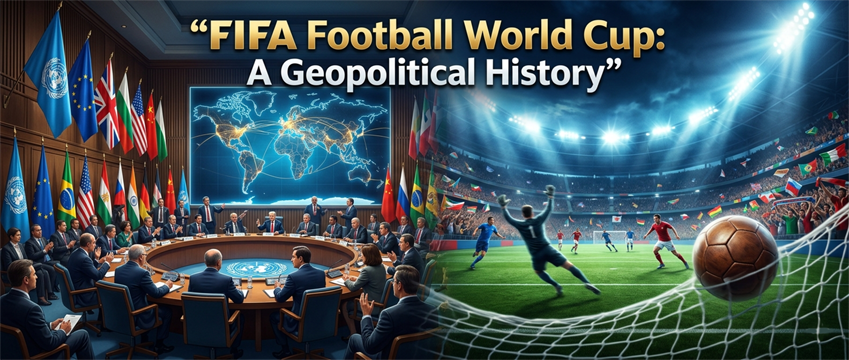
The FIFA World Cup has long branding itself as the ultimate celebration of global unity—a quadrennial festival where geopolitical animosities are momentarily suspended, and nations compete solely through the medium of sport. According to the governing body’s idealized narrative, the pitch is a sanctuary of neutrality. Yet, historical reality consistently shatters this utopian illusion. Instead of a refuge from global friction, the World Cup operates as a highly visible microcosm of international relations, structural inequalities, and state-sponsored propaganda.
From its foundational years in the shadow of mid-twentieth-century totalitarianism to the hyper-digitized, security-state apparatus of the current 2026 tournament across North America, the World Cup has served as an alternative battlefield. Governments routinely exploit the tournament to validate authoritarian regimes, project soft power, or execute subtle diplomatic warfare. Conversely, the strict border controls, diplomatic standoffs, and entry policies of host nations frequently weaponize administrative infrastructure, transforming visa procedures into instruments of political exclusion and intimidation.
As the 2026 tournament unfolds across its North American host territories, and has collided violently with the realities of modern immigration enforcement, national security paranoia, and deep-seated geopolitical rivalries. Over a mere 48-hour window, series of administrative crises, border detentions, and selective visa denials have targeted players, referees, and supporters, primarily from the Global South.
To understand this systemic friction, one must analyze the deep historical lineage of political interference that has defined the World Cup since its inception. By tracing this trajectory from the fascist spectacles of the 1930s, through the ideological proxy battles of the Cold War, to the sophisticated “sports-washing” campaigns of the twenty-first century, we can see that the current logistical and diplomatic crises are the logical culmination of a century-long entanglement between football and global statecraft.
The 2026 border crisis: Administrative warfare on the pitch
The recent forty-eight hours of the 2026 World Cup have completely unmasked the fiction of global sports neutrality, replacing it with a sobering demonstration of state sovereignty and border enforcement. Across the host venues, international squads and delegation members have faced an unprecedented wave of bureaucratic hostility, lengthy detentions, and outright exclusions, casting a shadow over the tournament’s integrity. These disruptions have disproportionately targeted specific nationalities, laying bare the underlying geopolitical fault lines that dictate contemporary international relations. Far from providing a smooth, welcoming environment for the world’s elite athletes, the administrative apparatus of the United States has instead erected formidable barriers, transforming entry procedures into a harrowing gauntlet for teams from Africa, the Middle East, and Central Asia.
The administrative disruptions began to surface prominently with the treatment of high-profile European and Middle Eastern competitors. Swiss international footballer Breel Embolo found his visa status abruptly placed under review by immigration authorities, an administrative hurdle that marooned him away from his squad during crucial final preparation phases. While Embolo was eventually permitted to cross the border and join his national team days later, the arbitrary delay disrupted his team’s training cohesion and underscored the unpredictable nature of the host nation’s border enforcement.
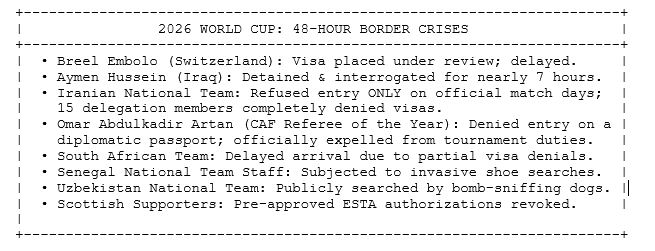
Far more severe was the ordeal endured by Iraqi national team striker Aymen Hussein. Upon arriving at a major United States port of entry, Hussein was pulled aside by border agents and held for questioning for nearly seven hours. This prolonged isolation and interrogation of a prominent international athlete, without clear public justification, sent shockwaves through the Iraqi delegation and drew sharp criticism from international observers who viewed the detention as a heavy-handed exercise in profiling.
Simultaneously, the geopolitical animosity between Washington and Tehran manifested directly within the tournament’s logistical framework. The Iranian national team spent days trapped in grueling diplomatic limbo, navigating complex visa procedures at the United States Consulate in Türkiye. The administrative resolution offered by the host nation was deliberately restrictive: The United States government permitted the Iranian squad entry into the country only on scheduled match days, functionally evicting them from standard training base camps between fixtures.
Furthermore, fifteen essential members of the official Iranian delegation—including coaching staff, medical personnel, and technical administrators—were flatly denied visas. This systemic gutting of Iran’s support staff severely compromised the squad’s operational capacity, provoking a fierce diplomatic response from the Football Federation Islamic Republic of Iran (FFRI). The situation deteriorated further when Iran’s official ticket allocation was abruptly revoked just days before the opening match, prompting the FFRI to issue stern warnings that they would halt matches if hostile political factions raised unauthorized flags or anti-regime slogans inside the stadium bowls.
Profiling, expulsions, and the exclusion of the Global South
The systemic nature of these border restrictions becomes undeniably clear when examining the treatment of African and Central Asian delegations over the same forty-eight-hour window. The most egregious institutional casualty of this border enforcement surge was Omar Abdulkadir Artan, the highly respected sporting official who had been named the Confederation of African Football’s (CAF) Best African Referee of 2025.
Despite traveling with the explicit backing of FIFA and utilizing a diplomatic passport—a document designed to facilitate smooth international transit for official dignitaries—Artan was flatly denied a visa upon arrival. Border enforcement personnel refused him entry and ordered him placed on a return flight, expelling him from the host nation. Faced with this insurmountable bureaucratic wall, FIFA was forced to announce that the premier African referee of the year would be entirely unable to officiate at the tournament, directly compromising the quality and global representation of the tournament’s refereeing corps.
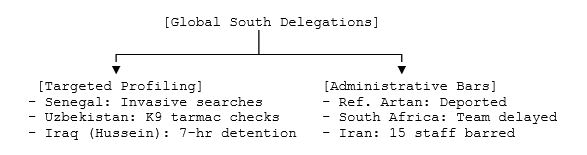
Other African delegations experienced similar systemic hostility. The South African national team saw its entire tournament preparation timeline derailed, arriving in the United States significantly later than scheduled because a substantial portion of their delegation failed to receive visa clearances in time.
More concerning still were the tactical security measures deployed against the Senegal national team staff. Upon arrival, members of the Senegalese technical delegation were singled out, forced to remove their shoes, and subjected to highly invasive, prolonged physical searches. This aggressive treatment immediately sparked widespread accusations of racial profiling and institutional bias, with critics pointing out the stark contrast between the treatment of West African support staff and their Western European counterparts.
The Uzbekistan national team faced a similarly humiliating public spectacle. International media outlets widely circulated viral footage showing Uzbek players and trainers being systematically searched on the tarmac using bomb-sniffing dogs, a visual display that commentators blasted as excessively punitive and deeply damaging to the dignity of the visiting nation.
This hostile security environment expanded beyond the athletes and officials to impact international fans, shattering the financial and personal investments of thousands who sought to attend the tournament. In Western Europe, a significant number of Scottish supporters, who reasonably assumed safe passage under the United States’ Electronic System for Travel Authorization (ESTA) visa-waiver program, had their travel clearances abruptly revoked just days before their scheduled flights. No detailed justifications were offered, leaving fans holding non-refundable flights and accommodation bookings.
Concurrently, thousands of football enthusiasts across the Global South, who had already spent significant personal savings purchasing official FIFA match tickets and securing lodging, saw their formal visa applications summarily rejected by consulates. These widespread rejections inflicted devastating financial losses on ordinary fans and ensured that the stadium stands would lack the diverse, authentic global audience that defines the spirit of the World Cup, replacing it instead with a heavily sanitized, demographically restricted crowd.
Mussolini’s shadow: The genesis of Fascist sports-washing
To understand the deeper ideological currents that feed modern tournament disruptions, one must look back to the pre-World War II era, where the template for state interference in football was first forged. The early history of the FIFA World Cup is permanently bound to the rise of European totalitarianism, specifically the Italian fascist regime of Benito Mussolini.
During the second-ever World Cup in 1934, hosted on Italian soil, Mussolini provided the historical blueprint for what modern political scientists term “sports-washing”—the practice of utilizing a high-profile sporting event to clean up an authoritarian state’s international reputation, stoke hyper-nationalism domestically, and project an illusion of internal stability and strength to the rest of the world.
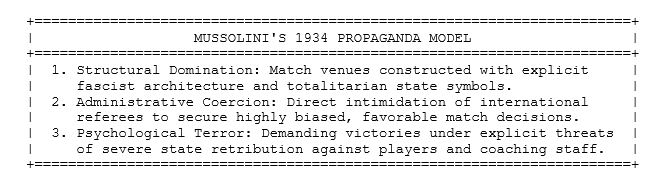
Mussolini viewed the 1934 World Cup not as a sporting contest, but as an aggressive ideological weapon. The Italian state poured immense public resources into constructing monumentalist modernist stadiums adorned with fascist iconography, ensuring that every match took place within a physical environment designed to glorify the state. Mussolini personally oversaw the organizational logistics, micro-managing details to ensure that the Italian national team—the Azzurri—won the tournament at all costs.
The pressure exerted on match officials was intense and documented; several referees delivered deeply compromised, heavily biased decisions in favor of the host nation, visibly cowed by the ominous presence of fascist dignitaries in the VIP boxes. The Italian players themselves operated under a cloud of psychological terror, knowing that failure to secure the trophy would be interpreted as a betrayal of the state, carrying severe personal and professional consequences.
By the time the 1938 World Cup arrived in France, the politicization of the Italian squad had shifted from domestic propaganda to aggressive international defiance. Under the stewardship of coach Vittorio Pozzo, but dictating the explicit ideological whims of Rome, the defending champions transformed every match into a geopolitical statement.
The defining moment of this tournament occurred during a highly charged quarter-final clash against the host nation, France, in Paris. Stepping onto the pitch before a deeply hostile French crowd, the Italian players rejected their traditional blue jerseys in favor of custom-made, completely black uniforms—the explicit color and symbol of the notorious fascist paramilitary volunteer units, the Blackshirts.
Before the opening whistle, the Italian squad lined up and executed the rigid, right-armed fascist salute toward the grandstands, maintaining the posture despite an explosion of boos and whistles from the stadium. This stark demonstration proved that the pitch had been fully co-opted as a platform for totalitarian defiance, a mere year before the outbreak of World War II plunged the globe into total conflict.
The Cold War on grass: German divisions and proxy pitch battles
The collapse of the Axis powers did not sever the ties between international football and global geopolitics; instead, the postwar realignment of global power under the Cold War created a new set of ideological fault lines that ran directly across the football pitch. For nearly five decades, the existential standoff between Western capitalism and Soviet communism converted World Cup matches into highly charged proxy battles.
The physical and psychological division of Europe found its most intense sporting manifestation during the 1974 World Cup, hosted by West Germany. In an extraordinary twist of athletic fate, the random group-stage draw placed the Federal Republic of Germany (West Germany) and the German Democratic Republic (East Germany) into the exact same competitive group, setting up an direct confrontation between two halves of a fractured nation.
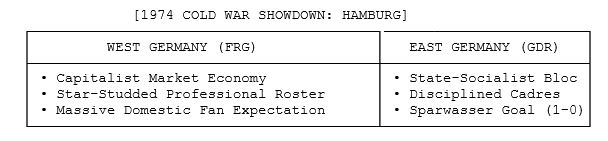
The match, played on June 22, 1974, in Hamburg, carried an immense amount of ideological weight. For both regimes, the fixture was viewed as a referendum on the superiority of their respective social, economic, and political systems. The West German squad, featuring legendary icons like Franz Beckenbauer and Gerd Müller, represented the affluent, capitalistic consumer society of the Western bloc. The East German squad, comprised of rigidly disciplined state-sponsored athletes, represented the collectivist ideological purity of the Soviet sphere.
The match itself defied all conventional sporting predictions. In the 77th minute, East German forward Jürgen Sparwasser latched onto a long pass, drifted past three West German defenders, and fired the ball into the back of the net, securing a stunning 1–0 victory for East Germany.
The result was instantly seized upon by the East German state apparatus as a massive propaganda triumph, held up as definitive proof that socialist discipline could humble Western capitalism. Though both teams ultimately advanced from the group stage—and West Germany would go on to win the tournament title—the match remains a defining historical example of how a ninety-minute football match can capture the anxieties of a global geopolitical standoff.
Twenty years later, as the Cold War drew to a close, the 1998 World Cup in France produced another historic fixture saturated with geopolitical tension: the group-stage match between the United States and the Islamic Republic of Iran. Relations between Washington and Tehran had been completely severed since the 1979 Iranian Revolution and the subsequent embassy hostage crisis, with both states viewing each other through a lens of profound hostility.
When the draw paired them together, international security experts and media commentators braced for potential violence, billing the match as the “mother of all games.” FIFA regulations dictated that team “A” (Iran) should walk towards team “B” (the US) for the pre-match handshakes, but Iranian supreme leadership strictly forbade their players from initiating a march toward the Americans.
To avoid a diplomatic collapse before kickoff, a compromise was brokered where the American players agreed to walk toward the Iranian line instead. What followed shook the hyper-politicized expectations of the media: the Iranian players presented their American counterparts with bouquets of white roses—the traditional Persian symbol of peace—and the two teams rejected protocol to stand intermingled in a single, unified group photograph.
This powerful moment of athletic diplomacy offered a brief, fleeting window of detente, demonstrating that while state structures may remain frozen in hostility, the human actors on the pitch can choose solidarity over state-mandated enmity.
Argentina 1978 and state-sponsored terror
While the 1998 match in France offered a glimpse of sports as a tool for peace, the 1978 World Cup in Argentina serves as a dark reminder of how a sporting event can cloak systemic state violence. Two years prior to the tournament, a brutal military coup d’état overthrew the Argentine government, establishing a military junta led by General Jorge Rafael Videla.
The junta initiated what history records as the “Dirty War”—a campaign of state-sponsored terror designed to eliminate all leftist political dissidents, student activists, union leaders, and intellectuals. Operating with impunity, the military regime arrested, tortured, and murdered thousands of citizens, creating a class of victims known as the Desaparecidos (the Disappeared).
Faced with mounting international condemnation and a damaged economy, General Videla recognized the 1978 World Cup as an invaluable tool to project a false narrative of national peace, unity, and civilian contentment. The junta spent a staggering ten percent of the national budget organizing the tournament, constructing opulent stadiums and modernizing urban infrastructure while concurrently operating secret detention and torture centers just blocks away from the pitches.
The most notorious of these facilities, the Navy Petty Officers School (ESMA), sat less than a mile from the River Plate Stadium in Buenos Aires. As tens of thousands of fans cheered inside the stadium, political prisoners inside ESMA could explicitly hear the roars of the crowd through their cell windows while undergoing brutal interrogation and torture.
The regime’s interference extended deeply into the sporting competition itself, as Videla understood that an Argentine tournament victory was essential to maximize the domestic propaganda value of the event. The most controversial moment occurred during the second group phase, where Argentina needed to defeat a highly capable Peruvian team by a margin of at least four clear goals to leapfrog their rivals, Brazil, and qualify for the final.
The subsequent match ended in a highly suspicious, lopsided 6–0 victory for Argentina. Numerous investigative journalists and historical accounts have since alleged that the junta actively interfered in the fixture, brokering a backroom deal with the Peruvian government that involved shipping thousands of tons of grain and releasing frozen financial assets to Peru in exchange for their players throwing the match.
Argentina advanced to the final, defeating the Netherlands 3–1 in extra time. General Videla personally handed the FIFA World Cup trophy to Argentine captain Daniel Passarella, a chilling historical image that perfectly illustrates the absolute co-optation of global sport by a murderous totalitarian state.
When matches ignite warfare: The 1969 “football war”
The intersections of football and geopolitics are not always limited to states exploiting tournaments for propaganda; occasionally, the competitive friction of qualifying matches can act as the direct catalyst for armed conflict. The most explosive example of this occurred during the qualification cycle for the 1970 World Cup in Mexico, involving the Central American neighbors El Salvador and Honduras.
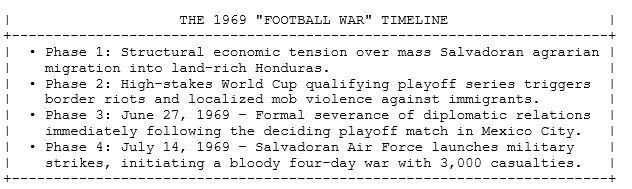
The bilateral relationship between the two nations was already strained to a breaking point by deep structural issues: land scarcity and hyper-population in El Salvador had driven over 300,000 impoverished Salvadoran peasants to migrate into neighboring Honduras, where they settled to work agricultural lands. The Honduran regime, facing domestic economic pressure, enacted land reform laws that stripped these Salvadoran immigrants of their holdings and initiated mass expulsions.
It was within this explosive political environment that the two nations were drawn to face each other in a multi-game playoff series to determine who would qualify for the World Cup. The opening match in Tegucigalpa, Honduras, saw the home side win 1–0, amid intense fan fighting in the stands.
The return match in San Salvador was defined by psychological warfare: Salvadoran fans swarmed the Honduran team’s hotel, keeping the players awake all night by smashing windows and burning effigies, before El Salvador secured a 3–0 victory on a pitch surrounded by armored military vehicles. The psychological terror directed at visiting fans led to widespread retaliatory violence across both countries, with mobs attacking immigrant communities, burning businesses, and forcing thousands of Salvadorans to flee for their lives.
+———————————————————————–The deciding third match was played on neutral ground in Mexico City on June 27, 1969. El Salvador won the hyper-intense fixture 3–2 in extra time to claim the World Cup berth, but the sporting conclusion offered no political resolution. On the exact same day, El Salvador formally severed all diplomatic relations with Honduras, citing the systematic persecution of its citizens.
On July 14, 1969, less than three weeks after the final whistle blew in Mexico City, the Salvadoran Air Force launched a surprise bombing raid against Honduran military bases and civilian targets, initiating an all-out military invasion. The resulting conflict, known historically as the “Football War” or the “100-Hour War,” raged for four days, destroying key infrastructure and leaving over 3,000 people dead—mostly civilians—before the Organization of American States (OAS) successfully brokered a ceasefire.
While the underlying causes of the war were rooted in long-term agrarian and economic disputes, the intense competitive ecosystem of the World Cup qualifiers acted as the psychological accelerant that turned a regional dispute into an armed conflict.
Mass boycotts, blocked paths, and institutional colonialism
While regional conflicts have triggered physical violence, the structural governance of FIFA has frequently provoked institutional warfare, leading to mass boycotts that altered the composition of the tournament. Throughout the mid-twentieth century, the World Cup functioned as an elite, Eurocentric club that systematically marginalized emerging post-colonial nations, particularly across Africa and Asia.
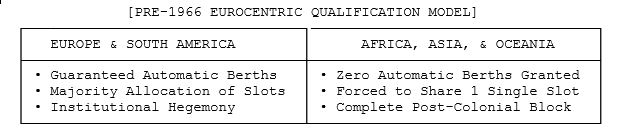
The tipping point for this institutional frustration occurred during the qualification cycle for the 1966 World Cup in England. FIFA’s executive committee, dominated by European and South American football bureaucrats, issued a competitive structure that denied African nations an automatic qualification berth.
Instead, FIFA mandated that the entire continent of Africa would have to compete in a complex, multi-stage playoff system against the winners of the Asian and Oceanian zones just to secure a single, shared spot in the final sixteen-team tournament. This meant that an African team could dominate its entire continent and still be barred from the World Cup without facing a European opponent.
The decision was widely condemned by leaders across the continent as an act of sporting colonialism, designed to protect traditional football powers from the unpredictable challenges of newly independent nations.
Led by Kwame Nkrumah’s Ghana and championed by the Confederation of African Football (CAF), fifteen African nations chose solidarity over participation, launching a historic, unanimous boycott of the 1966 World Cup. They flatly refused to take the pitch for the qualifying rounds, sacrificing their chances of global sporting exposure to demand institutional equity from FIFA.
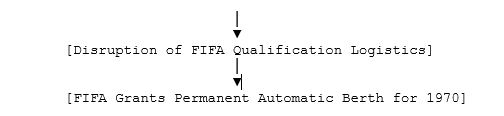
The mass boycott completely disrupted the qualification logistics and dealt a severe blow to FIFA’s claims of global representation. The strategy worked: facing a unified front and international embarrassment, FIFA succumbed to the pressure, restructuring its qualification format for the 1970 tournament to grant Africa its first permanent, automatic individual slot.
This historic boycott demonstrated that collective political action by marginalized nations could dismantle the Eurocentric power structures governing global sports.
A similarly intense qualification crisis erupted decades later during the 2010 World Cup cycle, illustrating that regional feuds remain volatile. The qualifying playoff between North African rivals Algeria and Egypt escalated into a major international incident. Following a series of highly charged matches marred by attacks on team buses and widespread fan violence in Algiers and Cairo, the deciding match was moved to neutral ground in Sudan.
The fixture took place under unprecedented security, with thousands of riot police deployed to prevent mass violence. Despite these measures, clashes erupted across Khartoum and spilled back into the home countries, resulting in extensive property damage and injuries to hundreds of fans.
The sporting rivalry became so toxic that it triggered a formal diplomatic crisis: both the Algerian and Egyptian governments officially recalled their mutual ambassadors for high-level consultations, freezing bilateral diplomatic relations over a football match. This severe fallout underscored how easily national governments can be drawn into the emotional volatility of World Cup competition.
Modern sports-washing: Corporate and geopolitical shift
As the World Cup transitioned into the twenty-first century, the crude, militaristic propaganda models utilized by twentieth-century dictators evolved into highly sophisticated, multi-billion-dollar corporate strategies. The contemporary era is defined by the rise of modern “sports-washing” on an unprecedented global scale.
No longer just a tool for immediate domestic distraction, authoritarian states and resource-rich regimes now view the acquisition of World Cup hosting rights as a long-term geopolitical investment strategy. This approach aims to diversify domestic economies, embed repressive states into global financial networks, and reshape international public perception.
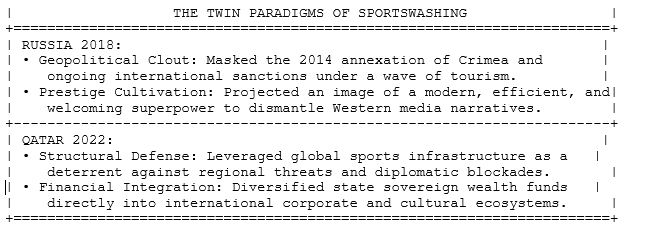
This modern sports-washing paradigm found its first major twenty-first-century manifestation during the 2018 World Cup, hosted by the Russian Federation. The tournament was awarded to and organized by Russia under a cloud of geopolitical tension. Only four years prior, Russia had initiated the illegal annexation of Crimea from Ukraine and faced a wave of economic sanctions from Western democracies.
Furthermore, the state stood accused of executing targeted assassinations on foreign soil, backing repressive regimes in the Syrian Civil War, and launching sophisticated cyberwarfare campaigns against Western democratic elections.
For Vladimir Putin’s administration, the 2018 World Cup was a calculated counter-offensive against international isolation. The Russian state spent over $14 billion constructing immaculate stadium infrastructure and implementing visa-free travel systems for ticket holders, projecting an image of a modern, efficient, and welcoming superpower.
Western governments widely criticized the tournament as a transparent effort to legitimize a corrupt, authoritarian regime, but the event proceeded with immense commercial success. By drawing millions of international tourists and dominating global sports headlines with positive stories for an entire month, the Russian state successfully blunted the immediate impact of Western diplomatic pressure, establishing a dangerous template for using major sporting events to obscure ongoing violations of international law.
Qatar 2022: The ultimate transformation of global sports
The 2018 Russian tournament, however, was merely a prelude to the most controversial and structurally transformative World Cup in modern history: the 2022 tournament in Qatar. The awarding of the tournament to a tiny, hyper-wealthy Gulf monarchy with no established football history triggered immediate international condemnation, sparking multi-year investigations into systemic corruption, bribery, and vote-buying within FIFA’s executive committee.
Once secured, Qatar transformed the tournament into an aggressive vehicle for state soft power, using an estimated $220 billion in state funds—by far the most expensive World Cup ever organized—to build an entire network of futuristic, air-conditioned stadiums, a brand-new metro system, and a completely new luxury city, Lusail, to host the final match.
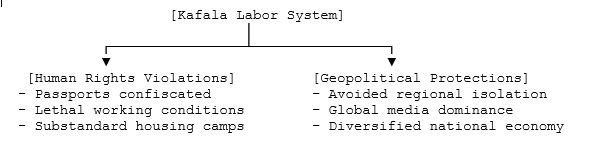
The geopolitical motivations driving Qatar’s immense expenditure were profound. Surrounded by powerful neighbors and having recently survived a grueling multi-year diplomatic and economic blockade imposed by Saudi Arabia, the United Arab Emirates, Bahrain, and Egypt, the Qatari leadership viewed the World Cup as an essential security strategy. By embedding itself as the premier hub for international sports, culture, and diplomacy, Qatar made it politically impossible for its regional rivals to isolate or absorb it without provoking a massive global backlash.
However, this massive construction effort came at a catastrophic human cost. The Qatari state relied heavily on the Kafala sponsorship system—a labor framework that human rights organizations blasted as a contemporary form of indentured servitude. Under this system, millions of migrant workers from South Asia and East Africa were stripped of their passports, forced to live in squalid labor camps, and compelled to work long hours in extreme desert heat.
International human rights organizations and major media outlets published extensive investigations estimating that thousands of migrant workers died due to heat stress, structural collapses, and uninvestigated medical failures during the decade-long infrastructure boom.
This grim human cost triggered a wave of human rights boycotts and grass-roots protests across Europe and the Americas. Fan groups across Germany, Scandinavia, and France explicitly boycotted matches, refused to watch broadcasts, and displayed massive stadium banners condemning the loss of life in Qatar.
On the pitch, the tournament became a highly visible arena for political protest. The German national team staged a striking visual demonstration during their opening team photograph, with all eleven players covering their mouths to protest FIFA’s authoritarian threat to issue immediate yellow cards if captains wore the “OneLove” rainbow armband supporting LGBTQ+ civil liberties.
Simultaneously, the domestic political instability inside Iran heavily spilled onto the pitch; amidst widespread domestic protests for women’s rights, the Iranian players stood in stony silence, refusing to sing their own national anthem before kickoff, while Iranian fans in the stands wept and wore shirts bearing protest slogans.
Despite this intense wave of global scrutiny and moral outrage, the 2022 World Cup left a complex, highly polarizing legacy that fundamentally altered how international mega-sporting events are evaluated. Once the opening whistle blew, Qatar’s strategy worked cleanly: the global media apparatus shifted its focus away from labor conditions and human rights abuses toward the drama on the pitch, culminating in a spectacular final match that many commentators labeled the greatest game ever played.
The tournament successfully solidified Qatar’s status as an indispensable global diplomatic and sports hub, proving that a flawless operational delivery and compelling sporting drama can effectively overwrite systemic political violations in the public consciousness.
2014 Brazil: The domestic cost of global spectacles
The utilization of the World Cup as a geopolitical tool does not only create international friction; it frequently inflicts severe economic damage on the domestic populations of the host nations themselves. This internal structural violence was vividly illustrated during the 2014 World Cup in Brazil.
Unlike the autocracies of Russia or Qatar, Brazil was a vibrant democracy undergoing significant economic shifts when it secured the hosting rights. The Brazilian government, led by the Workers’ Party, initially envisioned the tournament as a grand international coming-out party that would showcase Brazil’s rise as an economic superpower on the global stage.
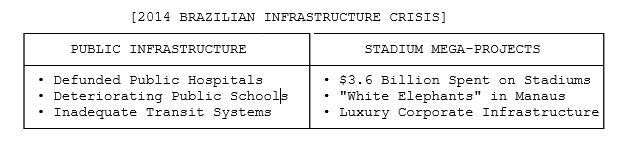
However, the reality for ordinary Brazilian citizens was starkly different. To meet FIFA’s stringent stadium specifications, the Brazilian state diverted billions of dollars in public funds away from struggling public infrastructure, underfunded schools, and failing healthcare systems into constructing opulent, hyper-expensive stadiums. Several of these venues were built in regions with no viable local football market—such as the Arena da Amazônia in Manaus—becoming immediate, decaying financial liabilities after the tournament concluded.
Furthermore, major urban revitalization projects resulted in the forced eviction of tens of thousands of impoverished citizens from their homes in the favelas, clearing space for luxury commercial zones and tourist infrastructure.
This stark disparity between corporate extravagance and domestic austerity triggered a massive wave of civil unrest. Millions of Brazilians took to the streets in historic protests, marching under the poignant slogan, “We demand FIFA-standard hospitals and schools!”
The protests disrupted the competitive logistics of the 2013 Confederations Cup and spilled directly into the 2014 tournament, with riot police firing tear gas and rubber bullets at protestors just blocks away from multi-million-dollar matches. These massive internal disruptions demonstrated that the immense financial demands of hosting a modern World Cup can exacerbate domestic inequalities, turning a sporting event into a battleground between a state’s global ambitions and its citizens’ survival needs.
The myth of the neutral pitch
The unfolding administrative crises of the 2026 World Cup—defined by targeted visa delays, arbitrary detentions, and the systematic exclusion of competitors and officials from the Global South—are not unprecedented disruptions to a neutral sporting tradition. Rather, they represent the contemporary manifestation of a century-long historical reality: the FIFA World Cup has always been, and will always remain, an arena for global power politics.
The tournament’s history reveals a consistent pattern of state co-optation. Whether through the overt fascist salutes of Mussolini’s Italy, the high-stakes ideological propaganda of the Cold War, the brutal sports-driven distractions of the Argentine military junta, or the multi-billion-dollar sportswashing campaigns of contemporary regimes, the World Cup is a powerful tool of statecraft.
When FIFA and its partner nations select host countries, they are not just choosing sporting venues; they are integrating the tournament into the sovereign legal frameworks, border enforcement apparatuses, and geopolitical rivalries of those states. The recent treatment of Breel Embolo, Aymen Hussein, Omar Abdulkadir Artan, and the national delegations of Iran, Senegal, South Africa, and Uzbekistan demonstrates that the modern host nation’s border is an active tool of political exclusion.
By utilizing visa denials and security profiling to compromise the competitive capacity of visiting teams, host nations undermine the foundational principle of athletic equity. This actions prove that despite the tournament’s marketing slogans of global unity and peace, the pitch can never be truly separated from the geopolitical architectures that surround it. As long as nations define themselves by borders, flags, and sovereign rivalries, the World Cup will remain a theater of international conflict, played out ninety minutes at a time.