
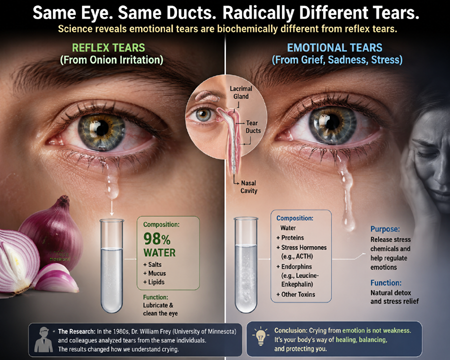
Similar looking tears, same duct, same eye but how radically different were the two types of tears. The human body amazes time and again. Frey and his colleagues collected different categories of tears from the same individuals. One set came from reflex reactions caused by irritants such as onions. Another set came from genuine emotional experiences involving grief, sadness, stress or emotional overwhelm
Human civilization has always had an uneasy relationship with crying. Across cultures and generations, people have been told to “be strong,” “hold it together,” or “stop crying.” Boys have often been conditioned to suppress tears in the name of masculinity, while women have frequently been accused of using tears as emotional manipulation. In boardrooms, battlefields, classrooms and even inside homes, tears have often been treated as symbols of vulnerability or lack of emotional control. Yet modern science has steadily begun dismantling these assumptions, revealing something extraordinary: crying may actually be one of the body’s most intelligent biochemical survival mechanisms.
One of the most fascinating pieces of research in this area emerged from the work of William H. Frey II, a biochemist associated with the former University of Minnesota and the St. Paul-Ramsey Medical Center during the 1980s. Frey became globally known for asking a deceptively simple question: are all tears chemically the same? Most people assume tears are merely salty water produced by the eyes. However, Frey suspected that emotional tears and reflex tears — such as those caused by chopping onions — might have fundamentally different biochemical compositions.
To investigate this, Frey and his colleagues collected different categories of tears from the same individuals. One set came from reflex reactions caused by irritants such as onions. Another set came from genuine emotional experiences involving grief, sadness, stress or emotional overwhelm. The findings stunned many researchers and helped reshape scientific thinking about crying.
The reflex tears generated while chopping onions turned out to be composed primarily of water and salt. Their main purpose was mechanical and protective: lubricating the eye and flushing out chemical irritants. Onion tears were essentially part of the body’s defensive cleaning system. The eyes sensed irritation from syn-Propanethial-S-oxide — the sulfur-containing compound released by cut onions — and responded by flooding themselves with fluid to wash the irritant away. The mechanism was similar to how the body reacts to dust, smoke or chemical particles entering the eye.
But emotional tears were radically different. Frey’s analysis revealed that these tears contained significantly higher concentrations of proteins and biologically active compounds. Emotional tears were found to include stress hormones such as adrenocorticotropic hormone (ACTH), along with naturally occurring pain-relieving chemicals such as leucine-enkephalin, an endorphin. This suggested something profound: emotional crying was not merely a psychological act. It appeared to be a physiological process tied directly to the body’s regulation of stress and emotional overload.
The implications of this research were revolutionary. If emotional tears contain stress-related biochemical compounds, then crying may function as a form of biological release. In other words, when people cry because of emotional pain, heartbreak, grief, fear or exhaustion, the body may literally be expelling stress-associated substances through the tear ducts. Crying, therefore, may not represent emotional collapse at all. It may instead represent the nervous system attempting to restore balance.
This idea challenged centuries of cultural assumptions. Instead of viewing crying as weakness, Frey’s work implied that tears are part of the body’s healing architecture. The human body evolved complex mechanisms to regulate physical stress — sweating to cool the body, coughing to clear airways, vomiting to remove toxins, inflammation to fight infection. Emotional crying may belong in this same category: a biological mechanism designed to help human beings survive emotional strain.
The research also intersected with growing understanding of psychoneuroimmunology — the study of how psychological stress affects the nervous system, hormones and immune function. Scientists were increasingly discovering that emotional stress is not an abstract experience confined to the mind. Stress changes hormone levels, blood pressure, heart rate, immune responses and brain chemistry. Chronic emotional suppression can contribute to anxiety disorders, hypertension, digestive disorders, insomnia and weakened immunity. Against this backdrop, crying began to look less like emotional instability and more like a pressure-release valve for the human organism.
Importantly, Frey’s findings did not imply that tears magically remove all emotional suffering. Crying is not a cure-all. However, the studies suggested that emotional expression may assist the body in regulating internal stress chemistry. Many people intuitively understand this even without scientific terminology. After a long cry, individuals frequently report feeling calmer, lighter or emotionally exhausted but relieved. That sensation may reflect not merely psychological catharsis, but genuine neurochemical shifts occurring within the body.
The science surrounding tears also helps explain why suppressing emotions for long periods can become physically harmful. Human beings are not machines capable of endlessly storing emotional pressure without consequences. The body keeps score of chronic stress. Elevated cortisol and stress hormone exposure over extended periods can affect cardiovascular health, digestion, metabolism and brain function. Emotional suppression often requires continuous physiological effort, activating stress pathways rather than calming them. In this context, crying may function as one of the body’s natural mechanisms for interrupting stress escalation.
The modern world, however, often rewards emotional suppression. Professional environments frequently prioritize emotional neutrality. Social media encourages performative happiness. Hyper-competitive cultures equate stoicism with competence. Many individuals learn to internalize grief, humiliation, disappointment and trauma because they fear appearing weak or unstable. Yet biology may not cooperate with these cultural expectations. The body evolved over millions of years under conditions where emotional signaling and social bonding were essential for survival.
Anthropologists and evolutionary psychologists believe emotional tears may also have evolved as social communication signals. Humans are the only known species that produce emotional tears in response to psychological experiences. Tears visibly communicate distress, vulnerability and need. In prehistoric communities, such signals may have strengthened social cohesion and increased survival by prompting caregiving, protection or emotional support from others. Crying may therefore serve both biochemical and social functions simultaneously.
The science behind tears and the nervous system
To fully understand why emotional crying matters, it is necessary to examine how the human nervous system responds to stress. When individuals experience emotional pain, the brain activates a sophisticated cascade of physiological reactions. The hypothalamus signals the pituitary gland, which in turn stimulates the adrenal glands. Stress hormones such as cortisol and adrenaline flood the bloodstream. Heart rate increases. Muscles tense. Blood pressure may rise. Digestion slows. The body shifts into a state commonly known as “fight or flight.”
This response evolved primarily for survival during physical danger. If prehistoric humans encountered predators or violent threats, these physiological changes improved chances of survival by increasing alertness and physical readiness. The problem is that modern humans activate these same biological systems during emotional experiences: grief after bereavement, workplace pressure, heartbreak, loneliness, financial anxiety or interpersonal conflict. The body reacts to emotional stress as though it were confronting physical danger.
Under acute conditions, stress responses are adaptive. But chronic activation becomes damaging. Prolonged elevation of cortisol has been linked to impaired immunity, inflammation, cardiovascular strain, sleep disruption and mental health disorders. Emotional suppression can prolong this activation because the nervous system remains trapped in unresolved tension.
This is where crying may play an important regulatory role. Emotional tears appear connected to activation of the parasympathetic nervous system — the system responsible for calming the body after stress. During intense crying, breathing patterns change, emotional tension peaks and eventually subsides, often leading to a calmer physiological state afterward. Many people experience slower breathing, muscular relaxation and reduced emotional intensity following a crying episode.
Researchers have proposed several mechanisms to explain this phenomenon. One theory suggests that crying stimulates parasympathetic recovery after sympathetic nervous system arousal. Another theory proposes that emotional expression reduces internal cognitive burden by allowing suppressed feelings to surface. Yet another explanation focuses on social bonding: crying often leads to comfort from others, which itself lowers stress responses through oxytocin release and social reassurance.
The role of endorphins is especially intriguing. Emotional tears containing leucine-enkephalin suggest that the body may release natural painkillers during crying episodes. Endorphins help reduce pain perception and may contribute to the soothing sensation people often experience after emotional release. This biochemical response resembles other natural stress-regulation mechanisms such as laughter, physical exercise or affectionate human contact.
Interestingly, not all crying experiences produce relief. Context matters enormously. People who cry in supportive environments often report feeling better afterward. By contrast, those who are shamed, ignored or ridiculed for crying may feel worse. This indicates that biology and social psychology interact closely. Crying evolved not only as a physiological mechanism but also within a social species dependent on empathy and interpersonal care.
The distinction between reflex tears and emotional tears also highlights the remarkable specialization of the human body. Reflex tears primarily contain water, oils and mucus designed to protect the eyes. Emotional tears, however, demonstrate increased concentrations of proteins and hormone-related substances. This difference strongly suggests emotional crying serves functions beyond simple eye lubrication.
The onion example remains one of the clearest demonstrations of this distinction. When onions are cut, they release sulfuric compounds that react with moisture in the eyes to create irritation. The lacrimal glands respond by producing tears to dilute and flush out the irritant. These tears are essentially a cleaning fluid. Emotional tears, by contrast, originate in complex neurological pathways involving the limbic system — particularly regions associated with emotion, memory and attachment.
The limbic system plays a central role in human emotional life. Structures such as the amygdala, hippocampus and hypothalamus interact continuously with hormonal and autonomic systems. Emotional pain is therefore not “imaginary” or detached from biology. It is deeply embodied. Heartbreak can produce chest pain. Anxiety can cause nausea. Fear can induce sweating. Shame can trigger flushing. Emotional suffering alters measurable physiology.
Understanding this embodied nature of emotion helps dismantle outdated cultural ideas that emotions are somehow less real than physical experiences. Neuroscience increasingly demonstrates that emotional and physical pain overlap within the brain. Social rejection, grief and trauma activate many of the same neural pathways involved in physical injury. Emotional tears may therefore represent part of the body’s response to genuine biological stress.
Modern psychiatry has also recognized the dangers of chronic emotional suppression. Studies have linked emotional inhibition to increased rates of depression, anxiety disorders, hypertension and even immune dysfunction. People who habitually suppress feelings often experience elevated physiological stress markers over time. Emotional repression requires energy because the brain continuously monitors and restrains emotional expression.
This does not mean constant crying is always healthy. Emotional regulation still matters. Severe uncontrolled crying episodes can sometimes signal underlying depression, trauma disorders or neurological conditions requiring professional support. But ordinary emotional crying in response to grief, disappointment, empathy or stress appears to be a normal and potentially beneficial human function.
The gender dimension of crying is equally significant. Across many societies, men are socialized to suppress tears from early childhood. Phrases such as “boys don’t cry” have shaped generations of male emotional behavior. Yet men possess the same neurobiological stress systems as women. Emotional suppression among men has been linked to higher risks of substance abuse, aggression, emotional isolation and suicide. The cultural policing of tears may therefore carry serious public health consequences.
Women, meanwhile, have often faced opposite stereotypes — being dismissed as overly emotional or irrational because they cry more openly. Ironically, the same act condemned in men as weakness has been condemned in women as instability. Scientific understanding of tears challenges both stereotypes by reframing crying as a human biological process rather than a gendered flaw.
Crying, emotional health and the future of mental wellbeing
The rediscovery of crying as a biological necessity comes at a critical moment in modern history. Around the world, rates of anxiety, depression, burnout and emotional exhaustion have risen dramatically. Urbanization, economic pressure, social fragmentation and digital overstimulation have created populations under chronic stress. Many people spend their lives emotionally overloaded yet socially isolated. In such an environment, understanding the biology of emotional release becomes increasingly important.
Mental health discussions have expanded enormously in recent decades, yet many societies still stigmatize visible emotional expression. Individuals are encouraged to discuss “mental wellness” abstractly while simultaneously being discouraged from displaying raw human vulnerability. Crying in workplaces, schools or public spaces often remains socially uncomfortable. The contradiction reveals how deeply entrenched emotional repression still is within modern culture.
Scientific insights into tears offer an opportunity to rethink emotional resilience itself. True resilience may not mean suppressing emotions indefinitely. Instead, resilience may involve the capacity to experience, process and recover from emotional stress without becoming trapped in chronic physiological overload. Emotional flexibility — not emotional numbness — may be the healthier long-term strategy.
This understanding is increasingly influencing psychotherapy and trauma treatment. Many therapeutic approaches now recognize that unresolved emotions can remain physiologically embedded within the nervous system. Trauma researchers have shown that traumatic experiences often persist not merely as memories but as bodily states involving hypervigilance, muscular tension and altered stress responses. Emotional release, including crying, can sometimes form part of the nervous system’s recovery process.
There is also growing recognition that tears may enhance social bonding and empathy. When humans witness another person crying, mirror neuron systems and empathy circuits often activate automatically. Tears can soften social aggression, invite compassion and strengthen interpersonal connection. In evolutionary terms, this may have increased group cohesion and mutual survival. Vulnerability, paradoxically, may have helped human communities endure.
The COVID-19 pandemic offered a vivid demonstration of humanity’s need for emotional expression. Across the world, millions experienced grief, fear, isolation and uncertainty simultaneously. Many who had previously hidden emotions found themselves overwhelmed. Psychologists observed rising emotional fatigue and burnout among healthcare workers, caregivers and ordinary citizens. During this period, conversations about emotional authenticity became more normalized, highlighting the importance of psychological release.
Importantly, however, crying should not be romanticized simplistically. Not every tear is therapeutic. Context, mental state and support systems matter enormously. Persistent despair, uncontrollable crying or inability to function may signal clinical depression or other conditions requiring medical attention. Emotional expression works best alongside supportive relationships, healthy coping strategies and psychological safety.
The commercialization of emotional wellness has also complicated public understanding. Social media platforms frequently transform emotional experiences into performance. Some individuals feel pressured either to dramatize emotions publicly or conceal them entirely. Genuine emotional processing, however, is rarely theatrical. Sometimes it occurs privately, quietly and invisibly. The scientific value of tears lies not in public display but in the body’s internal regulation mechanisms.
The findings associated with emotional tears also intersect with broader debates about the mind-body relationship. For centuries, Western thought often treated the mind and body as separate domains. Modern neuroscience increasingly rejects this division. Thoughts alter hormones. Emotions affect immunity. Chronic stress reshapes neural pathways. Trauma changes physiology. Tears exemplify this integration beautifully: emotional experiences literally produce measurable biochemical substances within the body.
The symbolism of tears in literature, religion and art now appears remarkably prescient. Ancient civilizations often viewed crying as purification, cleansing or spiritual release. Religious rituals across cultures incorporated mourning and lamentation. Poets described tears as washing sorrow from the soul long before biochemistry identified stress-related compounds within emotional tears. Science, in some respects, is rediscovering truths human cultures intuited emotionally for millennia.
The future of emotional health may depend partly on rebuilding healthier relationships with vulnerability. Children who are taught that emotions are dangerous or shameful may grow into adults disconnected from their own internal states. By contrast, emotionally supportive environments can help individuals develop healthier stress regulation and emotional intelligence. Allowing people to cry without humiliation may not merely be compassionate — it may be biologically wise.
Educational systems, workplaces and families increasingly face the challenge of balancing emotional resilience with emotional authenticity. The answer is unlikely to lie in either emotional excess or rigid suppression. Human biology appears designed for emotional processing, not permanent emotional denial. Tears are part of that design.
The research initiated by William H. Frey II remains influential because it reframed a deeply human experience through the lens of science. By distinguishing between reflex tears and emotional tears, Frey helped demonstrate that crying is not merely symbolic behavior. Emotional tears carry biochemical signatures linked to stress regulation, endorphin activity and nervous system recovery. While many details of emotional crying continue to be studied, the broader conclusion is increasingly difficult to dismiss: tears matter physiologically.
The next time someone cries from heartbreak, grief, exhaustion or emotional overwhelm, it may be more accurate to view the event not as failure but as biological adaptation. The body is attempting to regulate itself, restore equilibrium and survive emotional stress. Emotional tears are not empty water. They are evidence that the human organism possesses intricate mechanisms for coping with suffering.
For generations, societies celebrated stoicism while misunderstanding biology. Science now suggests that tears are not evidence of human weakness but of human complexity. The ability to cry may represent one of the body’s most sophisticated integrations of emotion, neurochemistry and survival. Far from being pointless, emotional tears may be part of how human beings endure pain without being destroyed by it.