
Indian Prime Minister Narendra Modi will replace the hyacinth in Bengal’s ecosystem with blooming lotuses. Maybe rename the state as just Bengal and the respell the city as Coal-Kaata? Incidentally, the decline of Bengal’s economy under colonial and communist rule was neither incidental nor inevitable; it was engineered
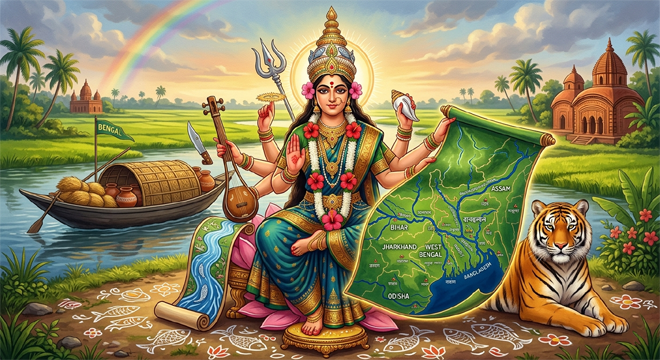
When Bengal once accounted for nearly 12 percent of global GDP, it was not an accident of geography or a fleeting statistical anomaly. It was the outcome of a deeply integrated economic ecosystem, one that combined fertile alluvial plains, intricate river networks, artisanal excellence, and a sophisticated commercial class. This Bengal was undivided, stretching across what is today West Bengal and Bangladesh, functioning as a cohesive economic unit powered by rivers like the Ganga, Brahmaputra, and their countless tributaries. Agriculture thrived on the back of predictable flooding cycles, producing rice, jute, sugar, and indigo. Simultaneously, Bengal’s handicraft industry, especially textiles like muslin and silk, commanded global demand. European traders, including the Portuguese, Dutch, French, and eventually the British, did not “discover” Bengal; they were drawn to it because it was already one of the richest regions in the world.
Equally crucial was the role of the Marwari mercantile and industrial class, which acted as the financial and logistical backbone of Bengal’s economy. These traders and financiers created capital networks that extended across India and beyond, ensuring that Bengal’s goods reached international markets efficiently. The synergy between agrarian productivity, artisanal skill, and commercial acumen created a self-sustaining economic powerhouse. Unlike modern industrial economies that rely heavily on centralized manufacturing, Bengal’s wealth was decentralized yet interconnected, making it resilient and adaptive.
However, this prosperity began to erode with the advent of British colonial rule. The transformation was not merely economic but structural. The British East India Company, after the Battle of Plassey in 1757, systematically dismantled Bengal’s indigenous economic systems. Heavy taxation, exploitative trade policies, and the destruction of local industries, particularly textiles, shifted Bengal from being a global exporter to a supplier of raw materials for British industries. The riverine economy, once the lifeline of commerce, was neglected as railways were developed primarily to serve colonial extraction rather than local integration.
The decline of a once-great economic ecosystem
The decline of Bengal’s economy under colonial rule was neither incidental nor inevitable; it was engineered. The British imposed revenue systems like the Permanent Settlement, which altered land ownership patterns and placed immense pressure on farmers. Agricultural productivity suffered as peasants were forced to prioritize cash crops over food security. Famines became more frequent and devastating, most notably the Bengal Famine of 1943, which exposed the fragility of an economy stripped of its indigenous resilience.
The handicraft sector, once the pride of Bengal, faced systematic destruction. British manufactured goods flooded Indian markets, undercutting local artisans who could not compete with industrial-scale production backed by imperial policy. Skilled weavers, who had once produced world-renowned muslin, were reduced to poverty. The loss was not just economic but cultural, as generations of craftsmanship were wiped out.
The Marwari industrial base, which had thrived in pre-colonial Bengal, adapted to the new realities but could not fully counterbalance the structural damage inflicted by colonial policies. Many industrialists shifted their focus to other regions or sectors, further weakening Bengal’s economic core. By the time India gained independence in 1947, Bengal was no longer the economic giant it once was.
Partition dealt another severe blow. The division of Bengal into West Bengal and East Pakistan (now Bangladesh) disrupted economic linkages that had existed for centuries. Rivers that once facilitated trade became international borders. Supply chains were broken, and industries that depended on raw materials from across the border struggled to survive. The once-integrated riverine economy was fragmented, leading to long-term stagnation.
Post-independence stagnation and missed opportunities
In the decades following independence, West Bengal faced a unique set of challenges that hindered its economic revival. Political instability, labor unrest, and a shift towards a state-controlled economic model created an environment that was not conducive to industrial growth. While land reforms improved rural equity to some extent, they did not translate into sustained agricultural productivity or industrial expansion.
The decline of Kolkata as India’s premier commercial hub is emblematic of this stagnation. Once the capital of British India and the center of trade and finance, the city gradually lost its prominence to Mumbai and Delhi. Infrastructure development lagged, and investment flowed to other states perceived as more business-friendly.
At the same time, the cultural narrative of Bengal underwent a transformation. Intellectual and political discourse often overshadowed economic pragmatism. While Bengal continued to produce some of India’s finest minds in literature, science, and politics, its economic engine remained subdued. The disconnect between cultural richness and economic vitality became increasingly apparent.
Yet, it would be simplistic to view this period solely through the lens of decline. Bengal retained several inherent strengths, its strategic location, fertile land, skilled workforce, and historical legacy of trade. These latent advantages, however, required a conducive policy environment and visionary leadership to be fully realized.
The riverine economy as a blueprint for revival
The idea of reviving Bengal’s economic fortunes by reconnecting with its riverine roots is not merely nostalgic; it is strategically sound. Rivers remain one of the most efficient modes of transportation, particularly for bulk goods. In an era where logistics costs significantly impact competitiveness, leveraging inland waterways could provide Bengal with a distinct advantage.
The Ganga-Brahmaputra river system offers immense potential for developing a modern, sustainable logistics network. Inland water transport is not only cost-effective but also environmentally friendly compared to road and rail. Reviving ports, improving navigability, and integrating river transport with road and rail networks could transform Bengal into a logistics hub once again.
Agriculture, too, can benefit from a renewed focus on the riverine ecosystem. Improved irrigation, flood management, and sustainable farming practices can enhance productivity while preserving ecological balance. The cultivation of high-value crops, combined with agro-processing industries, can create a robust rural economy.
The handicraft sector, which once defined Bengal’s global identity, also holds significant revival potential. With the rise of e-commerce and global demand for artisanal products, Bengal’s traditional crafts can find new markets. However, this requires investment in skill development, branding, and supply chain integration.
Political change and the promise of economic transformation
The electoral victory of the Bharatiya Janata Party in May 2026 introduces a new variable into Bengal’s economic equation. Political change often acts as a catalyst for policy shifts, and in this case, it could signal a renewed focus on economic development, infrastructure, and investment.
The BJP’s broader economic agenda at the national level emphasizes infrastructure development, ease of doing business, and integration of regional economies into global value chains. If these priorities are effectively implemented in Bengal, they could address many of the structural issues that have hindered growth.
One of the key challenges will be balancing development with inclusivity. Bengal’s socio-economic fabric is complex, and any policy framework must account for regional disparities, cultural sensitivities, and historical context. The success of this political transition will depend on the ability to create a development model that is both economically robust and socially equitable.
Infrastructure development will likely play a central role in this transformation. Investments in roads, ports, and inland waterways can enhance connectivity and reduce logistics costs. Industrial corridors, special economic zones, and urban development projects can attract investment and generate employment.
Reintegrating the Marwari industrial base and modern enterprise
A critical component of Bengal’s historical success was the presence of a strong commercial and industrial class, particularly the Marwari community. Reintegrating this entrepreneurial energy into Bengal’s economy could provide the capital and expertise needed for rapid growth.
In recent decades, many Marwari industrialists have established their businesses in other parts of India, drawn by more favorable business environments. Creating conditions that encourage their return, or at least their investment in Bengal, will be crucial. This includes policy stability, transparent governance, and a supportive regulatory framework.
At the same time, Bengal must nurture a new generation of entrepreneurs. Startups, technology-driven enterprises, and innovation hubs can complement traditional industries, creating a diversified economic base. The integration of technology into agriculture, handicrafts, and logistics can enhance efficiency and competitiveness.
Education and skill development will be key enablers of this transformation. Bengal’s strong intellectual tradition can be leveraged to create a workforce that is not only skilled but also adaptable to changing economic conditions. Collaboration between industry, academia, and government can ensure that education aligns with market needs.
Challenges on the path to revival
While the potential for revival is significant, the challenges are equally formidable. Infrastructure deficits, bureaucratic inefficiencies, and legacy issues cannot be resolved overnight. Moreover, global economic conditions, geopolitical dynamics, and environmental concerns will influence Bengal’s trajectory.
Climate change poses a particular challenge for a region so closely tied to its riverine ecosystem. Floods, cyclones, and rising sea levels can disrupt economic activity and threaten livelihoods. Any development strategy must incorporate climate resilience and sustainable practices.
Social and political cohesion will also be critical. Economic transformation often involves disruption, and managing this transition requires effective communication, stakeholder engagement, and policy continuity. The risk of polarization or policy reversals could undermine progress.
A return to economic relevance
The idea that Bengal can reclaim its historical position as a major contributor to global GDP may seem ambitious, but it is not entirely implausible. The foundations, geographical, cultural, and economic, still exist. What is required is a coherent strategy that aligns these elements with contemporary realities.
The BJP’s 2026 victory could mark the beginning of such a transformation, but political change alone is not sufficient. It must be accompanied by sustained policy efforts, institutional reforms, and active participation from all stakeholders, government, industry, and society.
Ultimately, the revival of Bengal’s economy will depend on its ability to blend tradition with modernity. The riverine economy that once powered its prosperity can serve as a blueprint, but it must be adapted to the demands of the 21st century. By reconnecting with its roots while embracing innovation, Bengal has the potential to once again become a significant player in the global economic landscape.