
Just as offering management consultancy services is an art and a science borne out of decades of experience, similarly hiring a business management consultant after selection, elimination and getting the best out of that person or firm is equally an art
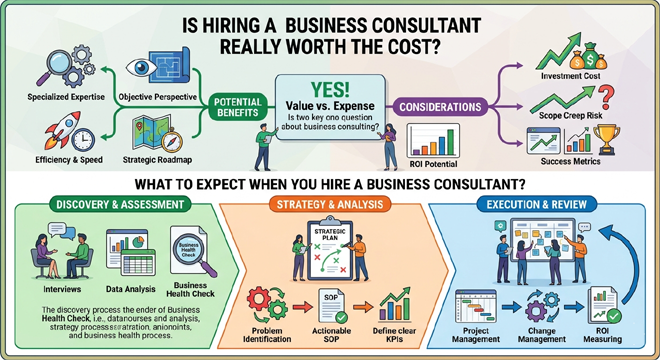
The honest answer is: sometimes yes, sometimes absolutely not, and the difference comes down to how, why, and whom you hire.
Let’s break it down without the usual consultant-speak.
💰 The core question: cost vs value
At its simplest, hiring a consultant is an ROI decision:
ROI = (Gain – Cost) ÷ Cost
If the gains (revenue growth, cost savings, avoided mistakes) exceed what you pay, it’s worth it. If not, it’s an expensive PowerPoint exercise.
The tricky part? Most of the value isn’t immediate or obvious.
✅ When hiring a consultant is worth it
1. When you lack expertise internally
If you’re entering a new market, launching a product, or restructuring, a consultant brings specialised experience you don’t have.
- They’ve seen similar problems across companies
- They know what works, and what fails
- They shorten your learning curve dramatically
This “borrowed expertise” is often the biggest value.
2. When mistakes would be expensive
Consultants often pay for themselves by helping you avoid bad decisions.
A failed product launch, wrong hiring strategy, or flawed expansion plan can cost far more than consulting fees.
Think of it this way:
👉 Paying ₹20 lakh to avoid a ₹5-crore mistake is a bargain.
3. When you’re stuck or plateauing
If your business has:
- stagnant growth
- repeated operational issues
- unclear strategy
…it’s often because internal teams are too close to the problem.
Consultants bring objective, outsider perspective, which can uncover blind spots.
4. When execution speed matters
Consultants don’t just advise, they accelerate.
They can:
- implement systems faster
- reduce decision-making time
- align teams quickly
This “speed advantage” translates into real financial gains over time.
5. When ROI compounds over time
The biggest returns are often long-term:
- better processes
- scalable systems
- improved strategy
These create recurring value, not one-time gains.
❌ When hiring a consultant is not worth it
1. When the problem is obvious but execution is weak
If you already know what to do but aren’t doing it, a consultant won’t fix that.
You don’t need advice, you need discipline.
2. When you expect instant ROI
Consulting is not magic.
- Some projects take 12–18 months to pay back
- Strategic benefits take even longer
If you want quick wins only, you may be disappointed.
3. When scope and goals are unclear
A huge reason consulting fails:
- vague objectives
- no measurable KPIs
In fact, many projects fail to deliver value simply because success wasn’t defined upfront.
4. When you hire the wrong consultant
Let’s be blunt:
- Some consultants sell jargon, not results
- Some recycle generic frameworks
Without accountability, you’re paying for “thinking” instead of outcomes.
📊 What kind of ROI can you expect?
When done right, consulting can deliver:
- 20–50% efficiency improvements
- Faster decision-making
- Reduced costs and errors
- Revenue growth from better strategy
In some analytics or tech consulting cases, returns can exceed 100% ROI, but failure rates can also be high if poorly executed.
⚖️ The real benefits (beyond money)
This is where most people underestimate value.
Consultants often improve:
- clarity of direction
- leadership alignment
- decision quality
- organisational focus
These are hard to measure, but hugely impactful.
🧠 A practical way to decide
Ask yourself three blunt questions:
- Is this problem costing me more than the consultant’s fee?
- Do I genuinely lack the expertise internally?
- Will I actually implement what they recommend?
If the answer to all three is “yes,” it’s probably worth it.
💰 💰 Bottom line
Hiring a business consultant is not inherently expensive, it’s context-dependent.
- ✔ Worth it when they bring clarity, expertise, and measurable impact
- ✖ Wasteful when used as a substitute for leadership or execution
The smartest companies don’t ask “What does it cost?”
They ask:
👉 “What is the cost of not solving this problem?”
Expect clarity, but don’t expect miracles delivered on a platter.
Hiring a business consultant is less like buying a finished product and more like bringing in a high-level co-pilot. The outcome depends as much on your involvement as on their expertise. Here’s what actually happens when you hire one, beyond the glossy pitch decks.
First phase: diagnosis before advice
A competent consultant will not jump into solutions immediately. If they do, that’s your first red flag.
Instead, they begin with:
- deep-dive discussions with leadership
- data review (financials, operations, market position)
- stakeholder interviews
- competitor and industry analysis
This phase often feels slow, but it’s critical. Good consultants spend 20–40% of project time just understanding the problem properly.
What you should expect:
👉 Lots of questions, some uncomfortable
👉 Requests for detailed internal data
👉 Challenges to your assumptions
If this phase is rushed, the rest of the engagement will likely fail.
🔍 Second phase: structured problem definition
After diagnosis, the consultant reframes your issue into a clear, structured problem statement.
For example, instead of:
“Sales are down”
You’ll get something like:
“Revenue decline is driven by a 22% drop in repeat customers in Tier-1 cities due to pricing misalignment and weak retention strategy.”
This is where consultants earn their money, turning vague problems into actionable clarity.
🧠 Third phase: strategy and recommendations
Now comes the part most people expect, but it’s only one piece of the puzzle.
You’ll typically receive:
- strategic options (not just one solution)
- pros and cons of each
- financial impact estimates
- implementation roadmap
If the consultant is credible, they won’t give you generic advice. They’ll tailor it to your:
- business model
- market realities
- resource constraints
Be wary of:
❌ cookie-cutter frameworks
❌ jargon-heavy slides with no clear actions
⚙️ Fourth phase: execution support (this is where value lives)
Here’s the uncomfortable truth:
👉 Advice is cheap. Execution is everything.
The best consultants don’t just recommend, they help implement:
- process redesign
- team alignment
- vendor selection
- performance tracking systems
Without this phase, most consulting projects fail.
If your consultant disappears after handing over a PowerPoint, you’ve likely overpaid.
📊 Fifth phase: measurement and accountability
A serious consultant will define clear KPIs upfront, such as:
- revenue growth
- cost reduction
- customer acquisition/retention
- operational efficiency
You should expect:
- regular progress reviews
- course corrections
- measurable outcomes
If success isn’t quantified, it becomes impossible to judge whether the engagement worked.
💸 What you’ll actually pay for
You’re not just paying for time, you’re paying for:
- pattern recognition from past experience
- speed (doing in weeks what might take you months)
- objectivity (no internal politics)
- decision-making clarity
In short: compressed learning and reduced risk.
⚠️ What consultants will NOT do for you
This is where expectations often go wrong.
A consultant will not:
- run your business for you
- fix a weak leadership team
- execute without your involvement
- guarantee results without cooperation
If your organisation resists change, even the best consultant will fail.
🧩 What determines success (more than the consultant)
Three factors matter more than the consultant’s brand name:
1. Your internal alignment
If leadership isn’t on the same page, recommendations go nowhere.
2. Access to real data
If you hold back or provide incomplete information, outcomes suffer.
3. Willingness to act
Many companies pay for advice they never implement.
That’s the biggest waste of money, not the consultant’s fee.
🧠 The reality check
Hiring a consultant is not about outsourcing thinking.
It’s about:
- sharpening your thinking
- accelerating decisions
- avoiding costly mistakes
The best engagements feel less like “being told what to do” and more like:
👉 having your thinking challenged, structured, and upgraded
📌 Bottom line
When you hire a business consultant, expect:
✔ rigorous analysis before advice
✔ structured, data-backed recommendations
✔ involvement in execution (if they’re good)
✔ measurable goals and outcomes
But also expect:
❗ hard questions
❗ internal resistance
❗ the need to change how you operate
If you go in expecting a magic fix, you’ll be disappointed.
If you go in ready to collaborate and act, the value can be enormous.