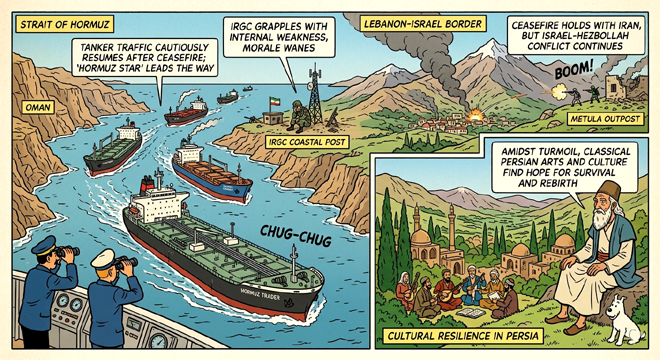
Few tankers begin to sail through Hormuz in a semblance of order. Meanwhile, Israel keeps occupying more land in Southern Lebanon ensuring Greater Israel and buffer zone with Hezbollah. Will IRGC crumble soon? Will Persia replace Iran?
A United Nations Security Council resolution aimed at reopening the critical maritime chokepoint of Hormuz failed dramatically, exposing deep divisions among global powers. The resolution, proposed by Abdullatif bin Rashid Al Zayani of Bahrain and backed strongly by the United States, was intended to ensure the restoration of free navigation through one of the world’s most vital oil arteries. However, vetoes from Russia and China halted the initiative, while Pakistan chose to abstain, as it had to hide behind obligations to its many creditor nations.
The Strait of Hormuz is a global economic lifeline with one-fifth of the world’s oil flowing through this narrow waterway, making any disruption immediately consequential for energy markets, inflation rates, and geopolitical stability. This blockade by Iran sent shockwaves through global markets, triggering fears of prolonged energy shortages and economic downturns, particularly in energy-dependent regions like Europe. Reports suggest that Europe is already suffering.
Despite the urgency, the resolution that came to a vote at the United Nations Security Council had already been significantly diluted. Originally, Gulf states had sought explicit authorization for the use of force to secure the strait. However, opposition from veto-wielding members forced revisions that removed any clear mandate for military action. Even this watered-down version failed to pass, revealing how entrenched geopolitical rivalries continue to paralyze multilateral institutions in times of crisis.
Diplomatic fractures and the meaning of Pakistan’s abstention
One of the most intriguing aspects of the vote was the decision by Shehbaz Sharif’s government to abstain. This move reflects Pakistan’s increasingly complex balancing act in global diplomacy. Historically aligned with both Western and Middle Eastern interests, Pakistan now finds itself navigating a delicate path between competing blocs.
By abstaining, Pakistan avoided directly opposing either the United States or China and Russia, both of which are critical partners in different contexts. Its relationship with China, particularly through economic initiatives like the China-Pakistan Economic Corridor, makes outright support for a US-backed resolution diplomatically sensitive. At the same time, Pakistan maintains security and economic ties with Gulf nations, many of whom supported Bahrain’s proposal.
The abstention also signals Pakistan’s potential role as a mediator. Indeed, reports suggest that Islamabad played a role in facilitating a temporary ceasefire between Iran and the United States. This aligns with Pakistan’s broader strategic interest in regional stability, as any prolonged conflict in the Gulf would have severe economic repercussions, including rising oil prices and disruptions to remittance flows from overseas workers in the Middle East.
From a broader perspective, the abstention illustrates the shifting nature of global alliances. The traditional binary of Western versus Eastern blocs is giving way to a more fluid, multipolar world where countries pursue pragmatic, issue-based alignments. Pakistan’s decision reflects this trend, highlighting how mid-sized powers are increasingly asserting independent foreign policies.
The veto by Russia and China and its global implications
The veto exercised by Vassili Nebenzia on behalf of Russia, alongside China, underscores a fundamental divide in how global powers interpret security and sovereignty. According to Moscow, the resolution contained “unbalanced, inaccurate and confrontational elements,” suggesting that it disproportionately targeted Iran while ignoring broader geopolitical dynamics.
China’s support for the veto aligns with its long-standing emphasis on non-interference and respect for state sovereignty. Both nations were wary of any language that could be interpreted as legitimizing military intervention, particularly given past experiences such as the 2011 intervention in Libya. In that case, a UN mandate intended to protect civilians eventually led to regime change, an outcome that Russia has repeatedly criticized.
The failure of the resolution highlights the limitations of the United Nations in addressing crises involving major powers. While the Security Council is designed to maintain international peace and security, its structure—particularly the veto power held by permanent members—often results in deadlock. In this instance, even a heavily diluted resolution could not overcome geopolitical divisions.
The implications extend beyond the immediate crisis. The inability of the UN to act decisively may encourage unilateral actions by powerful states. The United States has already indicated that it reserves the right to act in self-defense and in defense of its allies, regardless of the Security Council’s decision. This raises the risk of further escalation, as actions taken outside a multilateral framework are more likely to be contested.
Moreover, the veto sends a signal to smaller states about the limits of international law. If major powers cannot agree on basic principles such as freedom of navigation, it undermines confidence in global governance systems. This erosion of trust could have long-term consequences for international cooperation.
Iran’s position and the logic of strategic leverage
From Iran’s perspective, the blockade of the Strait of Hormuz is a strategic response to external pressures. Amir Saeid Iravani described the resolution as an attempt to “punish the victim,” framing Iran’s actions as defensive measures to protect its sovereignty and national interests.
The Strait of Hormuz represents one of Iran’s most significant sources of leverage in global geopolitics. By controlling access to this critical waterway, Tehran can exert pressure on both regional rivals and global powers. This leverage becomes particularly important in the context of economic sanctions and military threats.
Iran’s strategy appears to be aimed at forcing negotiations on its own terms. By disrupting oil flows, it raises the stakes for countries dependent on energy imports, thereby increasing the urgency of diplomatic solutions. At the same time, Iran has signaled a willingness to de-escalate under certain conditions, as evidenced by its acceptance of a temporary ceasefire.
The involvement of the Islamic Revolutionary Guard Corps adds another layer of complexity. The IRGC has warned that any attacks on civilian infrastructure would trigger a response beyond the region, potentially affecting global energy supplies for years. Such statements highlight the interconnected nature of modern conflicts, where local actions can have far-reaching global consequences.
Iran’s approach also reflects a broader shift in asymmetric warfare. Rather than engaging in direct confrontation with more powerful adversaries, it leverages geographic advantages and economic vulnerabilities. This strategy complicates traditional military responses, as it blurs the line between civilian and strategic targets.
Energy markets and Europe’s vulnerability
The crisis in the Strait of Hormuz has had immediate and profound effects on global energy markets. Europe, in particular, faces significant challenges due to its reliance on imported oil and gas. The phrase “Europe gas bill Trumped” captures the economic strain caused by rising energy prices and supply uncertainties.
Countries across the European Union have been scrambling to secure alternative energy sources, including increased imports of liquefied natural gas and accelerated investments in renewable energy. However, these measures cannot fully offset the impact of disruptions in the Gulf, at least in the short term.
The situation also underscores the geopolitical dimensions of energy security. Dependence on external suppliers exposes countries to risks that extend beyond market fluctuations. Political instability, military conflicts, and strategic decisions by producing nations can all influence energy availability and pricing.
In this context, the Strait of Hormuz crisis serves as a reminder of the importance of diversification and resilience in energy systems. It also highlights the need for coordinated international responses to ensure stability in global markets.
At the same time, the crisis presents opportunities for certain players. Energy-exporting countries outside the Gulf may benefit from higher prices, while companies involved in alternative energy technologies could see increased demand. However, these gains are unevenly distributed and do not mitigate the broader economic challenges.
Ceasefire dynamics and the role of mediation
Amid the tension, a temporary ceasefire has emerged as a crucial development. Iran’s agreement to a two-week pause in hostilities, reportedly facilitated by Pakistan, indicates that diplomatic channels remain open despite the breakdown at the United Nations.
The ceasefire was endorsed by Mojtaba Khamenei, signaling high-level support within Iran’s leadership. This suggests that Tehran is open to negotiation, provided its core interests are respected. The United States, for its part, has indicated a willingness to suspend attacks if the Strait of Hormuz is fully reopened.
Mediation efforts highlight the importance of third-party actors in conflict resolution. Countries like Pakistan can leverage their relationships with multiple stakeholders to facilitate dialogue. While such efforts may not lead to immediate solutions, they can help de-escalate tensions and create space for more comprehensive negotiations.
However, the durability of the ceasefire remains uncertain. Temporary pauses in conflict often serve as opportunities for regrouping rather than lasting peace. The underlying issues—ranging from regional rivalries to broader geopolitical tensions—remain unresolved.
The future of global order in a fractured world
The Strait of Hormuz crisis is emblematic of a broader transformation in the international system. The post-Cold War era, characterized by relative unipolarity, is giving way to a more fragmented and contested global order. In this environment, institutions like the United Nations face increasing challenges in fulfilling their mandates.
The failure of the Security Council resolution reflects not just a disagreement over a specific issue but a deeper divergence in worldviews. While some countries prioritize freedom of navigation and collective security, others emphasize sovereignty and non-interference. Reconciling these perspectives is essential for effective global governance but remains a daunting task.
The role of leadership also comes into focus. Statements by figures like Donald Trump demonstrate how individual leaders can shape the tone and direction of international relations. At the same time, the actions of diplomats and institutions reveal the constraints within which these leaders operate.
Looking ahead, the resolution of the Strait of Hormuz crisis will depend on a combination of diplomacy, strategic restraint, and pragmatic compromise. While military options remain on the table, their risks and consequences make them less desirable.
In conclusion, the unfolding events highlight the interconnected nature of modern geopolitics. A crisis in a narrow waterway can ripple across continents, affecting economies, alliances, and global stability. The challenge for policymakers is to navigate these complexities with foresight and responsibility, ensuring that immediate actions do not undermine long-term peace and security.