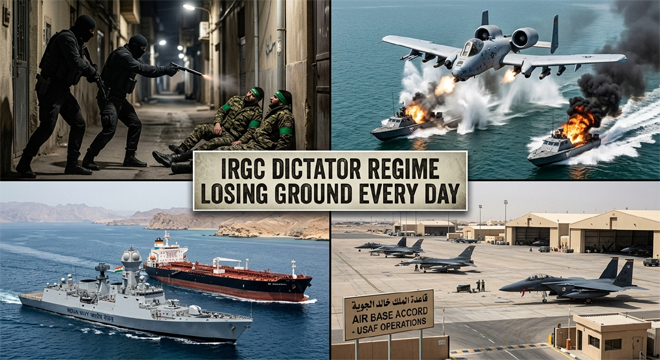
Mossad hitmen roaming the streets and felling IRGC / Basij rogues with silencer shots; USA’s A-10 aircraft blowing up IRGC speedboats; Indian Navy escorting Indian oil/gas tankers out of Hormuz; Saudi offering USA air base to fly from. IRGC dictator regime losing ground every day
At the heart of the Strait of Hormuz, is this unfolding drama where India’s decision to deploy naval assets to safeguard its energy lifelines has been put in action, a move that signals both strategic resolve and a recalibration of its role in global maritime security. The deployment of seven warships by the Indian Navy under what has been described as Operation Urja Suraksha represents not merely a tactical response to immediate threats, but a broader assertion of principles rooted in international law and national interest.
India’s message to Tehran is unambiguous: the Strait of Hormuz is an international waterway governed by the United Nations Convention on the Law of the Sea, and no extraneous permissions or payments are required for passage. This position directly challenges the practices attributed to the Islamic Revolutionary Guard Corps, which has often been accused of exerting coercive control over shipping lanes through intimidation, inspections, and informal levies.
For India, the stakes are existential in economic terms. A significant proportion of its crude oil, liquefied petroleum gas (LPG), and liquefied natural gas (LNG) imports traverse these waters. Any disruption reverberates through its economy, affecting everything from household energy consumption to industrial production. Thus, the deployment of naval escorts is not merely a show of force, but a practical necessity grounded in energy security.
Operation Urja Suraksha; strategic autonomy
India’s naval deployment reflects a long-standing doctrine of strategic autonomy, a principle that has guided its foreign policy since independence. Rather than aligning itself fully with any major power bloc, India has sought to retain the flexibility to act in accordance with its own interests. In the context of Hormuz, this translates into a willingness to protect its shipping independently, without relying solely on external security guarantees.
The operational details underscore the seriousness of this commitment. Indian warships, including guided missile destroyers and frigates, have been positioned in the Gulf of Oman and the Arabian Sea, maintaining a vigilant presence just outside the narrow confines of the strait. Their mission is to escort Indian-flagged and India-bound vessels through the most vulnerable segments of their journey, ensuring safe passage to open waters.
Reports of tankers such as Jag Vasant and Pine Gas being successfully escorted highlight the practical impact of this deployment. These operations require precise coordination, real-time intelligence, and the ability to respond swiftly to emerging threats. The presence of naval assets equipped with advanced radar systems, anti-ship missiles, and air defense capabilities acts as a deterrent against potential interference.
At a deeper level, Operation Urja Suraksha represents an evolution in India’s maritime thinking. Traditionally focused on coastal defense and regional security, the Indian Navy is increasingly projecting power into critical global chokepoints. This shift reflects the realities of a globalized economy in which maritime trade routes are the arteries of national prosperity.
The role of American military power
Parallel to India’s actions, the United States has intensified its own operations in the region. Under what has been described as Operation Epic Fury, American forces have deployed a combination of air and naval assets to counter perceived threats to shipping. Among the most notable elements of this campaign is the use of the A-10 Thunderbolt II, a platform renowned for its durability and firepower.
Originally designed during the Cold War to counter armored formations, the A-10 has found renewed relevance in the maritime domain. Equipped with the formidable GAU-8 Avenger cannon, it is capable of delivering devastating fire against small, fast-moving targets such as the speedboats often associated with IRGC naval units. Its ability to loiter over a battlefield for extended periods makes it particularly suited to the kind of persistent surveillance and engagement required in the Strait of Hormuz.
Complementing the A-10 are AH-64 Apache helicopters, which provide additional firepower and flexibility. Armed with Hellfire missiles and chain guns, these helicopters are capable of engaging both surface targets and aerial threats such as drones. Together, these platforms create a layered defense that complicates any attempt to disrupt shipping.
The reported neutralization of numerous vessels, including those allegedly involved in mine-laying operations, underscores the intensity of this campaign. Mines pose a particularly insidious threat in narrow waterways, where even a single detonation can have disproportionate consequences. By targeting such capabilities, the United States aims to ensure the continuity of global energy flows.
The contested narrative of deterrence and escalation
While these military actions are framed by their proponents as necessary measures to ensure security and stability, they also raise questions about escalation and the risk of broader conflict. The presence of multiple naval and air forces operating in close proximity increases the probability of miscalculation, particularly in a region already fraught with tension.
From one perspective, the deployment of overwhelming force serves as a deterrent, signaling that attempts to interfere with shipping will be met with decisive response. This logic has historical precedent, as maritime security has often depended on the ability of powerful states to enforce norms through their navies.
However, critics argue that such actions can also exacerbate tensions, creating a cycle of provocation and response. In this view, the emphasis on military solutions may overshadow the need for diplomatic engagement and conflict resolution. The challenge lies in balancing the immediate necessity of protecting shipping with the longer-term goal of regional stability.
Intelligence warfare and the shadow domain
Beyond the visible military operations, there are claims of a shadow war unfolding within Iran itself. Reports of targeted assassinations attributed to Mossad suggest a campaign aimed at weakening the IRGC and affiliated groups such as the Basij militia. These accounts, while difficult to independently verify, point to a broader strategy of undermining the internal structures of power.
The narrative describes a chilling pattern: individuals allegedly involved in past crackdowns being identified, contacted, and then eliminated with precision. Such operations, if accurate, would indicate a high degree of intelligence penetration and operational capability. They also highlight the increasingly blurred lines between conventional warfare and covert action.
For the IRGC, which has long been a pillar of the Iranian state, such developments would represent a significant challenge. The organization’s influence extends beyond the military sphere into politics, economics, and regional proxy networks. Any sustained campaign targeting its personnel and infrastructure could have far-reaching implications.
The regional ripple effects and proxy dynamics
The implications of these developments extend far beyond the confines of the Strait of Hormuz. The IRGC has been a central actor in what is often described as an “axis of resistance,” supporting groups such as Hezbollah, Hamas, and various militias in Iraq and Syria. A weakening of its capabilities could alter the balance of power across the Middle East.
From one perspective, this could lead to a reduction in the frequency and intensity of proxy conflicts, creating space for a more stable regional order. The disruption of supply lines and funding networks would limit the capacity of these groups to operate effectively.
However, the situation is inherently complex. Power vacuums can create new uncertainties, and the erosion of one actor’s influence does not necessarily translate into stability. Other regional powers may seek to fill the gap, leading to new alignments and rivalries.
India’s balancing act in a shifting geopolitical landscape
For India, navigating this environment requires a delicate balance. On the one hand, it must protect its immediate interests, particularly in relation to energy security. On the other hand, it must manage its relationships with a range of partners, including the United States, Iran, and Gulf states.
India’s ties with Iran have historically been shaped by considerations such as energy imports and connectivity projects like the Chabahar Port. At the same time, its strategic partnership with the United States has deepened in recent years, encompassing defense cooperation and shared concerns about maritime security.
The decision to assert its position in the Strait of Hormuz reflects an attempt to reconcile these different priorities. By framing its actions in terms of international law and the protection of commerce, India seeks to maintain a principled stance while avoiding unnecessary entanglement in regional rivalries.
The economics of energy security and global interdependence
The centrality of the Strait of Hormuz to global energy markets cannot be overstated. A significant portion of the world’s oil supply passes through this narrow corridor, making it a critical point in the global economy. Disruptions in this region have immediate and far-reaching consequences, affecting prices, supply chains, and economic stability.
For India, which imports a substantial share of its energy, the stakes are particularly high. Ensuring the uninterrupted flow of oil and gas is essential not only for economic growth but also for social stability. Rising energy costs can have cascading effects, influencing inflation, industrial output, and household expenses.
In this context, the deployment of naval escorts can be seen as an investment in economic resilience. By reducing the risk of disruption, India is effectively safeguarding its growth trajectory and mitigating the vulnerabilities associated with external dependencies.
The future of maritime security in contested waters
The events in the Strait of Hormuz highlight broader trends in maritime security. As global trade continues to expand, the importance of securing sea lanes is likely to increase. This, in turn, will require a combination of military capability, legal frameworks, and international cooperation.
The role of navies is evolving, with greater emphasis on protecting commerce, combating piracy, and responding to non-traditional threats. At the same time, the legal principles enshrined in agreements such as UNCLOS remain crucial in defining the rights and responsibilities of states.
For countries like India, the challenge lies in integrating these elements into a coherent strategy. This involves not only building naval capacity but also engaging in diplomacy and participating in multilateral initiatives.
Power, principle, and the uncertain road ahead
The unfolding situation in the Strait of Hormuz is a vivid illustration of the interplay between power and principle in international relations. India’s decision to deploy warships reflects a determination to defend its interests while adhering to established norms. The actions of the United States underscore the continued relevance of military power in shaping outcomes, even in an era often defined by economic and technological competition.
At the same time, the reports of covert operations and internal struggles within Iran point to the complexity of modern conflict, where the boundaries between war and peace are increasingly blurred. The weakening of established power structures can create opportunities, but also risks.
Ultimately, the trajectory of these developments will depend on a range of factors, including the choices made by regional and global actors. Whether the result is greater stability or further volatility remains uncertain. What is clear, however, is that the Strait of Hormuz will continue to be a focal point of geopolitical contestation, and that the decisions taken today will have lasting implications for the future of the region and the world.