
Iran seems to have a repository of systems and processes for daily administration as well as the war command centre to survive the killing of the Ayatollah and his immediate circle. Israel’s presumption that killing of the Ayatollah and his immediate circle with destabilise Iran seems to have been wrong; reflecting a system built to endure leadership loss
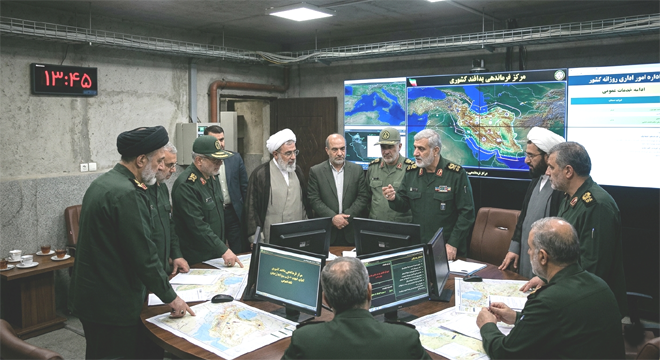
Power in Iran has never been simple, and it is even less so in moments of crisis or transition. The Islamic Republic was designed as a hybrid system, part theocracy, part republic, and part security state. In such a structure, authority does not flow cleanly from a single office but instead radiates through a network of clerics, elected officials, and, crucially, military commanders. When a dominant figure fades from the scene or political shocks occur, this network becomes more visible, revealing who truly shapes decisions behind the façade of formal institutions.
Today, Iran is effectively being steered by a constellation of powerful individuals drawn largely from the Islamic Revolutionary Guard Corps (IRGC), the political elite, and the clerical establishment. While formal titles still matter, real influence increasingly lies with those who control coercive power, strategic assets, and ideological legitimacy. The following analysis explores the key figures who currently define Iran’s direction, examining how their roles intersect and what this means for the country’s future.
Revolutionary Guards as the core power center
No discussion of contemporary Iran can begin without the Islamic Revolutionary Guard Corps. Established after the 1979 revolution to protect the Islamic system, the IRGC has evolved into far more than a military force. It is now an economic powerhouse, an intelligence network, and a political kingmaker. Its commanders wield immense influence over both domestic and foreign policy.
At the center of this structure stands Ahmad Vahidi, the current head of the Guards. His appointment followed the deaths of his two immediate predecessors, underscoring the volatility of the moment. Vahidi is not merely a bureaucratic appointee; he is a veteran of the Iran-Iraq War and a long-time insider who has served in multiple high-stakes roles, including leading the elite Qods Force and serving as defence minister.
His career trajectory illustrates a defining feature of Iran’s power structure: continuity within the revolutionary elite. Figures like Vahidi are not outsiders rising through democratic processes; they are insiders shaped by war, ideology, and institutional loyalty. His involvement in suppressing internal dissent further signals the IRGC’s dual role, defending the state externally while policing society internally.
Under Vahidi, the Guards are not just a military institution but the backbone of governance. They influence everything from economic contracts to electoral outcomes, ensuring that the ideological core of the Islamic Republic remains intact regardless of political shifts.
The shadow network of regional influence
If the IRGC is the backbone of Iran’s internal power, the Qods Force is its extended arm abroad. This elite unit manages Iran’s relationships with allied militias, political movements, and proxy forces across the Middle East.
Leading this effort is Esmail Qaani, a figure who operates largely out of the public eye. He assumed command after the assassination of Qassem Soleimani in a U.S. drone strike in 2020, an event that reshaped regional dynamics. Unlike his predecessor, Soleimani, who cultivated a near-mythical public persona, Qaani is known for his secrecy and low profile.
Despite this, his role is no less critical. He oversees Iran’s network of alliances stretching from Iraq and Syria to Lebanon and beyond. These relationships are central to Iran’s strategy of asymmetric warfare, allowing it to project power without direct confrontation with stronger adversaries.
Qaani’s leadership reflects a shift from charismatic command to institutional continuity. While he may lack Soleimani’s flair, he represents a system that no longer depends on individual personalities to function. The machinery of influence continues to operate, guided by strategic imperatives rather than personal ambition.
Control of strategic waterways and maritime leverage
Another crucial dimension of Iran’s power lies in its control over maritime chokepoints, particularly the Strait of Hormuz. This narrow passage is one of the world’s most critical oil transit routes, giving Iran significant leverage over global energy markets.
The man responsible for this domain is Alireza Tangsiri, head of the IRGC Navy. Since taking command in 2018, Tangsiri has played a central role in Iran’s maritime strategy, including periodic threats to close the Strait in response to external pressure.
His position highlights the militarization of economic strategy. In Iran’s case, geography is weaponized, and naval capabilities are used not just for defence but as tools of deterrence and negotiation. Tangsiri’s actions can influence oil prices, shipping routes, and diplomatic calculations far beyond Iran’s borders.
This integration of military and economic strategy underscores the IRGC’s centrality. It is not merely defending the nation; it is actively shaping global dynamics in ways that enhance Iran’s bargaining power.
The political heavyweight in parliament
While military figures dominate much of Iran’s power structure, civilian institutions still play a role, albeit one often aligned with or influenced by the Guards. Among these, the parliament (Majlis) remains a key forum for political maneuvering.
At its helm is Mohammad Baqer Qalibaf, a former IRGC commander who has successfully transitioned into civilian politics. His career includes serving as mayor of Tehran and running for president, though unsuccessfully.
Qalibaf’s significance lies in his ability to bridge military and political spheres. He is not merely a parliament speaker; he is a strategist who articulates Iran’s positions during times of crisis. Reports of his involvement in negotiations with the United States suggest that he operates beyond the formal limits of his office.
His presence illustrates how the line between civilian governance and military influence has blurred. In Iran, former commanders often become politicians, ensuring that the ethos of the IRGC permeates the entire system.
The judiciary as an instrument of control
In any political system, the judiciary plays a crucial role in maintaining order. In Iran, however, it is also a powerful tool for enforcing ideological conformity and suppressing dissent.
The current head of the judiciary is Gholamhossein Mohseni-Ejei, a cleric with a long history in intelligence and security. He has been sanctioned internationally for his role in the repression of protests, particularly those following the disputed 2009 presidential election.
Mohseni-Ejei represents the hardline faction within Iran’s leadership. Under his watch, the judiciary has continued to crack down on activists, journalists, and opposition figures. This ensures that political challenges are neutralized before they can gain momentum.
His role highlights another key feature of Iran’s system: the fusion of legal and security apparatuses. The judiciary is not an independent arbiter but a partner in governance, aligned with the broader objectives of the state.
The constrained authority of the presidency
Despite being the highest elected office, the presidency in Iran has seen its influence diminish over time. The current president, Masoud Pezeshkian, embodies this limited role. Pezeshkian’s election gives him democratic legitimacy, but his power is constrained by unelected institutions, particularly the IRGC and the clerical establishment. His recent apology to Gulf states, followed by a partial retraction under pressure from the Guards, illustrates the limits of his authority. This dynamic reveals a key fact: in Iran, electoral politics exist within boundaries set by the system. Presidents can shape tone and policy at the margins, but they cannot challenge the core principles or strategic directions determined by more powerful actors.
The enduring influence of hardline ideologues
Beyond those currently in office, figures like Saeed Jalili continue to wield significant influence. A veteran of the Iran-Iraq War and a former nuclear negotiator, Jalili represents the uncompromising faction of Iranian politics.
Though he lost the 2024 presidential election, his ideological stance resonates within key institutions. He advocates for resistance against Western pressure and emphasizes self-reliance, shaping debates on foreign policy and economic strategy.
Jalili’s presence underscores the importance of ideology in Iran’s governance. Even without formal authority, hardline thinkers can influence policy by shaping the intellectual framework within which decisions are made.
The gatekeepers of the political system
No analysis of Iran’s leadership would be complete without examining the role of the Guardian Council, the body responsible for vetting candidates and ensuring that elections align with the principles of the Islamic Republic.
A prominent member of this institution is Alireza Arafi, a senior cleric trusted enough to be part of the interim council that assumed responsibilities during a period of transition.
The Guardian Council acts as a gatekeeper, determining who can participate in the political process. This ensures that even elected bodies remain within the ideological limits set by the system.
Arafi’s role highlights the importance of clerical authority in maintaining the system’s continuity. While military figures may dominate operational power, clerics provide the ideological legitimacy that underpins the entire structure.
Diplomacy in a hostile world
Finally, Iran’s foreign policy is shaped by its diplomatic corps, led by Abbas Araqchi. A seasoned negotiator, Araqchi has engaged with Western powers, as well as countries like Russia and China, which maintain closer ties with Tehran.
His role is particularly challenging given the tensions between Iran and the West. Negotiations over nuclear policy, sanctions, and regional conflicts require a delicate balance between firmness and flexibility.
Araqchi operates within constraints set by the broader power structure, yet his work is crucial in navigating Iran’s international relationships. He represents the face of a system that is often perceived as rigid but is capable of pragmatic engagement when necessary.
A system of overlapping authorities
Taken together, these figures illustrate a system that cannot be understood through a single lens. Power in Iran is distributed, spread across multiple institutions and individuals, each with their own sphere of influence.
The IRGC provides the coercive power and strategic direction. Clerics offer ideological legitimacy. Politicians manage governance and public communication. Diplomats handle external relations. These elements do not always operate in harmony, but they are bound by a shared commitment to preserving the Islamic Republic.
This overlapping structure can create both resilience and tension. On one hand, it prevents any single actor from monopolizing power. On the other, it can lead to competing agendas and policy inconsistencies.
The implications for Iran’s future
Understanding who runs Iran is not merely an academic exercise; it has profound implications for the country’s trajectory and its interactions with the world.
The dominance of the IRGC suggests that security considerations will continue to shape policy. Regional influence through proxies is likely to remain a cornerstone of strategy. Domestic dissent will be managed through a combination of legal and security measures.
At the same time, the presence of elected officials and diplomats indicates that there is still room for pragmatism. Iran is not a monolith; it is a system, where competing priorities must be balanced.
The future will depend on how these forces interact. Will hardliners consolidate further control, or will pragmatic voices gain influence? Will the system adapt to changing circumstances, or will it double down on established approaches?
Power behind the façade
In the end, asking “Who is running Iran?” does not yield a simple answer. It is not just the president, nor solely the clerics, nor exclusively the military commanders. It is all of them, interacting, competing, and cooperating within a complex system designed to endure.
Figures like Ahmad Vahidi, Esmail Qaani, and Mohammad Baqer Qalibaf represent different facets of this power structure, yet they are part of a larger whole. Together, they form a leadership that is both diffuse and deeply entrenched.
This complexity is Iran’s strength and its challenge. It allows the system to survive shocks and transitions, but it also makes reform difficult and policy unpredictable. For observers and policymakers alike, understanding this intricate web is essential to making sense of Iran’s actions on the global stage.
In a world often driven by clear hierarchies, Iran remains an exception, a state where power is not held by one, but by many, bound together by history, ideology, and a shared determination to preserve the system they inherited.

