
At the heart of Bhagat’s appeal lies a stylistic decision that many in elite literary circles continue to view with suspicion: he writes in simple, easily readable English. This is not the English of dense metaphors, layered symbolism, or obscure allusions to classical texts. It is conversational, direct, and deliberately stripped of ornamentation. In a country where English itself functions as both a bridge and a barrier, this choice is revolutionary
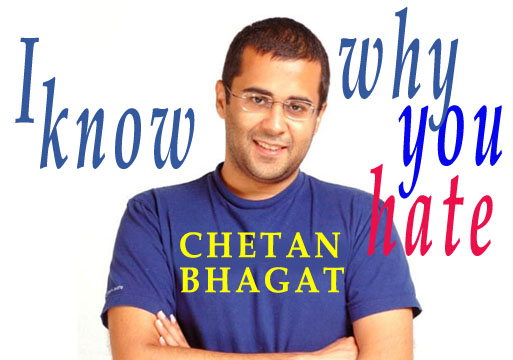
Chetan Bhagat is an Indian writer of novels. He writes in easily readable English. He is highly successful as an author, meaning he makes pots of money through the sale of his novels. His money does not come from his father’s estate or even his ‘main’ business of investment banking, which he left long ago. He does not pretend to be a savant or even a master of difficult words, which would drip out from the writings of an author fresh out of Oxford, Cambridge or Yale. Chetan Bhagat does not pretend to admire all things artistic from MOMA to Raja Ravi Verma. Chetan Bhagat does not sit in lobbies of the Calcutta Club, the India International Centre or even the Jaipur Literary Festival stage, admiring Homer, Rosseau, Kalidas or Shakespeare. Chetan Bhagat just writes, succeeds and adds considerably to his bank balance at regular intervals. Therein likes the rough sandpaper rub to the sphincter.
If Chetan Bhagat had been a struggling writer sitting at the Press Club with a not so trimmed beard in expensive salons where he has spent his own hard earned money from the sale of his books, and had been mouthing how the society refuses to read his oh so beautiful books which talk about the poverty of tribals in Dandakaranya or Bastar district or the torture that marginalized minorities have to go through in India (supposedly) then Chetan Bhagat would have been loved to bits. It is his consistent and exceptional success both in admiration and pecuniary terms that irks losers in Marxist circles.
If Chetan Bhagat had been a failure then he would have been celebrated and admired by the pseudo artistic bunch. The fact is that Bhagat is loved by his readers who are people who do not need to drop names of authors in drinking sessions in the evening or kitty parties during the day. (Oh! Yesterday I finished Satre’s book. The man is such a darling. What thoughts. Yeah! You know Kafka is a delight too.) That kind of conversation does not fit in with a Chetan Bhagat book. What’s more? Chetan Bhagat does not care. He just writes, succeeds and adds considerably to his bank balance at regular intervals. Therein likes the rough sandpaper rub to the sphincter.
The uncomfortable success of a popular writer
In contemporary India’s literary landscape, few figures provoke as much debate, admiration, irritation, and outright dismissal as Chetan Bhagat. His journey, from investment banker to one of the country’s most commercially successful English-language novelists, represents a tectonic shift in what constitutes literary success in India. Yet, the very qualities that have enabled his rise, simplicity of language, accessibility of themes, and unapologetic commercial orientation, have also made him a lightning rod for criticism. His story is not merely about one man’s literary career; it is about the changing nature of readership, class anxieties, cultural gatekeeping, and the uneasy coexistence of art and commerce.
Simplicity as a deliberate choice
At the heart of Bhagat’s appeal lies a stylistic decision that many in elite literary circles continue to view with suspicion: he writes in simple, easily readable English. This is not the English of dense metaphors, layered symbolism, or obscure allusions to classical texts. It is conversational, direct, and deliberately stripped of ornamentation. In a country where English itself functions as both a bridge and a barrier, this choice is revolutionary.
India’s English-reading population has expanded dramatically over the past few decades. Much of this readership consists of first-generation English users, students from small towns, young professionals, and aspirants navigating a rapidly globalizing economy. For them, literature written in overly complex prose can feel exclusionary. Bhagat’s writing meets them where they are. It validates their linguistic comfort zone rather than challenging it in ways that might alienate them.
Critics often mistake simplicity for lack of skill. However, writing simply while retaining engagement requires its own discipline. The ability to communicate ideas without relying on linguistic flourish demands clarity of thought and precision of expression. Bhagat’s work demonstrates an understanding of his audience that many “serious” writers fail to achieve.
Commercial success and its discontents
Bhagat’s success is measurable in the most unambiguous terms: sales figures. His novels sell in millions. They are adapted into films, translated into multiple languages, and discussed widely across social strata. His financial success is not inherited wealth nor a byproduct of another profession. He left investment banking long ago to pursue writing full-time, and writing has rewarded him handsomely.
This financial independence is crucial. It challenges a long-standing assumption that literary merit and commercial success are inversely related. In many traditional literary ecosystems, the struggling writer, financially precarious but artistically “pure”, is romanticized. Success, especially monetary success, is often viewed as evidence of compromise.
Bhagat disrupts this narrative. He neither apologizes for his earnings nor cloaks them in false modesty. He writes, sells, earns, and repeats the cycle with remarkable consistency. For many aspiring writers, this is inspiring. For others, particularly those who equate artistic legitimacy with obscurity or limited readership, it is deeply unsettling.
The myth of the suffering artist
Indian literary culture, especially in its English-language segment, has long been influenced by a particular archetype: the suffering artist. This figure is often imagined as someone who struggles against societal indifference, producing work of profound depth that goes largely unrecognized in their lifetime. There is an implicit moral superiority attached to this struggle.
Bhagat does not fit this mold. He is not the bearded, underappreciated intellectual lamenting society’s failure to appreciate his nuanced explorations of marginalization. He does not position himself as a martyr to artistic integrity. Instead, he engages directly with his readers, often writing about themes that resonate with middle-class aspirations, education, relationships, career pressures, and social mobility.
This divergence from the archetype creates discomfort. If success can be achieved without suffering, if readership can be built without catering to elite tastes, then what becomes of the moral hierarchy that privileges the obscure over the popular?
Cultural gatekeeping and literary elitism
Institutions such as the Jaipur Literature Festival, India International Centre, and traditional clubs like the Calcutta Club have historically functioned as hubs of intellectual and cultural exchange. They are spaces where literature is discussed, critiqued, and celebrated. However, they also embody a certain exclusivity, social, linguistic, and ideological.
Within these spaces, literary value is often defined through a narrow lens. Writers who reference canonical figures like William Shakespeare, Homer, or Kalidasa are seen as engaging with a grand tradition. Those who admire artists like Raja Ravi Varma or institutions like Museum of Modern Art signal their cultural literacy.
Bhagat, by contrast, does not perform this cultural alignment. He does not pepper his writing with references designed to impress a narrow audience. His focus remains firmly on storytelling that resonates with contemporary readers. This refusal to engage in what might be termed “cultural signaling” is perceived by some as a lack of sophistication.
Yet, it raises an important question: who decides what constitutes literary merit? And why should accessibility be seen as a deficiency rather than a strength?
The politics of taste
Taste is never neutral. It is shaped by education, class, exposure, and ideology. In India, English-language literature occupies a particularly complex space, intersecting with issues of colonial legacy, globalization, and social mobility.
For a long time, the gatekeepers of English literature in India were drawn from a relatively narrow demographic—urban, elite, and often educated in institutions that emphasized Western literary traditions. Their preferences naturally reflected their backgrounds. Dense prose, experimental structures, and intertextual references became markers of quality.
Bhagat’s work challenges these markers. His readers are not limited to elite circles; they include students from engineering colleges, young professionals in small towns, and first-time readers of English novels. For them, his stories are not “simplistic”; they are relatable.
The tension, therefore, is not merely about literary style. It is about whose tastes are considered legitimate. When Bhagat’s books outsell those of critically acclaimed authors, it disrupts the implicit hierarchy that places elite taste above popular preference.
Success as a source of resentment
It is often said that success breeds envy, but in Bhagat’s case, the resentment seems to stem from a deeper source. His success is not accidental or fleeting; it is consistent and sustained. Each new book finds an audience. Each release reinforces his position in the market.
For critics who operate within frameworks that valorize struggle and marginality, this consistency is difficult to reconcile. If a writer can achieve both popularity and financial success without conforming to established notions of literary excellence, then those notions themselves come under scrutiny.
The irritation directed at Bhagat is not always articulated openly. It manifests in dismissive reviews, condescending commentary, and a tendency to exclude him from serious literary discussions. Yet, these reactions reveal more about the insecurities of the critics than about the quality of his work.
The middle-class imagination
One of Bhagat’s most significant contributions lies in his portrayal of the Indian middle class. His novels often revolve around characters navigating education systems, corporate environments, and personal relationships. These are not grand narratives of historical upheaval or philosophical inquiry; they are stories of everyday life.
For millions of readers, this representation is powerful. It reflects their own experiences, aspirations, and anxieties. In a literary landscape that has often prioritized either rural poverty or elite cosmopolitanism, the middle class has been underrepresented.
Bhagat fills this gap. He writes about engineering colleges, call centers, and urban relationships with a familiarity that resonates deeply with his audience. This focus on the middle class is sometimes dismissed as trivial, but it is, in fact, a reflection of India’s socio-economic transformation.
The question of literary merit
The debate around Bhagat inevitably leads to the question of what constitutes good literature. Is it complexity of language? Depth of theme? Innovation in form? Or is it the ability to connect with readers?
There is no single answer. Literature serves multiple purposes, it can challenge, entertain, provoke, and comfort. Different readers seek different experiences. To judge all writing by a single معيار is to ignore this diversity. Bhagat’s work may not align with traditional definitions of literary excellence, but it fulfills a crucial function: it brings people into the habit of reading. For many, his books are a gateway to literature. Once readers develop confidence and interest, they may explore other authors and genres.
In this sense, his contribution extends beyond his own writing. He expands the readership base, creating opportunities for the broader literary ecosystem.
The economics of publishing
The publishing industry, like any other, operates within economic constraints. Books need to sell for publishers to survive. In this context, authors like Bhagat play a vital role. Their commercial success subsidizes riskier projects, debut novels, experimental works, and niche genres.
This economic reality is often overlooked in discussions about literary value. There is a tendency to romanticize the industry as purely artistic, ignoring the financial considerations that underpin it. Bhagat’s success highlights the importance of market dynamics.
He understands his audience, delivers what they want, and in doing so, sustains a business model that benefits multiple stakeholders. This pragmatic approach contrasts sharply with the idealized vision of literature as detached from commerce.
The global context
Bhagat’s trajectory is not unique to India. Around the world, popular authors who achieve massive commercial success often face similar criticism. Whether it is genre fiction in the West or mass-market novels in other regions, the divide between “serious” and “popular” literature is a recurring theme.
However, the Indian context adds layers of complexity. The legacy of colonial education, the diversity of languages, and the rapid expansion of the middle class create a unique environment. Bhagat’s success reflects these dynamics. He is not merely a writer; he is a cultural phenomenon shaped by—and shaping—the society in which he operates.
Authenticity versus performance
One of the reasons Bhagat resonates with readers is his perceived authenticity. He does not attempt to project an image of intellectual superiority. He does not engage in performative admiration of canonical figures or institutions. His public persona aligns with his writing, direct, unpretentious, and focused.
In contrast, some writers feel compelled to perform a certain kind of intellectualism to gain acceptance within elite circles. This performance can create a disconnect between the writer and the reader. Bhagat’s refusal to engage in such performance is both a strength and a source of criticism.
Authenticity, however, is not easily measured. It is a perception shaped by reader experience. For Bhagat’s audience, his authenticity lies in his ability to speak their language, literally and figuratively.
The role of ideology
The criticism directed at Bhagat is sometimes framed in ideological terms. His focus on middle-class aspirations and individual success is seen by some as aligned with a capitalist worldview. In contrast, literature that addresses issues of marginalization, inequality, and systemic injustice is often associated with more left-leaning perspectives.
This ideological divide influences how different groups perceive his work. For some, his stories are empowering; for others, they are insufficiently critical of societal structures. However, reducing literature to ideological categories can be limiting. It risks overlooking the multiplicity of voices and experiences that literature can encompass.
Bhagat’s work does not claim to address all aspects of society. It focuses on a specific segment, and within that scope, it offers insights and narratives that resonate with its audience.
The democratization of reading
Perhaps the most significant impact of Bhagat’s success is the democratization of reading. By making English-language novels accessible to a wider audience, he challenges the notion that literature is the preserve of a privileged few. This democratization has far-reaching implications. It encourages publishers to cater to diverse audiences, inspires new writers to enter the field, and fosters a culture of reading that transcends traditional boundaries. In a country as diverse as India, this inclusivity is crucial. Literature should not be confined to elite spaces; it should be a shared cultural resource. Bhagat’s work contributes to this vision, even if it does so in ways that do not conform to established norms.
The persistence of hierarchy
Despite these changes, hierarchical attitudes persist. The divide between “high” and “low” literature continues to shape critical discourse. Authors like Bhagat are often placed at the lower end of this hierarchy, regardless of their impact. This persistence reflects broader social dynamics. Hierarchies are not easily dismantled; they adapt and reassert themselves in new forms. In the literary world, they manifest through awards, critical recognition, and institutional validation. Bhagat’s relative exclusion from these spaces does not diminish his success, but it highlights the gap between popular and critical recognition. Bridging this gap requires a re-evaluation of how literary value is defined.
Redefining success in literature
Chetan Bhagat’s career compels us to rethink fundamental assumptions about literature. His success challenges the idea that complexity equates to quality, that financial success undermines artistic integrity, and that readership should be limited to elite circles. He represents a shift towards a more inclusive literary culture—one that values accessibility, relatability, and engagement. While his work may not satisfy all critics, it fulfills an essential role in expanding the reach of literature.
The discomfort he provokes is, in many ways, a sign of change. It reflects the tension between old hierarchies and new realities. As India’s reading public continues to evolve, the definitions of literary success will likely evolve with it. In the end, literature is not a zero-sum game. There is space for both the complex and the simple, the niche and the popular, the experimental and the accessible. Bhagat’s journey reminds us that success in literature can take many forms—and that perhaps the true measure of a writer lies not in conformity to established norms, but in the ability to connect with readers in meaningful ways.