
The Indian Air Force (IAF) is reportedly moving to acquire hundreds of R-37M (RVV-BD) long-range air-to-air missiles to equip its Su-30MKI fleet, significantly extending its beyond-visual-range (BVR) strike capability. This strategic shift is largely driven by tactical lessons learned from ‘Operation Sindoor’ in May 2025, during which the IAF reportedly faced challenges against Pakistan Air Force J-10CE fighters equipped with 200 km-range Chinese PL-15 missiles. The Chinese PL-15 missile was reportedly the game changer for Pakistan’s Air Force and for India it reportedly came as a rude shock, which the Indian Air Force is now trying to rectify
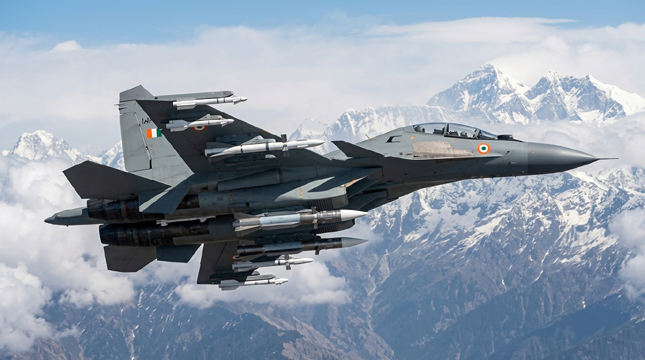
The reported Indian Air Force interest in acquiring large numbers of Russian R-37M, or export RVV-BD, long-range air-to-air missiles for the Su-30MKI fleet sits at the intersection of three trends: the return of long-range air combat as a central planning problem, the spread of Chinese missile technology into Pakistan’s order of battle, and the operational lessons drawn from the May 2025 India-Pakistan fighting conducted under the shadow of Operation Sindoor. The broad claim behind the report is easy to understand. If Pakistan’s Chinese-origin PL-15 family created a new beyond-visual-range threat envelope for the Pakistan Air Force, then India’s answer would logically involve extending the Su-30MKI’s reach so that the IAF is no longer fighting at a range disadvantage. That logic is plausible. But the details matter, and the details show a more complicated picture than the simple phrase “game changer” suggests.
What can be said with confidence is that Pakistan had already begun visibly integrating the PL-15 into its fighter force before the May 2025 crisis. Janes reported in May 2025 that Pakistan publicly showed a JF-17 Block III fitted with PL-15 missiles for the first time, and Janes assessed the PL-15’s maximum range at about 300 km, far beyond the earlier PL-12 family in Pakistani service. That matters because missile range, even when not equivalent to no-escape zone, shapes tactics, formation spacing, support aircraft survivability, and the willingness of pilots to press or disengage. A missile that credibly threatens targets much farther out changes the geometry of the fight even if real-world kill probabilities are much lower than brochure numbers.
What can also be said with reasonable confidence is that Operation Sindoor and the subsequent India-Pakistan aerial clashes jolted planners across the region. The Indian government’s own briefings establish the timing and seriousness of the crisis, while outside assessments such as RUSI’s June 2025 commentary concluded that Pakistani forces fired a significant number of PL-15 missiles, likely from J-10CE and or JF-17 platforms, and that the IAF suffered several aircraft losses during the engagements. Stimson likewise noted that recovered debris in India confirmed PL-15 use. That does not settle every dispute about who shot down what, at what distance, or under which exact sensor architecture. But it does settle the larger point: the PL-15 entered combat in South Asia and forced Indian planners to reckon with an adversary fielding genuinely long-range Chinese air-to-air weapons.
What the R-37M would give the Su-30MKI
The R-37M is not a new missile, but in Indian service it would represent a sharp doctrinal shift. Designed originally for Russian long-range interception missions, the weapon is associated with engaging high-value targets such as airborne early warning aircraft, tankers, and other support platforms, while also threatening fighters at very long ranges under favorable launch conditions. Janes has described two variants of the R-37 family and assessed the R-37M as conceived for very long-range employment, while the export RVV-BD version marketed by Rosoboronexport is presented with a launch range of up to 200 km. Open-source references also note its high speed and large warhead, characteristics that make it a serious long-range threat even allowing for real-world attrition of performance against maneuvering targets.
That distinction between domestic and export versions is crucial. A lot of public commentary casually throws around the 300 to 400 km number associated with some Janes references to the R-37M concept, then assumes India would receive exactly that. The safer reading is narrower. Rosoboronexport has publicly marketed RVV-BD at up to 200 km, and any actual Indian integration would depend on seeker performance, datalink compatibility, launch altitude, target profile, and software adaptation for the Su-30MKI. In other words, even if India buys “R-37M class” missiles, the operational effect will depend on the exact variant and the integration standard, not just on the label.
Still, even a 200 km-class weapon would materially deepen the Su-30MKI’s engagement envelope compared with older Russian BVR inventories. More importantly, it would let the IAF exploit the Su-30MKI in a role it is naturally suited for: a large, long-endurance, heavy-payload fighter that can carry substantial missile loads and stay on station. Some defense reporting in 2026 has suggested Russian proposals envisioning very heavy R-37M loadouts on Su-30 derivatives. That kind of configuration would not turn the Su-30MKI into a stealth fighter or erase every sensor disadvantage, but it would turn the aircraft into a more dangerous standoff shooter and escort-disruption platform.
Why the PL-15 triggered alarm in India
The PL-15’s significance lies not just in range, but in the wider Chinese combat system logic around it. Janes describes the missile as AESA-seeker equipped and substantially more capable than the older PL-12. Analysts writing after the May 2025 clashes, including at RUSI and The Diplomat, emphasized that the Pakistani concept of operations likely used networked sensors, airborne early warning support, and data links to build an “air ambush” rather than simply relying on a fighter radar illuminating a target in isolation. That is the key point. A long-range missile becomes much more dangerous when it is part of a kill chain involving offboard cueing, electronic warfare support, and disciplined emissions control.
This is why describing the PL-15 as a rude shock is not entirely wrong, but it is incomplete. The shock was not merely that Pakistan had a missile with a quoted long range. The shock was that Pakistan could combine Chinese fighters, Chinese missiles, network support, and operational planning in a way that complicated India’s assumptions about stand-off strike packages and escort survivability. A missile never acts alone. It sits inside a doctrine. In that sense, the PL-15 episode was a warning about the maturation of Pakistan’s Chinese-backed air combat ecosystem, not just about one round of ordnance.
The reporting also needs caution. Public claims about 200 km shots, specific kill chains, and exact missile effectiveness remain contested. RUSI said Pakistani forces fired significant numbers of PL-15s, but the exact circumstances of all IAF losses remain disputed, and some commentary has argued that some aircraft may have been threatened or hit by surface-to-air systems rather than solely by air-to-air missiles. That ambiguity is normal in the aftermath of a short, politically sensitive conflict. Serious defense analysis is about probabilities and evidence trails, not social-media certainty.
Operation Sindoor and the rebirth of long-range air combat lessons
Operation Sindoor did something the region had not experienced at that scale in years: it forced both India and Pakistan to confront a compressed, high-end fight involving stand-off munitions, layered air defense, drones, electronic warfare, and beyond-visual-range air combat. India’s official material on the operation emphasizes precision, preparedness, and the integration of indigenous systems. Outside analysts, however, have focused just as much on the aerial engagement itself and the way it exposed vulnerabilities and strengths on both sides. RUSI’s commentary described a major exchange of long-range missiles. The Australian Air and Space Power Centre later called it a “near-peer air war” in brief format. Stimson highlighted the confirmation of PL-15 use. That cluster of assessments from reputable defense voices is why the episode has attracted so much attention in professional circles.
For India, the lesson was not simply “buy a longer-range missile.” The deeper lesson is that BVR combat is now a systems contest where radar quality, data fusion, offboard support, missile kinematics, electronic attack, pilot training, and battle management all shape the result. A longer-reaching missile helps. It can even alter the tactical balance. But if it is not paired with robust sensor support, secure networking, electronic protection, and disciplined doctrine, it becomes an expensive line item rather than a true capability leap. The world’s air arms have been relearning this lesson from Ukraine to the Western Pacific: missiles with impressive range figures matter most when integrated into a coherent kill web.
The Su-30MKI’s strengths and limits in an R-37M era
The Su-30MKI remains one of the IAF’s central combat assets because of its range, payload, and fleet size. On paper, it is exactly the sort of aircraft that can benefit from a very long-range air-to-air missile. It can carry heavy stores, patrol for extended periods, and act as a missile truck if linked to the right sensor and command architecture. In that sense, pairing the platform with the R-37M is operationally logical. It would allow India to create patrols capable of holding Pakistani support aircraft at greater risk, complicating the PAF’s use of airborne early warning and its broader BVR tactics.
But there are hard limits. The missile does not magically make the Su-30MKI stealthy. It does not remove the challenge of being detected, tracked, and targeted in a contested electromagnetic environment. It also does not automatically solve the sensor mismatch problem if the opposing side is operating modern AESA radars and networked airborne support. Much will depend on the Su-30MKI upgrade path, including radar modernization, mission computer integration, secure datalinks, and electronic warfare improvements. A missile buys reach. It does not buy invisibility.
There is also the issue of export dependence. If India does move for large numbers of RVV-BD class missiles, it will be adding another critical dependency on Russian supply and support at a time when sanctions, production stress, and Russia’s own wartime consumption have complicated defense-industrial reliability. That does not mean the deal cannot happen. It does mean planners would have to think beyond acquisition to sustained stockpile depth, integration timelines, testing, and wartime replenishment. In modern air warfare, a missile inventory is not just a catalog entry. It is a logistics problem married to a training problem.
What authoritative defense voices really suggest
Across the more serious defense commentary, there is broad agreement on three points. First, the PL-15 is a major capability step for Pakistan compared with earlier BVR stocks. Janes is clear on the jump in range class and technology. Second, the May 2025 clashes demonstrated that South Asian air combat has entered a much more demanding phase, one where long-range engagements and networked systems are central rather than peripheral. RUSI, Stimson, and later professional airpower commentary all point in that direction. Third, long-range missile procurement alone is not enough; the decisive question is how these missiles are embedded in tactics, sensors, and battle networks.
That is why the most sober interpretation of the reported Indian move is not panic but adaptation. The IAF appears to be adjusting to a battlespace in which the comfortable assumption of range parity can no longer be made. The PL-15 did not rewrite all the rules by itself, but it highlighted the costs of letting an adversary hold the outer ring of the engagement envelope. If India answers with the R-37M, it is signaling that it wants to contest that outer ring again.
From rude shock to doctrinal reset
Calling the PL-15 a game changer is defensible if the term is used carefully. It was a game changer not because it guaranteed Pakistani victory or because every sensational claim made in the immediate aftermath of Operation Sindoor has been proven. It was a game changer because it forced the IAF to confront a new tactical problem under combat conditions. It exposed the degree to which Chinese weapons, when transferred to Pakistan and integrated into a broader air combat system, can alter South Asia’s operational equations. That kind of realization tends to concentrate minds very fast.
If India now equips large parts of its Su-30MKI fleet with R-37M or RVV-BD missiles, that will be less a simple purchase than a doctrinal reset. The aim would be to rebuild deterrence in the BVR arena, push the threat envelope outward, endanger Pakistani enablers, and reduce the possibility that Indian strike and escort packages are forced to operate under an adversary’s preferred missile geometry. Whether that works will depend on far more than missile range figures. It will depend on the ugly, unglamorous details of integration, training, networking, electronic warfare, and stockpile management.
That is the real lesson from global defense reporting and the serious voices in the field. Air combat is once again a competition of systems, not slogans. In that competition, the reported Indian move toward the R-37M makes strategic sense. But it will only matter if India treats the missile not as a silver bullet, but as one piece of a larger airpower redesign shaped by the hard lessons of May 2025.