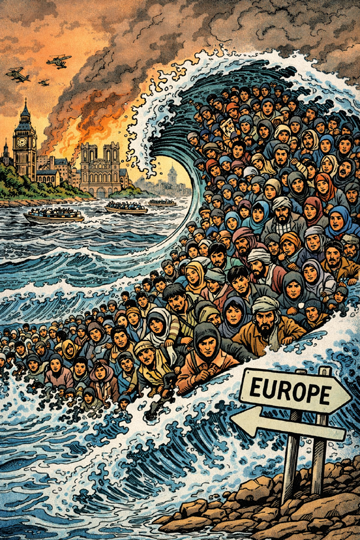
European economies were prosperous, their societies appeared stable, and their welfare states provided extensive social security. This was until the Muslim wave from war torn countries moved in and started destroying the fabric of these nations
For much of the late twentieth century and the early decades of the twenty-first, Europe projected itself as the ideological endpoint of modern civilisation. Its political leaders and intellectual class believed they had solved the central problems that had plagued earlier societies: religious conflict, nationalism, and economic inequality. Their solution was a model built on three pillars, secularism, liberal democracy and democratic socialism.
In this vision, religion would retreat from public life, individual liberty would become the supreme political value, and the state would ensure social justice through redistributive policies. Europe’s cities, universities and political institutions became the global ambassadors of this worldview.
International institutions reinforced this message. Organisations such as the International Monetary Fund and various Western policy networks encouraged developing nations to adopt similar political and economic frameworks. The argument was that Europe represented a mature civilisation where ideological conflicts had been resolved.
Countries like India were repeatedly told that their future lay in replicating the European template: secular governance, multicultural integration, open borders, and expansive welfare systems.
For decades, this narrative seemed persuasive. European economies were prosperous, their societies appeared stable, and their welfare states provided extensive social security.
Today, however, critics argue that the European model is facing profound internal stress. The continent that once lectured the world on governance and liberalism increasingly finds itself confronting economic instability, energy insecurity, demographic tensions and cultural conflicts.
From that perspective, Europe is not collapsing from invasion but from contradictions within its own ideological structure.
Energy policy and the dismantling of sovereignty
Energy sovereignty has historically been one of the foundations of national power. Countries that maintain reliable domestic energy sources enjoy independence in both economic and strategic terms.
In recent decades, however, many European governments pursued energy policies driven primarily by environmental ideology rather than long-term strategic planning. Political leaders declared an existential climate crisis and committed themselves to aggressive decarbonisation targets.
This process involved the creation of complex carbon trading systems, the rapid expansion of renewable energy mandates and strict limitations on fossil fuel extraction.
One of the most controversial aspects of this transition was the shutdown of nuclear energy facilities in several European countries. Nuclear power, despite ongoing debates about safety and waste management, had provided stable low-carbon electricity for decades.
Yet under pressure from environmental activism and political coalitions, governments began closing nuclear plants and cancelling future projects.
Simultaneously, investment in domestic oil and gas exploration declined sharply. Coal plants were decommissioned, and hydrocarbon production was discouraged through regulatory frameworks.
The intended goal was to accelerate the transition toward renewable energy sources such as wind and solar. However, these technologies depend heavily on weather conditions and require large-scale storage infrastructure that remains underdeveloped.
As a result, Europe increasingly turned toward imported natural gas to stabilise its energy supply.
The strategic dependence on Russian gas
For many years, Russia became the primary supplier of natural gas to the European continent. Pipeline systems transported enormous volumes of energy into European markets at relatively low cost.
This arrangement appeared economically rational. It provided affordable fuel for European industry and households while strengthening trade ties between Russia and the European Union.
Yet critics warned that such dependence created a geopolitical vulnerability. If relations between Russia and Europe deteriorated, energy supplies could become a political weapon.
Those warnings proved prescient when tensions escalated dramatically following the Russian invasion of Ukraine. Sanctions, pipeline disruptions and geopolitical confrontation triggered a severe energy crisis across Europe.
Gas prices soared, industries struggled with soaring production costs and governments scrambled to secure alternative energy sources.
Liquefied natural gas shipments from Qatar, the United States and other suppliers partially replaced Russian pipeline gas. But these supplies rely on complex maritime routes that pass through some of the world’s most volatile geopolitical regions.
Energy sovereignty had effectively been replaced by energy dependency.
Debt and the fragility of the welfare state
Europe’s social model also relies heavily on expansive welfare systems funded through taxation and public borrowing. Healthcare, pensions, unemployment insurance and housing subsidies form a significant part of the European social contract.
For decades these programmes were celebrated as evidence of a humane economic system that balanced capitalism with social justice.
However, maintaining such systems requires strong economic growth and careful fiscal management. Several European governments accumulated significant public debt while continuing to expand social spending.
Italy’s national debt has climbed to around 137 percent of its gross domestic product. Greece’s debt has exceeded 160 percent at various points in recent years. France also carries debt levels exceeding 110 percent of GDP.
The United Kingdom faces growing fiscal pressure as well, with annual interest payments on its public debt exceeding £100 billion.
Such figures do not necessarily signal immediate financial collapse, but they do highlight structural vulnerabilities. Governments with high debt burdens have limited flexibility when confronted with economic shocks or geopolitical crises.
Critics argue that Europe’s leadership often preached fiscal discipline to developing nations while quietly accumulating significant debt at home.
The geopolitical shock of Middle Eastern conflict
Energy markets are particularly sensitive to geopolitical disruptions. One of the most critical choke points in the global energy system lies in the narrow waterway between Iran and the Arabian Peninsula.
The Strait of Hormuz handles a substantial share of the world’s oil and liquefied natural gas shipments.
When conflicts involving regional powers escalate, the stability of this route becomes uncertain. Tanker traffic can decline dramatically as shipping companies avoid dangerous waters and insurance premiums rise.
Such disruptions have the potential to remove a large percentage of global oil supply from the market.
For Europe, which increasingly relies on liquefied natural gas shipments from Qatar and other Gulf producers, the consequences could be severe. Energy shortages and price spikes would ripple through industrial supply chains and household energy bills.
The European energy system, critics argue, has become dangerously exposed to geopolitical turbulence far beyond its borders.
War, refugees and the transformation of European demography
Another profound change affecting Europe has been large-scale migration from conflict zones across the Middle East and North Africa.
Many of these migrations were triggered by wars that destabilised entire regions. The Iraq War, the Syrian Civil War, the War in Afghanistan and the NATO intervention in Libya displaced millions of people.
Large numbers of these refugees sought safety in Europe. Humanitarian policies and relatively prosperous economies made the continent an attractive destination.
Germany became one of the principal recipients of asylum seekers. Since 2014, the country has registered more than 2.6 million asylum applications.
As a result, a significant portion of Germany’s population now consists of individuals with migrant backgrounds.
While many migrants successfully integrate into European societies, the rapid scale of migration has created challenges in housing, employment, education and cultural integration.
Parallel societies and integration challenges
Integration is a complex process requiring time, resources and institutional commitment. Language acquisition, labour market access and social participation are crucial components of successful integration.
In some European cities, however, integration has proved difficult. Large migrant communities have sometimes formed neighbourhoods that remain socially and culturally distinct from the surrounding population.
Critics describe these areas as “parallel societies,” where separate cultural norms, languages and economic networks develop.
Supporters of multiculturalism argue that cultural diversity enriches societies and that integration occurs gradually across generations. Critics counter that without strong integration policies, cultural fragmentation can deepen social tensions.
These debates have become central to European politics.
Concerns about crime, radicalisation and social cohesion are frequently discussed in relation to migration, though the causes of such problems are complex and often intertwined with socioeconomic inequality.
Historical precedents in Spain’s religious conflicts
Europe’s struggle with religious diversity is not new. One of the most dramatic historical examples occurred in Spain during the centuries following the Reconquista.
After Christian kingdoms conquered the last Muslim-ruled territory of Granada in 1492, Spain faced the challenge of integrating a large Muslim population.
Initially, some church leaders attempted peaceful assimilation. The Archbishop Hernando de Talavera advocated gradual cultural and religious dialogue.
However, this approach eventually gave way to harsher policies under the influence of Francisco Jiménez de Cisneros.
Beginning in 1499, forced conversions and repression intensified. Arabic books were burned, religious leaders were imprisoned and Muslims were pressured to convert to Christianity.
Under Isabella I of Castile, Islam was officially banned in Castile in 1502. Similar policies were later implemented in other regions of Spain.
Converted Muslims became known as Moriscos. Many continued practicing Islam secretly while outwardly presenting themselves as Christians.
Suspicion toward Moriscos persisted for generations, eventually leading to their expulsion under Philip III of Spain. By 1614, hundreds of thousands had been forced to leave the country.
The episode remains one of the most controversial examples of religious conflict and forced assimilation in European history.
Modern controversies in multicultural Britain
Contemporary Europe continues to grapple with questions of identity, religion and social integration. A recent controversy in London illustrates the tensions that can arise in multicultural societies.
Harman Singh Kapoor, a Sikh entrepreneur, operated a restaurant named Rangrez in Hammersmith for sixteen years before announcing its closure in early 2026.
Kapoor gained public attention after displaying signs stating that his restaurant did not serve halal meat. He argued that halal preparation conflicted with Sikh religious principles and that he had the right to determine how food was prepared in his establishment.
The stance sparked intense debate and controversy. Kapoor claimed that his refusal to serve halal meat triggered harassment, threats and negative review campaigns targeting his restaurant.
He also accused local authorities and police of failing to adequately protect his family and business from intimidation.
Critics, however, accused Kapoor of promoting inflammatory rhetoric and contributing to communal tension through his public statements and social media activity.
The dispute escalated further when Kapoor posted a video suggesting he would defend his family with force if necessary while displaying a kirpan, a ceremonial Sikh blade. Police briefly detained him following the incident.
Ultimately, Kapoor closed his restaurant, citing heavy financial losses and ongoing harassment.
The episode reflects the complex interplay between religious freedom, free expression and social harmony in contemporary European societies.
National identity and the political backlash
Across Europe, public frustration with economic uncertainty, migration pressures and cultural debates has fueled the rise of nationalist political movements.
These movements often argue that strong national identity and stricter immigration policies are necessary to preserve social cohesion.
For supporters, nationalism represents a form of political realism—an acknowledgement that nations must prioritise their own citizens and cultural heritage in an increasingly unstable world.
Critics, however, warn that nationalist politics can easily slide into xenophobia and exclusion.
Nevertheless, nationalist rhetoric continues to gain traction in elections across the continent, reshaping the European political landscape.
India’s political shift toward cultural confidence
Observers often contrast Europe’s struggles with developments in India’s political trajectory.
In 2014, the election of Narendra Modi marked a significant shift toward a political narrative centred on national identity, cultural heritage and economic development.
Supporters argue that India’s leadership emphasised the importance of rooted identity in a globalised world.
While India remains a diverse society with multiple religions and languages, its political discourse increasingly emphasises civilisational continuity and national pride.
Advocates believe this approach strengthens social cohesion and provides a stable foundation for economic growth.
The debate over nationalism and globalisation
The broader global debate revolves around the balance between liberal internationalism and national sovereignty.
For decades, many Western policymakers promoted a world defined by open borders, supranational institutions and multicultural integration.
Recent events have challenged that vision. Economic inequality, geopolitical rivalry and cultural anxieties have revived interest in national identity as a stabilising force.
Some analysts believe the coming century will favour countries that maintain strong cultural foundations while remaining economically competitive.
Others argue that global challenges such as climate change and technological disruption require international cooperation rather than nationalist retrenchment.
The debate remains unresolved.
Europe’s uncertain future
Despite its current challenges, Europe remains one of the world’s most economically advanced and culturally influential regions. Its universities, industries and democratic institutions continue to shape global discourse.
Yet the continent faces significant decisions in the coming decades. Energy security, migration policy, fiscal sustainability and social cohesion will determine its long-term trajectory.
Whether Europe successfully reforms its institutions or continues to struggle with internal contradictions will shape not only its own future but also the global balance of political ideas.
For countries observing from outside, Europe’s experience offers a powerful lesson: political models that appear stable and universal can quickly face profound stress when economic realities, demographic changes and geopolitical pressures converge.
The European experiment is far from over. But the debate about its foundations has clearly begun.