To understand Iran properly, it is necessary to separate three concepts that are often confused: ethnicity, language, and political identity. Persian culture has indeed played a central role in Iranian state formation and literature. However, Persian identity represents only one strand within a much broader Indo-Iranian tapestry
Modern discussions about Iran often simplify the country’s identity into a single word: Persian. The term has historical resonance and cultural prestige, yet it obscures the remarkable diversity that has shaped the Iranian plateau for millennia. Much like the civilizational complexity of India, Iran is not the story of one people alone. It is the product of migrations, cultural exchanges, imperial expansions, and linguistic transformations that have unfolded across thousands of years.
When outsiders refer to Iran as “Persian,” they usually mean that the majority population historically identified as Persians and that the national language, Persian or Farsi, has dominated literary and administrative life. Yet such a description masks the deeper reality of the region. Iran is a vast cultural mosaic inhabited by many different ethnic groups, languages, and regional identities.
This complexity is not a modern phenomenon created by contemporary politics or nationalism. Rather, it is rooted in the deep past of the Indo-Iranian world, where different branches of related peoples settled across the plateau, the Caspian coast, the mountains of the Zagros, and the deserts stretching toward Central Asia.
To understand Iran properly, it is necessary to separate three concepts that are often confused: ethnicity, language, and political identity. Persian culture has indeed played a central role in Iranian state formation and literature. However, Persian identity represents only one strand within a much broader Indo-Iranian tapestry.
Iran as a civilisational crossroads
The Iranian plateau sits at one of the great crossroads of Eurasia. To the west lie Mesopotamia and the Mediterranean world. To the north stretch the Caucasus and the Eurasian steppe. Central Asia lies to the northeast, while the Indian subcontinent spreads out to the east and southeast.
For thousands of years this geography ensured that Iran would become a meeting ground for migrating peoples, traders, armies, and religions. Indo-Iranian tribes arrived in waves during the second millennium BCE, spreading across large parts of Central Asia, Iran, and northern India.
Over time these tribes diversified into multiple linguistic and cultural communities. Some moved westward and southward across the Iranian plateau, while others moved eastward into the Indian subcontinent. The result was the emergence of two related but distinct cultural spheres: the Indo-Aryan world of early India and the Iranian world of the plateau.
These groups shared linguistic and cultural roots, reflected in similarities between ancient Iranian and Vedic traditions. Yet they gradually developed separate identities, languages, and religious traditions.
Iran’s history, therefore, cannot be understood as the story of a single homogeneous nation. Instead, it is the history of multiple Iranian peoples who shared a broad civilizational heritage but developed distinctive regional cultures.
Persians and the rise of the imperial state
Among the many Iranian groups who settled across the plateau, the Persians eventually emerged as the most politically influential. Their homeland lay in the region known in antiquity as Pārsa, corresponding roughly to modern Fars in southwestern Iran.
From this region rose one of the most powerful empires of the ancient world: the Achaemenid Empire. Founded in the sixth century BCE by Cyrus the Great, the empire expanded rapidly across Western Asia, eventually stretching from the Indus Valley to the Mediterranean.
Under the Achaemenids, Persian became the language of royal inscriptions and imperial administration. The prestige of the imperial court elevated Persian identity across the region. However, even at the height of the empire, the state governed a vast and diverse population consisting of many ethnic groups and languages.
The empire’s administrative structure acknowledged this diversity. Local languages continued to flourish, and provincial elites often retained their cultural autonomy. The Achaemenid model of governance was less about enforcing a single cultural identity and more about integrating diverse regions under imperial authority.
This pattern would continue throughout Iranian history. Persian culture often dominated the political center, but the broader Iranian world remained ethnically and linguistically diverse.
The mosaic of Iranian peoples
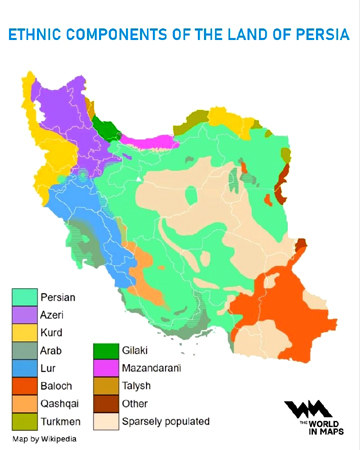
Today, Iran remains home to a remarkable array of ethnic groups whose origins trace back to different branches of the ancient Iranian world.
In the western mountainous regions live the Kurds, one of the largest stateless ethnic groups in the world. Their language, Kurdish, belongs to the Northwestern branch of the Iranian language family. Kurdish culture has developed its own literary traditions and folklore while retaining deep historical ties to the broader Iranian cultural sphere.
Further south along the Zagros Mountains live the Lurs, whose language Luri also belongs to the Iranian family. The Lurs have historically maintained a tribal social structure shaped by the rugged terrain of the Zagros belt.
In southeastern Iran reside the Baloch people, whose language Balochi forms another branch of the Iranian linguistic family. The Baloch inhabit regions that stretch across modern Iran, Pakistan, and Afghanistan, illustrating how ethnic identities in the Iranian world often transcend modern national borders.
Along the lush Caspian coast live the Gilaki and Mazandarani peoples. Their languages, Gilaki and Mazandarani, preserve unique linguistic features that differ significantly from standard Persian.
In the northeastern regions near Central Asia live the Turkmen, whose language belongs to the Turkic family rather than the Iranian one. Their presence reflects later migrations that brought Turkic peoples into the region during the medieval period.
This complex mosaic demonstrates that Iran has never been a uniform ethnic entity. Instead, it represents a layered civilizational zone shaped by centuries of migration, interaction, and political transformation.
The Indo-Iranian linguistic family
The diversity of Iranian peoples becomes clearer when viewed through the lens of historical linguistics. Persian and other Iranian languages belong to the Indo-Iranian branch of the broader Indo-European languages family.
Within this branch lie numerous languages that share common origins but evolved in different directions over time. Persian, Kurdish, Balochi, Luri, and several other languages belong to this Iranian subgroup.
These languages are not dialects of Persian. Instead, they are sister languages descended from an earlier ancestral language known as Proto-Iranian. Each developed its own vocabulary, grammar, and literary traditions.
The Indo-Iranian branch also includes the Indo-Aryan languages of South Asia, whose ancient form appears in Rigveda, the oldest text of Vedic Sanskrit. Linguists have long noted deep similarities between ancient Iranian and Vedic Sanskrit vocabulary, grammar, and mythological concepts.
This shared heritage reflects the common origin of Indo-Iranian peoples before their eventual divergence into Iranian and Indo-Aryan branches.
Avestan and the Zoroastrian tradition
Another important element of Iranian linguistic history involves the ancient language known as Avestan. Avestan is the language of the sacred texts of Zoroastrianism, particularly the Avesta.
A common misunderstanding suggests that Avestan was the direct ancestor of Persian. In reality, Avestan and Persian are parallel descendants of Proto-Iranian rather than parent and child.
Avestan belongs to the Eastern Iranian branch of the language family. It was used primarily as a liturgical language by priestly communities associated with Zoroastrian religious traditions.
These communities were concentrated in the northeastern regions of the Iranian cultural sphere, including areas corresponding to ancient Bactria and Margiana. These regions played a major role in the development and preservation of Zoroastrian religious texts.
Unlike Persian, Avestan did not evolve into a widely spoken everyday language. Instead, it remained preserved in religious rituals and scriptures, much like Sanskrit in the Hindu religious tradition.
Old Persian and the evolution of the Persian language
While Avestan developed in the eastern Iranian world, Old Persian emerged in the southwestern region of Pārsa. Old Persian was the language used in royal inscriptions of the Achaemenid kings.
These inscriptions, carved into stone monuments and administrative records, provide valuable evidence about the language and political ideology of the early Persian empire.
Over time Old Persian evolved into Middle Persian, also known as Pahlavi, during the era of the Sasanian Empire. This language became the administrative and literary language of the imperial court.
Following the Arab conquest of Iran in the seventh century CE, Persian underwent further transformation, eventually emerging as New Persian. This form of the language incorporated a large number of Arabic loanwords while retaining its Indo-Iranian grammatical structure.
New Persian would go on to become one of the great literary languages of the Islamic world, producing celebrated poets such as Rumi, Hafez, and Ferdowsi.
Memories of Iran in ancient Indian texts
The ancient relationship between the Iranian and Indian worlds is preserved not only in linguistic evidence but also in historical references found in Indian texts.
Sanskrit literature contains several references to western peoples who lived beyond the Indus region. Among these are the Parasikas and the Pahlavas.
The term Parasika is widely understood to refer to the Persians. It corresponds to Pārsa, the ancient homeland of the Persian people located in southwestern Iran near the Persian Gulf.
The term Pahlava, derived from Parthava, refers to the Parthians. The Parthians were an Iranian people whose core territory lay in northeastern Iran near the Caspian Sea.
These references illustrate how ancient Indian traditions preserved memories of distinct Iranian groups living in different regions of the Iranian world.
The Parthians and the northeastern Iranian world
The Parthians played a major role in the history of the Iranian plateau after the fall of the Achaemenid Empire. Their homeland lay in the northeastern region historically known as Parthia.
During the third century BCE, the Parthians established a powerful state known as the Parthian Empire. This empire controlled large parts of Iran and Mesopotamia for several centuries.
Unlike the centralized administrative structure of the Achaemenids, the Parthian political system relied heavily on a network of noble families and regional rulers.
The Parthian Empire served as a bridge between the Hellenistic world and the emerging powers of Central Asia and India. It also played a key role in trade along the Silk Road.
The memory of the Parthians survived in various traditions, including references in Sanskrit texts to the Pahlavas.
Language, power, and identity
The history of Iran demonstrates how language, ethnicity, and political power do not always coincide neatly. Persian language and culture gained prominence because of imperial institutions and literary traditions.
However, this dominance did not erase the identities of other Iranian peoples. Kurdish, Balochi, Luri, and other languages continued to flourish in their respective regions.
This pattern resembles the linguistic landscape of India, where multiple language families coexist within a single political framework. Just as Hindi does not define all Indian identities, Persian does not define the entirety of Iranian culture.
The arrival of Turkic peoples
Iran’s cultural diversity expanded further during the medieval period with the arrival of Turkic peoples from Central Asia. Among these were the ancestors of the modern Azeris and Turkmen.
The Azeri language belongs to the Turkic language family rather than the Iranian one. Its presence in northwestern Iran reflects historical migrations and political changes that occurred over many centuries.
Despite linguistic differences, Azeri communities became deeply integrated into Iranian society. Several major Iranian dynasties, including the Safavids, had Turkic origins yet ruled a largely Persianized cultural sphere.
Iran as a layered civilizational zone
When viewed across the long arc of history, Iran appears less as a single ethnic nation and more as a layered civilizational zone.
Different peoples settled in different regions, developed distinct languages, and interacted through trade, warfare, and cultural exchange. Empires rose and fell, but the underlying diversity of the Iranian plateau persisted.
The Persian language served as a unifying cultural medium in literature, administration, and intellectual life. Yet beneath this shared cultural framework lay a rich tapestry of regional identities.
Understanding Iran in a broader Indo-Iranian context
Recognizing Iran’s diversity also helps illuminate the deeper connections between the Iranian and Indian worlds. Both regions emerged from the broader Indo-Iranian cultural sphere and share ancient linguistic and mythological roots.
These shared origins are visible in similarities between Vedic Sanskrit and ancient Iranian languages, as well as in parallel mythological traditions.
At the same time, the two regions evolved along different historical paths shaped by geography, religion, and political developments.
The enduring complexity of Iranian identity
Today, modern Iran continues to reflect this complex heritage. Persian remains the national language and an important symbol of cultural unity. Yet millions of citizens speak other Iranian languages or belong to ethnic groups with distinct traditions.
The Iranian state, like many modern nations, must balance national unity with cultural diversity. This challenge is not unique to Iran; it is shared by many countries whose histories stretch back through centuries of migration and empire.
A civilization shaped by migration and memory
Iran’s story ultimately illustrates how civilizations emerge not from homogeneity but from interaction and transformation. Waves of migration brought different peoples to the Iranian plateau. Empires connected distant regions under shared political structures. Religious traditions preserved ancient languages long after they ceased to be spoken.
Through these processes, Iran became a civilizational zone defined not by a single identity but by the coexistence of many.
Understanding this complexity allows a deeper appreciation of Iran’s history. It reveals a world where Persians, Kurds, Baloch, Lurs, and many others contributed to a shared yet diverse cultural landscape.
Iran was never a monolith. It was, and remains, a dynamic Indo-Iranian civilization shaped by divergence, migration, ritual tradition, and imperial power.