
The vision combines engineering, environmental science, and entrepreneurial energy. Slat and his team argue that the global plastic pollution crisis could be dramatically reduced within fifteen years and for less than one billion dollars. The proposal has attracted international attention, funding, and support from engineers, investors, and governments
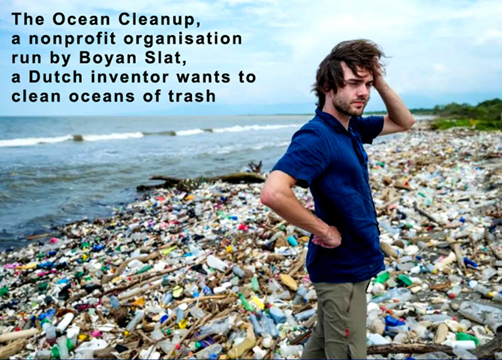
Plastic pollution in the oceans has become one of the defining environmental challenges of the twenty-first century. Over the past few decades, the mass production of plastic products has transformed economies and consumer lifestyles, but it has also created an enormous waste problem. Millions of tonnes of plastic enter the seas every year, carried by rivers, blown by winds, or dumped directly into coastal waters. Once in the ocean, plastic does not disappear; it fragments into smaller pieces that circulate in currents for decades or even centuries. The consequences affect marine ecosystems, fisheries, tourism, and human health.
In response to this escalating crisis, a new generation of environmental innovators has begun to search for solutions that go beyond traditional cleanup campaigns and recycling drives. One of the most ambitious efforts has emerged from the nonprofit organization The Ocean Cleanup, founded by the Dutch inventor and environmentalist Boyan Slat. Slat’s proposal is bold in its simplicity: instead of chasing plastic across the oceans with ships and nets, allow the ocean’s own currents to gather the waste using large floating barriers that function like giant lassos.
The vision combines engineering, environmental science, and entrepreneurial energy. Slat and his team argue that the global plastic pollution crisis could be dramatically reduced within fifteen years and for less than one billion dollars. At first glance, such a claim appears astonishingly optimistic given the vast scale of the problem. Yet the proposal has attracted international attention, funding, and support from engineers, investors, and governments. Whether the plan ultimately succeeds or not, it has already reshaped the conversation about how humanity might tackle ocean pollution.
The scale of the plastic problem
The problem that Slat seeks to address is enormous. Scientists estimate that more than eight million tonnes of plastic enter the oceans every year. This waste originates from mismanaged landfills, litter carried by rivers, industrial discharge, fishing gear, and everyday consumer products. Once plastic reaches the sea, it spreads rapidly across marine ecosystems.
Ocean currents concentrate much of this debris in large rotating systems known as gyres. The most famous of these is the Great Pacific Garbage Patch, located between California and Hawaii. Contrary to popular imagination, the patch is not a floating island of trash but a vast region where plastic fragments and debris accumulate due to circular ocean currents. Scientists estimate that the patch contains hundreds of thousands of tonnes of plastic waste.
The environmental impact of this accumulation is severe. Marine animals often mistake plastic fragments for food, leading to starvation, poisoning, or internal injury. Sea turtles consume plastic bags thinking they are jellyfish, while seabirds feed small pieces of plastic to their chicks. Microplastics—tiny fragments produced by the breakdown of larger items—have now been found in fish, sea salt, and even human bloodstreams.
Beyond ecological damage, plastic pollution also imposes economic costs. Fisheries lose productivity when fish stocks decline or become contaminated. Coastal communities must spend heavily to keep beaches clean for tourism. Shipping and maritime industries face hazards when debris interferes with navigation.
For decades, environmental policy has focused primarily on preventing plastic waste from entering the ocean. Recycling, waste management improvements, and bans on single-use plastics have become common policy tools. While these measures are essential, they do little to remove the vast quantities of plastic already circulating in marine environments. This gap between prevention and remediation is where The Ocean Cleanup proposes to intervene.
The origin of the lasso concept
The idea behind The Ocean Cleanup began with a simple observation made by Boyan Slat when he was still a teenager. While diving in the Mediterranean Sea during a holiday, Slat noticed that there seemed to be more plastic bags than fish in the water around him. Disturbed by what he saw, he began researching the issue and discovered that the ocean’s currents naturally gather floating debris into certain areas.
Most cleanup efforts at the time involved ships dragging nets through polluted waters. However, such operations were expensive, slow, and energy-intensive. Slat realized that if plastic debris tends to concentrate in specific regions, then perhaps stationary or semi-stationary barriers could be used to capture it passively.
This insight led to the development of the “lasso” concept. Instead of towing nets across the ocean, floating barriers would be deployed in the path of ocean currents. These barriers would act like giant arms extending across the water, guiding plastic debris toward a central collection point. The currents would do most of the work, reducing the need for fuel-powered vessels.
Slat presented his early ideas at a technology conference in 2012. The concept quickly attracted public interest, partly because of the clarity and ambition of the proposal. Within a year, Slat founded The Ocean Cleanup and launched a crowdfunding campaign that raised millions of dollars for research and prototype development.
The organization assembled a team of engineers, oceanographers, and environmental scientists to evaluate the feasibility of the concept. Early studies suggested that passive collection systems could indeed gather significant quantities of plastic if placed strategically within ocean gyres.
Designing the floating lasso
The engineering challenge behind the floating lasso system is substantial. Ocean conditions are harsh and unpredictable, with strong currents, storms, and corrosive saltwater environments. Any cleanup structure must withstand these forces while remaining effective over long periods.
The Ocean Cleanup’s solution involves long floating barriers made from durable materials that sit on the surface of the water. Beneath the barrier hangs a flexible skirt that extends several metres into the water column. This skirt prevents plastic debris from drifting underneath the barrier while allowing marine life to swim safely below it.
The barriers are arranged in a curved shape, somewhat resembling the letter “U.” Ocean currents push floating debris toward the center of the curve, where it accumulates. Periodically, support vessels collect the gathered plastic and transport it to shore for recycling or disposal.
Unlike fishing nets, the barriers do not capture marine animals. Because the system moves slowly relative to the surrounding water, fish and other creatures can easily swim away. This design helps minimize ecological disruption while maximizing plastic collection.
Over the years, the organization has tested multiple versions of the system in the Pacific Ocean. Early prototypes encountered difficulties such as structural stress and inefficient debris retention. Each setback led to redesigns and engineering improvements.
The latest generation of systems has demonstrated significantly higher collection rates. In test deployments, the barriers have successfully gathered large quantities of plastic debris, including fishing nets, containers, and microplastic fragments.
The power of ocean currents
A key principle behind the lasso concept is the harnessing of natural ocean currents. The oceans are in constant motion, driven by winds, temperature differences, and the rotation of the Earth. These currents form large circular patterns known as gyres, which can trap floating debris for decades.
Instead of fighting these currents, The Ocean Cleanup’s approach uses them as an ally. By placing floating barriers in strategic locations within gyres, the system allows currents to funnel debris toward collection points.
This passive approach dramatically reduces operational costs compared to traditional cleanup methods. Ships dragging nets through the ocean must burn fuel continuously and cover vast areas to gather relatively small amounts of plastic. In contrast, a stationary or slowly drifting barrier can collect debris around the clock without consuming energy.
The idea of using natural forces for environmental cleanup reflects a broader trend in sustainable engineering. By working with natural processes rather than against them, designers can create systems that are both efficient and environmentally friendly.
Stopping plastic at its source
While removing plastic from ocean gyres is an important goal, The Ocean Cleanup has also recognized that the problem must be addressed at its source. Most ocean plastic originates from rivers that carry waste from inland regions to the sea.
To tackle this issue, the organization has developed river interception technologies designed to capture plastic before it reaches the ocean. These systems use floating barriers and conveyor mechanisms to extract debris from rivers and transport it to collection points on land.
One of the most widely deployed designs is known as the Interceptor, a solar-powered vessel that collects plastic from rivers autonomously. The device operates continuously, gathering waste carried by river currents and storing it in onboard containers until it can be removed.
The organization has deployed Interceptors in several heavily polluted rivers around the world, including waterways in Southeast Asia and Central America. By focusing on the most polluting rivers, the initiative aims to prevent large volumes of plastic from entering the oceans in the first place.
The economics of ocean cleanup
One of the most striking aspects of Boyan Slat’s proposal is the claim that the global plastic pollution crisis could be addressed within fifteen years for less than one billion dollars. In an era when environmental projects often require massive investments, this figure appears remarkably modest.
Slat argues that the relatively low cost is possible because of the passive nature of the cleanup systems. Once deployed, the floating barriers require minimal energy input and limited maintenance. Their primary operational cost involves periodic retrieval of collected debris.
Compared to the enormous economic damage caused by plastic pollution—ranging from lost fisheries to degraded tourism—the cost of cleanup may indeed represent a bargain. Governments and private donors have increasingly recognized this potential return on investment.
However, critics caution that the estimate may be overly optimistic. Ocean plastic pollution is a complex problem involving billions of individual pieces of debris scattered across vast areas. Even with efficient systems, removing the majority of this waste will require sustained effort and funding.
Nevertheless, the proposal has stimulated serious discussion about the economics of environmental restoration. By framing cleanup as a manageable financial challenge rather than an insurmountable one, Slat has helped mobilize public and private support.
Leadership and expertise behind the mission
The success of The Ocean Cleanup depends not only on engineering innovation but also on effective organizational leadership. The nonprofit’s management team combines young innovators with experienced professionals from industries such as engineering, maritime logistics, and environmental science.
Advisory boards composed of scientists, engineers, and industry experts provide guidance on technical and strategic decisions. These advisors help ensure that the organization’s designs are grounded in scientific research and practical engineering considerations.
This blend of creativity and experience has been central to the organization’s progress. Young innovators bring fresh ideas and enthusiasm, while seasoned professionals contribute technical expertise and project management skills.
The result is an organization that operates at the intersection of environmental activism, engineering innovation, and entrepreneurial ambition.
Challenges and criticism
Despite its promise, The Ocean Cleanup initiative has faced skepticism and criticism from some environmental scientists. Critics argue that removing plastic from ocean gyres may address only part of the problem while diverting attention from the need to reduce plastic production and improve waste management.
Some researchers have also expressed concern about potential ecological impacts, such as the possibility of barriers interfering with marine life or disrupting natural habitats. Others question whether large-scale cleanup operations can realistically capture the smallest microplastics.
Slat and his team have responded by emphasizing that cleanup is only one component of a broader solution. They argue that prevention, recycling, and improved waste management must continue alongside ocean cleanup efforts.
The organization has also conducted extensive environmental impact assessments to ensure that its systems minimize harm to marine ecosystems.
A vision for the next fifteen years
Looking ahead, The Ocean Cleanup envisions a future in which floating barriers operate continuously in major ocean gyres, gradually removing accumulated plastic waste. Combined with river interception technologies and improved waste management practices, this approach could dramatically reduce the amount of plastic circulating in marine environments.
If successful, the initiative could remove millions of tonnes of plastic from the oceans within the next fifteen years. Such an achievement would represent one of the largest environmental restoration efforts in human history.
The project also carries symbolic significance. It demonstrates that technological innovation and entrepreneurial initiative can play a powerful role in addressing global environmental challenges.
Turning waste into a resource
Another intriguing aspect of the initiative involves the potential reuse of collected plastic. The Ocean Cleanup has explored ways to recycle recovered materials into new products, including consumer goods and industrial materials.
By transforming ocean plastic into valuable resources, the organization hopes to create a circular economy that supports cleanup operations financially. Products made from recycled ocean plastic also help raise public awareness about the pollution crisis.
Several companies have partnered with the organization to develop products made from recovered plastic. These collaborations illustrate how environmental initiatives can intersect with commercial innovation.
A new chapter in environmental action
The story of The Ocean Cleanup reflects a broader shift in environmental thinking. For many years, environmental activism focused primarily on regulation, conservation, and public awareness. While these approaches remain essential, new technological solutions are increasingly emerging alongside them.
The idea of capturing ocean plastic with a giant floating lasso may once have seemed like science fiction. Today, it represents a tangible effort backed by engineering expertise, international funding, and growing public support.
Whether or not the ambitious goal of cleaning the oceans within fifteen years is fully achieved, the initiative has already changed the way people think about environmental problems. It demonstrates that bold ideas, when combined with scientific rigor and determined leadership, can inspire new approaches to even the most daunting global challenges.
As humanity confronts the escalating environmental pressures of the modern era, such innovation may prove indispensable. The oceans have long been symbols of the planet’s vastness and resilience. Yet they are not immune to the consequences of human activity. The effort to capture ocean trash with a technological lasso represents more than a cleanup project. It is a reminder that the same ingenuity that created the plastic age may also hold the key to repairing its damage.