
Historically, economic relations between India and France have been broad but selective, with strengths in defense procurement, aerospace, nuclear energy, luxury and consumer goods, and high technology sectors. France has long stood among the top European investors and commercial partners in India
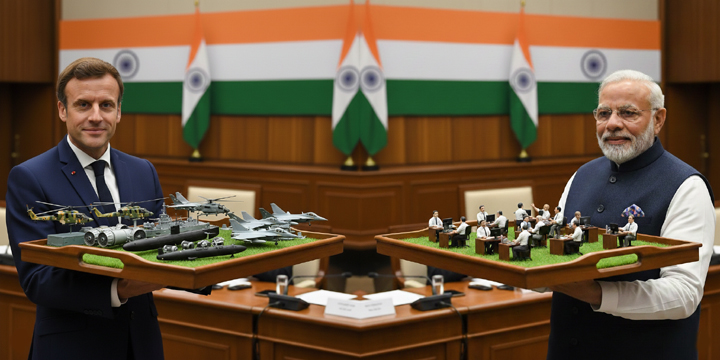
In mid-February 2026, Emmanuel Macron embarked on a landmark official visit to India from February 17 to February 19, 2026, at the invitation of Narendra Modi. The visit was built around a high-level agenda that included the Artificial Intelligence Impact Summit 2026, bilateral economic dialogues, technology innovation engagements, and the launch of the India-France Year of Innovation 2026 in Mumbai.
Both leaders used the platform not merely to reaffirm historical goodwill but to institutionalise a new epoch in bilateral relations, one that elevates economic cooperation, strategic industrial partnerships, and bilateral trade to unprecedented levels. This shift is reflected in the formal upgrade of India-France ties to a “Special Global Strategic Partnership”, encompassing trade, defense, technology, innovation, and investment coordination.
The ambitious vision outlined in these talks showcases how both nations are intent on deepening trade and business linkages, leveraging comparative strengths, strategic mutual interests, and shared outlooks on international economic governance.
Part I: The trade landscape between India and France
Historic Context of Economic Engagement
Historically, economic relations between India and France have been broad but selective, with strengths in defense procurement, aerospace, nuclear energy, luxury and consumer goods, and high technology sectors. France has long stood among the top European investors and commercial partners in India, with French firms present in sectors ranging from consumer brands and financial services to technology and infrastructure.
However, on the whole, bilateral trade volume traditionally hovered at moderate levels (e.g., merchandise trade around US $11–12 billion in 2024–25). While significant, this figure lagged behind the potential of two large economies sharing complementary industrial and strategic interests.
Macron’s 2026 visit sought to address this gap by actualising a more systems-level economic engagement, where not only goods and services but joint industrial value chains would deliver reciprocal benefits.
Bilateral trade trends and growth prospects
Over the past decade, merchandise trade between India and France grew steadily, averaging around US $11.68 billion in FY 2024–25, with continued momentum in FY 2025–26.
But beyond trade volume, recent strategic dialogues have emphasised:
- Diversification of trade baskets, moving from traditional defense and aerospace focus to include digital technology, innovation, energy transition products, and sustainable goods.
- Strengthened investment flows, encouraging French companies to expand value chains in India through joint ventures, manufacturing, and R&D.
- Trade facilitation reforms, revising tax treaties to support capital mobility, investment confidence, and legal clarity for cross-border enterprises.
These reforms signal a more facilitative environment where trade can grow not just in scale but in structural depth.
Part II: Leveraging strengths; sectoral cooperation
1. Defence and Aerospace: From Purchases to Co-Production
One of the most consequential components of the bilateral economic agenda has been defence industrial cooperation. Traditionally, India’s defence imports from France have included flagship equipment like fighters and submarine systems. But the partnership has shifted to mutual industrialisation.
During Macron’s visit, both nations moved beyond simple transactional procurement toward joint industrial pathways, such as:
- Cooperation to jointly produce Rafale fighter jets and helicopters on Indian soil, integrating French aerospace excellence with India’s manufacturing base.
- Co-production frameworks with Airbus, Safran, Tata Advanced Systems, HAL, and others to anchor production, assembly, and MRO (maintenance, repair, and overhaul) facilities in India.
This transition signals a pivotal shift where defence cooperation becomes an engine for industrial growth, jobs, and export potential, rather than a one-way purchase. It aligns with India’s Make in India ethos and France’s industrial footprint expansion strategy.
2. Technology, innovation, and digital economy
Another hallmark of the recent engagement has been technology partnership, particularly focusing on innovation ecosystems, digital commerce, and emerging technologies:
- The India-France Year of Innovation 2026 was jointly inaugurated to act as a framework for binational research, startup collaboration, digital solutions, and technological exchange.
- Collaboration across AI, digital health, sustainable progress, and innovation networks, linking research institutions, incubators, and industry players from both countries.
This initiative reflects a mutual recognition: France’s strong capacity in high-end research and Europe’s digital ecosystem can complement India’s large pool of technology talent, vibrant startup ecosystem, and expanding digital market.
3. Tax and investment law reforms to boost confidence
A significant economic policy development during Macron’s visit involved the amendment of the India-France Double Taxation Avoidance Treaty (DTAA), including the removal of the Most Favoured Nation (MFN) clause.
- Removes automatic triggers that would compel India to extend to France tax benefits it offers to other countries, providing clarity for long-term investors.
- Revises dividend taxation with reduced rates for majority holdings, aiding major French investors operating in India.
- Clarifies capital gains taxation authority, giving India enhanced rights to tax share sales, aligning with global norms and strengthening fiscal certainty.
This treaty overhaul serves as an example of how bilateral cooperation can be engineered to encourage investment, reduce ambiguity in cross-border corporate taxation, and create a predictable legal environment for business scaling.
4. Digital payments, finance, and services integration
While primarily seen as a policy discussion, the India-France dialogue has also included financial and digital services integration, particularly:
- Expansion of India’s UPI digital payment system across European markets, including France, propelling seamless cross-border commerce for consumers and businesses.
- Deepening financial technology collaboration and interoperability frameworks, which facilitate cross-border digital transactions.
This reflects India’s growing role in global digital financial infrastructure and France’s openness to embracing innovative payment ecosystems.
5. Tourism, culture, and business mobility
Beyond hard trade and industrial facets, cultural and people-to-people exchanges were part of the broader engagement. Agreements aim to promote:
- Student mobility and educational partnerships.
- Tourism linkages that support bilateral travel and tourism industries.
- Cultural exchange frameworks that can lead to broader economic cooperation.
Although not always headline economic measures, these platforms play a long-term role in reinforcing market familiarity and business confidence.
Part III: Strategic economic outcomes and forward outlook
1. A robust strategic partnership framework
Macron’s visit solidified a framework under which trade, business and strategic cooperation are jointly advanced. Upgrading to a Special Global Strategic Partnership symbolises an integrated, multi-sector lens, where economic outcomes are not incidental but central pillars of wider geopolitical cooperation.
2. Implications for supply chains and global competitiveness
Deepening India-France cooperation, especially on technology, defence, and innovation, dovetails with broader global supply chain realignments. By collaborating on advanced manufacturing, dual-use technologies, and high-value exports, India and France can jointly build alternative resilient supply routes spanning Europe–Asia, countering geopolitically risky dependencies.
Marseille’s port connections and logistics corridors have been increasingly seen as bridges linking markets across Africa, the Middle East, and Asia, enhancing France’s utility as a gateway for Indian exports and business activities in broader regions.
3. Accelerating trade and investment confidence
Tax treaty reforms, commitment to stable fiscal environments, and clear legal frameworks create predictability for investors, key to unlocking deeper French investment in India and encouraging Indian firms to expand in France and Europe. The adjustments in dividend tax and capital gains norms are practical steps that send clear signals to the business community of both nations.
4. Shared values and global economic governance
Beyond the immediate bilateral canvas, India and France project shared values of rules-based economic engagement, open markets, multilateral cooperation, and sustainable development. Their partnership aligns with international economic standards and encourages collaborative participation in shaping global trade norms, especially within frameworks like the World Trade Organization (WTO) and EU-India free trade dialogues.
Integrating strengths for a new economic axis
The 2026 visit of French President Emmanuel Macron to India marks a definitive moment in India-France economic relations, transitioning from traditional thematic cooperation to comprehensive economic co-creation. Through defence industrial collaboration, technology and innovation partnerships, legal and tax reforms, and shared approaches to global trade, both countries are forging a mutually beneficial trade and business nexus.
What distinguishes this phase of engagement is its intentionality, both nations are harnessing their strengths:
- India’s large and dynamic market, innovation talent pool, and manufacturing momentum
- France’s technological sophistication, industrial expertise, and European market access
Together, they are crafting synergistic trade mechanisms, co-manufacturing frameworks, and long-term strategic commercial partnerships that promise to redefine their economic relationship for decades.
In doing so, India and France aren’t just enhancing bilateral ties, they are shaping a collaborative model that balances economic growth, technological progress, and global cooperation in an increasingly interconnected world order.