
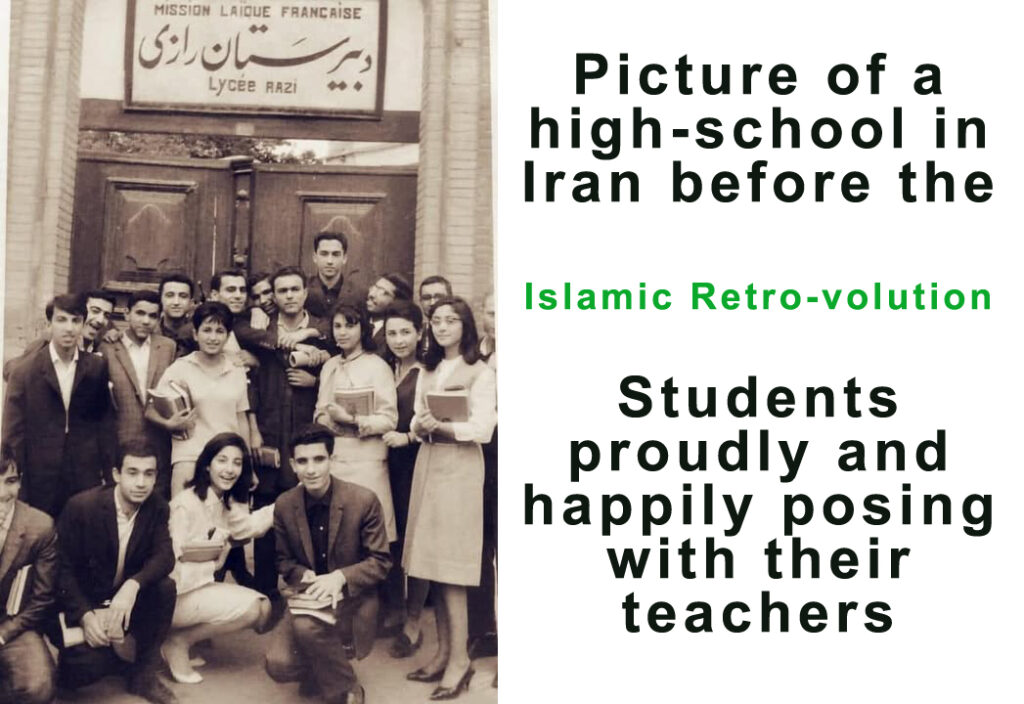
Women moved freely in Iran before 1979. Before Ruhollah Khomeini overthrew Mohammad Reza Pahlavi and transformed Iran into a blind, Islamic republic fomenting trouble and nurturing terrorists, life was different. Iran and Israel were allies before 1979
Few nations carry as deep and layered a civilizational memory as Iran. Long before it was known by its modern name, it stood at the heart of the ancient Persian empires that shaped law, governance, religion, and science across continents. The arc from the Achaemenid Empire to the modern Islamic Republic of Iran is not merely a political story; it is a civilizational debate about identity, faith, modernity, and power.
The 1979 revolution transformed Iran’s political order, redefined its diplomatic alignments, and reshaped the everyday lives of its citizens, especially women. Before that upheaval, the country was governed by Mohammad Reza Pahlavi, whose reign represented a particular vision of modernization, secular, Western-leaning, and economically ambitious. The revolution led by Ruhollah Khomeini replaced that order with a theocratic state grounded in Shia Islamic jurisprudence.
Today, as Iran navigates economic sanctions, regional rivalries, and internal dissent, debates about its cultural roots, including its pre-Islamic Zoroastrian heritage, periodically resurface. Calls for a civilizational reorientation toward Zoroastrianism are not new; they echo a longer struggle between religious authority, national identity, and scientific temper that has marked Iranian history for more than a century.
Understanding this debate requires a journey through ancient empires, modern reforms, revolution, war, and diplomacy.
Ancient Persia and the legacy of Zoroastrian thought
Long before the rise of Islam in the 7th century, Persian civilization flourished under imperial systems that influenced governance from India to the Mediterranean. The Achaemenid rulers, beginning with Cyrus the Great in the 6th century BCE, created one of history’s first large-scale bureaucratic states. Cyrus is often remembered for the Cyrus Cylinder, cited by some historians as an early charter of human rights, reflecting policies of religious tolerance and local autonomy.
The spiritual framework of that empire was Zoroastrianism, founded by the prophet Zoroaster (Zarathustra). Its core ethical triad, good thoughts, good words, good deeds, placed moral responsibility at the center of human action. Scholars of comparative religion have long noted Zoroastrianism’s influence on later Abrahamic traditions, particularly in concepts of dualism, angels, and eschatology.
Under the Sasanian Empire (224–651 CE), Zoroastrianism became closely intertwined with state authority. Persian scholars during this period advanced astronomy, medicine, mathematics, and administrative law. The city of Gundeshapur, for example, functioned as a center of learning where Greek, Indian, and Persian knowledge converged, often cited by historians as a precursor to later Islamic and European scientific institutions.
The Arab conquest of Persia in the 7th century introduced Islam as the dominant religion. Over centuries, Iran became a major center of Islamic theology, philosophy, and science. It is important to note that Iran’s scientific heritage continued robustly under Islamic rule, contributing to mathematics, optics, medicine, and philosophy during the Islamic Golden Age.
Thus, Iran’s pre-Islamic and Islamic histories are not separate silos but interconnected layers of intellectual development.
The Pahlavi modernization project
The modern state of Iran emerged from the collapse of the Qajar dynasty and the rise of the Pahlavi dynasty in the early 20th century. Reza Shah Pahlavi initiated sweeping reforms: centralizing the state, expanding railways, modernizing education, and reducing clerical authority. His son, Mohammad Reza Pahlavi, continued and expanded this trajectory.
The Shah’s “White Revolution” in the 1960s introduced land reforms, women’s suffrage, literacy campaigns, and industrialization initiatives. Women entered universities in growing numbers. Tehran in the 1960s and 1970s projected an image of cosmopolitan modernity, with visible Western cultural influences. Legal reforms reduced the authority of religious courts in matters of family law.
Iran also invested heavily in scientific and technological development. Universities expanded. Nuclear research began under the Shah with Western cooperation. Oil revenues financed infrastructure and industrial growth.
Yet modernization under the Pahlavis came with contradictions. The secret police, SAVAK, repressed dissent. Political parties were tightly controlled. Rapid urbanization created social dislocation. Economic inequality widened between elites and rural populations. Critics argued that modernization without political pluralism bred resentment.
The Shah’s secular-nationalist narrative sometimes invoked Iran’s ancient Persian glory, celebrating pre-Islamic heritage as a source of pride. The 2,500-year celebration of the Persian Empire in 1971 symbolized this orientation. However, many clerics and traditionalists viewed these gestures as marginalizing Islamic identity.
Iran and Israel before 1979
Before the revolution, Iran maintained pragmatic ties with Israel. Though not formally publicized due to regional sensitivities, the two states cooperated in intelligence sharing, trade, and security matters. Both perceived common threats in certain Arab nationalist movements.
During the Cold War, Iran also aligned strategically with the United States, hosting American advisers and purchasing Western military equipment. The Shah positioned Iran as a regional pillar against Soviet expansion and radical Arab regimes.
This diplomatic posture contrasted sharply with the post-1979 government’s stance, which has defined Israel as an adversary and reoriented alliances toward non-Western partners.
The 1979 revolution and the birth of the Islamic Republic
The Iranian Revolution was a mass uprising drawing diverse ideological streams: clerics, Marxists, liberals, students, and bazaar merchants. Economic grievances, political repression, and cultural alienation converged.
Ayatollah Khomeini emerged as the revolution’s dominant figure. The new constitution institutionalized velayat-e faqih, guardianship of the jurist, granting ultimate authority to a Supreme Leader. Iran became an Islamic republic with elected institutions operating within a theocratic framework.
The revolution reconfigured Iran’s domestic and foreign policy. Women’s dress codes were enforced. Legal structures were Islamized. Relations with the United States collapsed following the hostage crisis. Israel became an ideological adversary. Iran sought to export revolutionary ideals across the region.
Supporters argued that the revolution restored cultural authenticity and social justice. Critics contend that it curtailed personal freedoms and subordinated scientific and cultural life to religious oversight.
War, resilience, and militarization
Shortly after the revolution, Iraq under Saddam Hussein invaded Iran, triggering the Iran-Iraq War. The eight-year war devastated infrastructure and cost hundreds of thousands of lives. It also consolidated revolutionary legitimacy, as defense of the homeland transcended factional divides.
War records document extensive use of trench warfare, ballistic missiles, and chemical weapons by Iraq. Iran’s Revolutionary Guard Corps gained prominence during this period, evolving into a powerful military and economic actor.
The war reinforced a siege mentality within Iranian political culture. Sanctions, isolation, and external threats strengthened hardline narratives. Over time, Iran developed missile programs and pursued nuclear technology, leading to prolonged negotiations with world powers and the eventual 2015 nuclear agreement.
Iran’s regional strategy expanded through support for allied non-state actors, reshaping power dynamics in Lebanon, Iraq, Syria, and Yemen. This posture has drawn both strategic influence and sustained sanctions.
Women, society, and shifting freedoms
The status of women in Iran remains a focal point in debates about pre- and post-revolutionary identity. Under the Pahlavis, legal reforms expanded women’s rights in education and employment. After 1979, mandatory hijab laws and Islamic family codes altered the legal landscape.
Yet Iranian women have continued to pursue higher education at remarkable rates. In many disciplines, women constitute a significant share of university students. Iranian cinema, literature, and civil society movements often reflect female agency and critique.
Recent protests following the death of Mahsa Amini in 2022 drew global attention to demands for personal freedom and reform. These movements reveal that Iranian society is dynamic and internally contested rather than monolithic.
The tension between religious governance and evolving social aspirations continues to define domestic debates.
Scientific temper and intellectual continuity
Iran’s scientific development has persisted despite sanctions and political constraints. Universities in Tehran, Isfahan, and Shiraz maintain research programs in engineering, medicine, and physics. Iranian scholars contribute to global scientific literature.
Historically, Iran’s intellectual tradition spans both Zoroastrian and Islamic eras. The translation movements of late antiquity and the Islamic Golden Age integrated Greek, Indian, and Persian knowledge systems. Philosophers such as Avicenna (Ibn Sina) exemplified synthesis rather than rupture.
The question of scientific temper in modern Iran is thus complex. While ideological oversight influences certain fields, scientific education remains valued. The nuclear program, though controversial diplomatically, demonstrates technical capacity.
Civilizational debates about Zoroastrian heritage often emphasize ethical rationalism and pre-Islamic pluralism. However, Iran’s Islamic intellectual history also produced rigorous philosophical and scientific inquiry.
Diplomacy in a polarized region
Iran’s global diplomatic relationships have oscillated dramatically over decades. Pre-1979 alignment with the West gave way to confrontation. The hostage crisis severed ties with Washington. Sanctions regimes followed over nuclear concerns and regional interventions.
At the same time, Iran has cultivated ties with Russia and China. The nuclear agreement negotiated in 2015 with the United States, European Union, Russia, and China marked a rare moment of multilateral diplomacy. Its later unraveling revived tensions.
In recent years, regional diplomacy has shown signs of recalibration. Talks mediated by China led to a restoration of relations between Iran and Saudi Arabia in 2023. This suggests that strategic pragmatism can coexist with ideological rigidity.
Iran’s relationship with Israel remains deeply adversarial. Yet before 1979, the two states cooperated discreetly. History demonstrates that alliances in the Middle East are fluid rather than eternal.
The resurgence of Zoroastrian nostalgia
Within Iran and among segments of the diaspora, interest in pre-Islamic heritage has grown. Celebrations of Nowruz, the Persian New Year with Zoroastrian roots, are embraced nationally. Archaeological sites like Persepolis symbolize ancient grandeur.
Some argue that rediscovering Zoroastrian ethical frameworks could strengthen national cohesion and scientific rationalism. Others caution that framing identity in civilizational opposition risks oversimplifying centuries of Islamic cultural contribution.
Religious transformation at a societal scale is neither swift nor purely ideological. Iran today is overwhelmingly Shia Muslim in demographic composition. Constitutional change would require profound political shifts.
Civilizations evolve through synthesis more often than through wholesale abandonment.
Beyond binaries: Identity, reform, and future pathways
The framing of Iran’s future as a binary choice — Islam or Zoroastrianism — may obscure the more nuanced reality. Iran’s history shows layered identities: Persian, Islamic, revolutionary, nationalist, and global.
Reform movements within the Islamic Republic have periodically sought to reconcile faith with republican accountability. Intellectuals debate constitutional reinterpretation rather than religious replacement. Others advocate secular governance without erasing religious heritage.
The deeper issue may not be theology but governance: rule of law, economic transparency, gender equity, and scientific openness. Nations thrive when institutions foster accountability and innovation.
Iran’s pre-Islamic past offers lessons in administrative tolerance and imperial pragmatism. Its Islamic heritage offers intellectual depth and spiritual continuity. Its modern revolutionary experience offers cautionary insights into ideological absolutism.
History as resource, not weapon
Iran stands at a civilizational crossroads shaped by empire, faith, revolution, war, and diplomacy. Before 1979, it pursued a secular modernization aligned with Western powers and maintained quiet cooperation with Israel. After 1979, it adopted a theocratic model and reoriented geopolitically.
Women’s freedoms, scientific inquiry, and global alliances have all evolved under shifting regimes. War and sanctions hardened national resilience but also entrenched isolation.
Whether Iran’s future involves religious reform, secular recalibration, or continued ideological continuity will depend on internal political processes rather than external exhortation. History provides resources for renewal — Zoroastrian ethics, Islamic scholarship, Persian administrative tradition — but it does not dictate a single path.
Civilizations endure not by rejecting their past wholesale but by reinterpreting it with confidence and openness. Iran’s long history demonstrates that it has reinvented itself before. The question is not whether it should abandon one identity for another, but how it can harmonize its many inheritances into a stable, prosperous, and peaceful future within the global community.

