
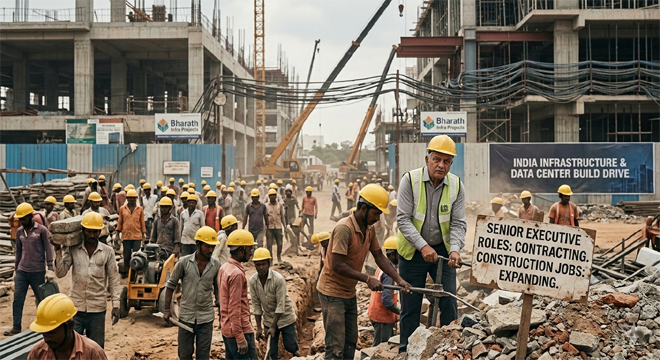
Higher level, decision making jobs are shrinking today, as the economy readjusts with new technology and goes in to mechanical construction drive similar to the time when Y2K hit or the software bubble hit where millions of lines of code had to either written or re-written. Millions of low level jobs requiring very little skill are spawning all over the Indian economy. Director or Veep level roles are currently being glossed over as there is no immediate need for them for the company to survive
In the opening months of 2026, India’s labour market presents a perplexing, and increasingly consequential, dilemma for policymakers, employers, and job seekers alike. Despite robust headline economic growth, rising digital adoption, and expanded tech-enabled hiring processes, an unsettling paradox has emerged that defies conventional narratives about employment:
- Aspirational job seekers cannot find real jobs to apply to, or feel unprepared to navigate the ones that exist.
- Employers struggle to find quality talent, even as millions of candidates queue up for limited opportunities.
- Employees already hired often lack the skills, productivity, or adaptability that employers demand, resulting in low retention, internal skill gaps, and widening mismatch.
This triangle, of unemployed aspirants, talent-hungry employers, and underperforming incumbents, is not merely anecdotal. Detailed surveys, labour force data, government surveys, and academic research are converging on the same conclusion: India’s labour market is caught in a fundamental misalignment between skills supply and demand.
The myth of ‘no jobs’: Why millions of job seekers feel stuck
Contrary to popular belief, the narrative that India simply “has no jobs” is both over-simplified and partially misleading. Official labour force data does show a declining unemployment rate, yet this statistic masks deep structural distortions that affect job seekers across sectors.
Official labour force data paints a mixed picture
According to the government’s Periodic Labour Force Survey (PLFS), unemployment in India appears moderate by traditional metrics, with figures around 5.1–5.2% in 2025, down slightly from previous quarters.
But these headline numbers conceal multiple realities:
- A significant portion of informal workers are classified as “employed” despite working irregular, low-paid, or precarious jobs.
- Labour force participation rates (LFPR) remain deceptively low, especially among women, a sign that many potential workers have dropped out of the labour force entirely.
Independent economists also point out that official unemployment data may underestimate the real scale of joblessness because of classification rules that treat any minimal work as “employment”. A Reuters poll found many experts believe the true unemployment rate is closer to twice the official figure.
Graduate aspirations vs. real job opportunities
Reports from LinkedIn and other consultancies underline the intensifying competition for jobs. According to LinkedIn’s India Job Outlook and HR data for 2026:
- 84% of Indian professionals say they feel unprepared to find a job.
- 72–76% are actively seeking new roles yet struggle with skill misalignment and AI-mediated hiring processes.
- The number of applicants per role has more than doubled since early 2022, transforming even ordinary job openings into “crowded lotteries”.
These surveys reveal that millions of job seekers do not lack intent, they lack clarity and preparation in navigating the hiring landscape. AI-driven hiring systems, while efficient, have raised the bar for role-specific skills and resume relevance, leaving many applicants at a disadvantage.
Youth, education, and skilling challenges
At a structural level, India’s educational and vocational systems have struggled to keep pace with evolving labour market demands. Only a small percentage of the workforce receives formal vocational training, leaving large swathes ill-equipped for high-growth sectors such as advanced technology, data analytics, or AI.
Academic studies show that:
- India’s labour market remains polarised, with a high concentration of low-skill jobs vulnerable to automation, even as demand rises for high-skill competencies.
- A large proportion of graduates are either underemployed or mismatched for the roles they apply to, meaning they take jobs below their qualification level or struggle to translate education into employability.
Taken together, these trends explain why so many job seekers feel both ambitious and stuck, eager to work but unclear on where the real opportunities lie.
The talent shortage paradox: Employers can’t find suitable hires
If millions of candidates complain they can’t find jobs, one might expect employers to have a field day picking from the surplus labour pool. Yet employer surveys paint a very different picture: there is a substantial “talent shortage” in India.
Employer struggles documented in global and industry surveys
Recent data from the Global Talent Shortage Survey by ManpowerGroup, one of the world’s largest talent studies, reports that 82% of employers in India find it challenging to secure the right hires for their open roles, a figure well above the global average.
Employers are particularly struggling to find candidates with:
- AI and data science skills
- Advanced digital competencies
- Role-specific technical capabilities
This aligns with LinkedIn’s findings where 74% of recruiters say it has become harder to find qualified talent over the past year.
Mismatch between job postings and candidate skills
The sheer mismatch between job requirements and candidate skill sets is striking:
- Studies show that skills needed for emerging industries often differ significantly from what most graduates possess. Academic research suggests job ads increasingly highlight technical competences that are not well represented within India’s general talent pool.
- Traditional degrees, once seen as proxies for skill, are losing currency as employers prioritize hands-on experience, project portfolios, and up-to-date technical proficiency over formal credentials.
Sectoral imbalances and demand shifts
Some industries, particularly high-tech, AI, cloud computing, and cybersecurity, are growing faster than the pace at which skilled professionals can be produced. Recruitment surveys show employers struggling to fill roles in these domains, creating a “skills gap” that persists alongside wider unemployment.
This leads to a bizarre situation:
- Companies report job openings with no qualified applicants.
- Recruiters often see applications in volume, but few that satisfy the specific criteria needed for the job.
As a result, many positions stay vacant, even in high growth segments, because employers prefer to wait for the right fit rather than compromise on quality. It’s a case of “no bad hire is better than a mismatched hire”, a principle increasingly cited in HR decision-making in 2026.
The underperforming incumbent: Employees on the payroll but lacking value
Moving beyond job seekers and unfilled positions, a third aspect of the triangle is often underappreciated: employees actually on the payroll are frequently described as underperforming, low-skilled, or mismatched to their roles.
Productivity issues in India’s workforce
Longstanding data from NITI Aayog and other policy analysts have highlighted that India’s labour productivity remains low compared to other major economies, a factor that depresses output per worker even as employment rises.
Low productivity manifests in multiple ways:
- Workers in many sectors lack role-specific skills, leading to dependence on on-the-job training or external consultants.
- Routine tasks are slow or error-prone relative to peers in more mature labour markets.
- Technological adoption without commensurate upskilling creates digital divides within teams.
Skill gaps within firms
The India Skills Report and other industry assessments reveal that:
- Even among employed workers, only around 56% are considered “job-ready” in 2026, meaning nearly half of India’s workforce still lacks the competencies employers consider essential.
- Women have made meaningful gains in employability, but workforce participation remains uneven, a factor that affects team diversity, innovation, and productivity growth.
Importantly, “job-ready” in many surveys does not necessarily mean productivity-ready, since assessments often focus on entry-level competencies rather than advanced workplace performance.
Mismatch inside organisations
Research shows that even where firms hire candidates, internal misalignment between employees’ skills and the organisation’s strategic needs is widespread. This can contribute to:
- Poor team performance and missed targets
- High training costs
- Internal attrition and morale problems
- A cycle of hiring and rehiring without real organisational capacity building
When firms lack internal frameworks for continuous upskilling and career development, existing employees quickly fall behind technological change, replicate outdated practices, and fail to innovate.
Intersecting factors: AI, automation, and changing work expectations
No analysis of India’s 2026 labour market is complete without understanding the disruptive influence of automation and AI.
AI changing hiring, not just workflows
AI is driving an ambidextrous shift:
- Hiring processes are increasingly automated, screening, shortlisting, and even interviewing with algorithmic filters, making it harder for candidates without specific keywords, portfolios, or digital presence to pass initial stages.
- AI is reshaping job content, accelerating demand for roles that blend human judgment with digital literacy, from data engineers to AI trainers.
While professionals often report being comfortable using AI, many admit they are unclear on how AI affects recruitment decisions, contributing to widespread frustration.
Automation risks widening the gap
Automation does not eliminate jobs uniformly. It tends to:
- Replace or reduce demand for repetitive, routine tasks
- Increase demand for higher cognitive skills, creativity, and adaptive problem solving
India’s labour market, with large shares of workers in low-skill or informal segments, faces a dual risk: automation may displace routine jobs while demand for high-skill roles outpaces the supply of qualified candidates. This sets up a polarised labour market, where both ends (low-skill and high-skill) are underserved, and middle-skill jobs are squeezed.
Policy, education, and structural imperatives: How India can resolve the conundrum
Solving the triangular conundrum, connecting job seekers, employers, and employee productivity, requires multi-layered reforms.
1. Rethinking education and skilling ecosystems
Instead of traditional degree-centric models:
- India needs modular, outcomes-oriented training aligned with employer needs
- Curricula must be co-designed with industry partners, particularly in emerging tech sectors
- Lifelong learning incentives should be strengthened
2. Expanding industry-education collaboration
Partnerships between educational institutions and industry, from internships to apprenticeships, can create smoother on-ramps to employment and reduce the mismatch between skills and workplace requirements.
3. Improving transparency in hiring
Employers and platforms should create clearer competency frameworks and use AI in hiring ethically and transparently, enabling applicants to understand how to compete effectively.
4. Enhancing productivity and internal capacity building
Firms should invest in:
- Continuous employee development
- Cross-functional training
- Leadership and adaptive skills, reducing the risk that incumbent workers become obsolete
5. Policy frameworks for inclusive growth
Government policies should incentivize quality job creation, support skilling pathways, and improve labour market data transparency so that aspirants, employers, and training institutions can make better decisions.
From paradox to pathways
The Indian labour market in 2026 is not “broken”, it is transitioning through a complex phase where growth, technology, education, and economic structures are rapidly evolving. The triangular conundrum, job seekers without jobs, employers without hires, and employees without productivity, reflects misalignment rather than scarcity.
If India can align its education systems, workforce policies, and corporate practices to the demands of a digital-augmented economy, this paradox can transform into an opportunity for inclusive, productive growth, mobilizing the world’s largest young workforce into meaningful, high-value employment.