
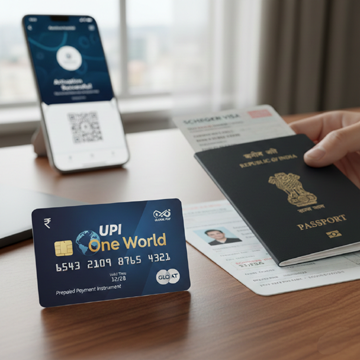
UPI One World is a prepaid payment instrument (PPI) wallet denominated in Indian rupees, linked to an international mobile number and activated after physical know-your-customer verification using passport and visa documents
India’s digital payments revolution has reached a new frontier with UPI One World, a specialized prepaid wallet designed for foreign tourists, non-resident Indians (NRIs), and overseas citizens of Indian origin (OCI). Built on the country’s Unified Payments Interface infrastructure and supported by institutions such as the Reserve Bank of India, the National Payments Corporation of India, and the Government of India, the initiative represents a strategic attempt to integrate global travelers into India’s domestic digital economy without friction. For decades, visitors arriving in India had to navigate currency exchange counters, foreign card fees, and inconsistent merchant acceptance. UPI One World seeks to eliminate those barriers entirely by allowing users to load Indian rupees into a regulated wallet and pay anywhere a UPI QR code is accepted.
Economists increasingly view payment interoperability as a major driver of tourism growth and cross-border consumption. According to projections from the International Monetary Fund, countries that reduce payment frictions for travelers can increase tourism receipts by several percentage points annually due to higher per-capita spending and reduced transaction costs. Similarly, research from the World Bank indicates that digital payment adoption contributes directly to formalization of economic activity, tax compliance, and financial inclusion. UPI One World sits precisely at this intersection—tourism, fintech, and macroeconomic modernization.
What UPI One World is and why it matters
UPI One World is essentially a prepaid payment instrument (PPI) wallet denominated in Indian rupees, linked to an international mobile number and activated after physical know-your-customer verification using passport and visa documents. Unlike conventional banking solutions, it does not require an Indian bank account or SIM card. Users can load funds through international debit cards, credit cards, or forex cards and then transact by scanning QR codes at merchants across India, from metropolitan malls to rural roadside vendors.
The significance goes far beyond convenience. India’s domestic digital payment ecosystem is already among the world’s largest, processing billions of transactions monthly. By extending that network to foreign visitors, India is exporting its payment infrastructure model. Analysts at the Bank for International Settlements have repeatedly highlighted India’s instant payment architecture as a leading example for other nations exploring retail payment modernization. The BIS has noted that interoperable real-time systems reduce reliance on cash, lower transaction costs, and stimulate innovation in financial services ecosystems.
From a traveler’s perspective, the wallet eliminates foreign exchange queues, reduces card rejection risk, and improves spending visibility through a single mobile interface. From a policy perspective, it increases transparency, traceability, and formal economic participation. For India, it also becomes a soft-power instrument—demonstrating technological leadership to millions of international visitors annually.
Activation and user journey simplified
The onboarding process for UPI One World is intentionally structured to balance ease with regulatory compliance. A traveler downloads a supported application, registers using an international phone number, and completes physical KYC at authorized counters, often located at airports or tourist hubs. Documents typically include a valid passport, visa, and payment instrument for loading funds. Once activated, the wallet functions like any domestic UPI account for merchant payments.
Partner institutions—including banks such as IDFC FIRST Bank and licensed fintech firms—issue these wallets under regulatory supervision. Users can reload funds during their stay and withdraw or transfer remaining balances back to their source accounts before departure. Importantly, onboarding and transactions carry zero fees for the user, aligning with India’s broader policy of encouraging digital payments through minimal cost barriers.
The user journey is intentionally designed to mirror domestic UPI behavior: open app, scan QR, enter PIN, confirm payment. That familiarity helps merchants accept payments seamlessly without additional infrastructure or training. For travelers, the simplicity reduces cognitive friction, encouraging higher digital spending adoption.
Economic implications for tourism, consumption, and GDP
Tourism economists argue that payment convenience directly correlates with traveler expenditure. A 2024 study by the McKinsey & Company estimated that digital payment adoption in emerging markets could unlock hundreds of billions of dollars in incremental consumption annually by reducing transaction barriers. In India’s context, this means foreign visitors are more likely to spend at small merchants, local transport providers, and informal sector vendors who previously accepted only cash.
The Boston Consulting Group has projected that India’s digital payments ecosystem could exceed $10 trillion in annual transaction value within the next decade, driven by smartphone penetration and merchant adoption. Integrating foreign users into this ecosystem expands the addressable market and creates multiplier effects across sectors such as hospitality, retail, transportation, and entertainment.
Bank economists also see macroeconomic benefits. Analysts at Goldman Sachs have argued that digitalization of payments increases productivity by reducing cash handling costs and improving transaction efficiency. Similarly, research from JPMorgan Chase suggests that real-time payment systems can enhance economic resilience by improving liquidity circulation and reducing settlement delays.
For India, where tourism contributes significantly to employment, the ability to seamlessly integrate foreign visitors into domestic payment networks could translate into higher GDP growth through increased spending velocity. The Reserve Bank has also emphasized that digital payments reduce the cost of currency management for the economy, including printing, transportation, and storage.
Global comparisons and central bank perspectives
Central banks worldwide are closely observing India’s payment innovations. Institutions such as the Federal Reserve and the European Central Bank are exploring faster payment systems and digital currency frameworks, but few have achieved the scale and interoperability seen in India’s ecosystem. Experts frequently cite India as proof that large-population economies can leapfrog traditional card-based infrastructure using mobile-first solutions.
International economist Eswar Prasad has noted in multiple analyses that India’s digital public infrastructure—including identity, payments, and data layers—represents one of the most advanced frameworks globally for inclusive finance. He argues that such systems can dramatically reduce transaction costs and increase financial participation across income groups.
UPI One World extends this philosophy internationally. Instead of building separate cross-border payment rails, India is effectively inviting foreign users into its domestic network temporarily. This model could influence global payment interoperability strategies, particularly for tourism-dependent economies seeking to modernize visitor spending experiences.
Financial inclusion, transparency, and regulatory safeguards
One of the most powerful aspects of UPI One World is its regulatory architecture. Wallet issuance follows prepaid instrument guidelines, foreign exchange rules, and anti-money-laundering requirements. Physical KYC ensures identity verification, while transaction monitoring maintains compliance with financial regulations.
Digital payments also enhance transparency compared to cash transactions. Governments worldwide recognize that traceable payments reduce tax evasion and illicit financial flows. The World Bank has repeatedly emphasized that digital financial ecosystems improve governance outcomes by creating audit trails and reducing corruption opportunities.
For travelers, security benefits are equally important. Losing cash in a foreign country can be devastating, but a regulated wallet protected by PIN authentication significantly reduces risk. Users also gain real-time transaction visibility, helping with budgeting and expense tracking during travel.
Currency exchange disruption and forex market impact
Traditionally, foreign visitors rely on currency exchange counters or international cards with high fees. UPI One World disrupts this model by allowing direct rupee loading into a digital wallet. Economists note that reducing reliance on physical exchange counters can lower transaction spreads and improve consumer welfare.
The BIS has observed that digital payment ecosystems can influence currency usage patterns by increasing the convenience of local currency transactions. For India, increased rupee usage among foreign visitors—even temporarily—supports the broader policy objective of enhancing the currency’s global relevance.
Some analysts speculate that widespread adoption of systems like UPI One World could eventually reshape retail foreign exchange markets, reducing demand for physical cash conversion services and encouraging digital cross-border settlement mechanisms.
Tourism sector transformation and merchant empowerment
From the perspective of small businesses, UPI One World represents a major opportunity. Merchants already accepting domestic UPI payments automatically gain access to foreign customers without additional investment. Street vendors, local artisans, taxi drivers, and small restaurants can now transact with international travelers seamlessly.
Tourism boards and hospitality economists emphasize that frictionless payments improve visitor satisfaction scores, which in turn influence repeat tourism and international reputation. Countries such as Singapore and South Korea have long invested in digital payment convenience for tourists; India’s approach, however, leverages an already massive domestic network rather than building a separate system.
Higher tourist spending also benefits regional economies beyond major cities. Rural tourism, heritage sites, and eco-tourism destinations stand to gain as digital payments remove logistical barriers for visitors who might otherwise carry limited cash.
Strategic implications for India’s fintech leadership
UPI has already been exported or integrated into several countries through bilateral partnerships. UPI One World strengthens India’s position as a global fintech innovator by demonstrating how domestic digital public infrastructure can support international users. Policymakers increasingly view digital payments as part of geopolitical influence—similar to how card networks shaped global commerce in previous decades.
Consulting firms argue that countries with scalable digital infrastructure gain competitive advantages in attracting investment and tourism. India’s model, combining government policy support with private innovation, is often cited as a template for emerging economies seeking rapid financial modernization.
Future outlook and expansion possibilities
Looking ahead, economists expect cross-border payment integration to accelerate globally. The IMF and BIS have both highlighted interoperability of national payment systems as a priority for reducing remittance costs and improving international commerce efficiency. UPI One World could evolve into broader cross-border payment corridors, enabling travelers to use their home payment apps directly in India and vice versa.
Central bank digital currencies (CBDCs) may also intersect with such systems. If digital currencies become mainstream, instant settlement between countries could become routine. India’s experience with large-scale digital payment adoption positions it well for that future.
Technological enhancements such as offline payments, multilingual interfaces, and AI-driven fraud detection could further improve the traveler experience. Integration with travel platforms, airline bookings, and hotel systems could create an end-to-end digital journey for visitors.
A small wallet with big economic implications
UPI One World may appear to be a simple tourist wallet, but its implications are far larger. It represents the convergence of fintech innovation, macroeconomic policy, tourism strategy, and global financial integration. By removing currency friction and enabling seamless payments across millions of merchants, India is redefining how travelers interact with local economies.
International economists consistently emphasize that payment efficiency is a hidden driver of economic growth. Whether through increased consumption, improved transparency, or enhanced financial inclusion, digital payment systems create multiplier effects across sectors. With institutional backing from the Reserve Bank, NPCI, and government authorities, UPI One World demonstrates how public digital infrastructure can extend beyond national borders to serve global users.
For travelers, it means convenience and safety. For merchants, it means access to new customers. For policymakers, it means formalization and growth. And for the global financial community, it offers a glimpse into the future of cross-border payments—instant, interoperable, and mobile-first.