
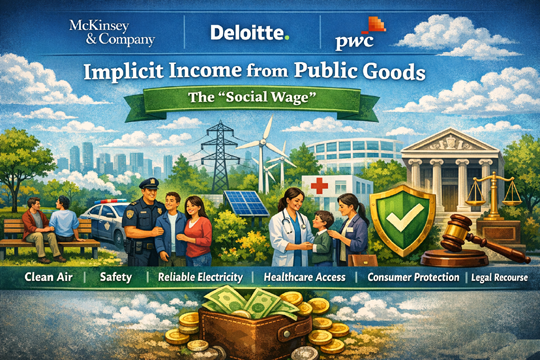
Consulting giants like McKinsey, Deloitte, and PwC have repeatedly highlighted that citizens in advanced welfare economies derive “implicit income” from public goods—clean air, safety, reliable electricity, healthcare access, consumer protection, and legal recourse. The OECD calls this the “social wage.”
Every few months, a viral social media post reignites the great diaspora debate: is life abroad really better, or are Indians romanticising Western welfare states while ignoring loneliness, high rent, and the absence of domestic help? But beneath the noise lies a more serious economic question: how does one actually compare the benefits of an organised welfare state offering social security, predictable Insurance, accessible Loans, stable Mortgage systems, and rule-based governance against a disorganised environment with chaotic enforcement, draconian taxation, and weak public services? The answer is not ideological. It is measurable. Economists, consulting firms, bilateral agencies, and think tanks have been studying this for decades, and the results consistently show that quality of institutions—not just tax rates—determines prosperity and personal wellbeing. That is why skilled migrants from countries with high tax burdens still move to nations where they may pay equal or higher taxes but receive far greater public value in return.
Consider the story of Aman Rai, an IIT Delhi graduate pursuing an MBA at the Yale School of Management, who recently described nine ways his life improved after moving to the United States. His experience triggered debate because it contradicted the increasingly popular narrative that Indians abroad are miserable. Rai described safer sidewalks, better air quality, predictable traffic behaviour, access to nature, and professional opportunities that opened rapidly—including work with a billion-dollar venture capital fund. What he was really describing, without using academic language, was institutional efficiency: the invisible infrastructure that economists say drives productivity and wellbeing more than headline GDP growth numbers. When his wife began driving within two months after avoiding it for five years in India, it was not just a lifestyle anecdote. It was a reflection of enforcement credibility—laws that actually work.
The economics of organised welfare states
Consulting giants like McKinsey, Deloitte, and PwC have repeatedly highlighted that citizens in advanced welfare economies derive “implicit income” from public goods—clean air, safety, reliable electricity, healthcare access, consumer protection, and legal recourse. The OECD calls this the “social wage.” When governments provide strong public systems, individuals spend less private money on risk mitigation. A family in a country with reliable public healthcare buys less private Insurance. A worker in a nation with unemployment benefits needs fewer emergency savings. A homeowner in a regulated financial system gets cheaper Mortgage rates because lenders face lower legal uncertainty. These benefits rarely appear in income tax comparisons, but they fundamentally shape quality of life.
The World Bank’s Worldwide Governance Indicators show a strong correlation between rule of law and per capita income. Countries with higher institutional trust attract more investment bank activity, more innovation, and more entrepreneurship. Investors care less about tax rates than about predictability. A moderate tax rate in a stable environment often beats a low tax rate in a chaotic one. That is why global capital flows into countries like the United States, Germany, Canada, and Australia despite relatively high taxes. Investors want contract enforcement, intellectual property protection, and reliable courts where an Attorney or Lawyer can defend claims efficiently.
The hidden tax of disorder
In contrast, disorganised systems impose what economists call “informal taxation.” Citizens pay bribes, waste time navigating bureaucracy, face unreliable infrastructure, and spend heavily on private substitutes for public services. Households buy water purifiers because municipal water is unsafe. Businesses invest in generators due to unstable Gas/Electricity supply. Parents pay for private Classes because public education is inconsistent. Patients travel long distances for Treatment because local hospitals lack equipment. Entrepreneurs hire Lawyers pre-emptively because regulations are unpredictable. These costs function like additional taxes but are rarely counted in national statistics.
The World Economic Forum has repeatedly ranked institutional weakness as a major barrier to competitiveness in emerging economies. Similarly, reports from the Confederation of Indian Industry and Federation of Indian Chambers of Commerce and Industry have acknowledged that regulatory complexity increases business costs significantly. When citizens complain about high income tax rates in developing countries, the frustration is often not about taxation itself but about poor return on taxes paid. People do not mind paying when they see results.
Migration as a rational investment decision
Migration economists increasingly describe moving abroad as a “human capital investment.” Individuals compare expected lifetime earnings, public services, safety, and opportunities for children. Bilateral agencies such as the International Organization for Migration and OECD have documented that migrants from middle-income countries often experience significant income jumps even after accounting for higher living costs. For skilled professionals, the gain is even larger because advanced economies reward specialised Degrees more effectively.
This is why Indians in Australia frequently report strong satisfaction despite high rents in Sydney or Melbourne. Australia offers predictable work hours, public healthcare through Medicare, safe urban planning, and strong labour protections. Salaries for skilled migrants commonly range from AUD 90,000 to 120,000, according to government labour statistics. The country’s emphasis on work-life balance—typically a 37.5-hour work week—creates time wealth, which economists now recognise as a major contributor to happiness. Parents benefit from better schooling systems focused on holistic development rather than exam pressure.
Comparing welfare models across regions
Different regions illustrate different combinations of benefits and risks. The United States provides unmatched professional opportunities, innovation ecosystems, and access to venture capital and Trading markets. Europe offers stronger social welfare safety nets, universal healthcare, and generous parental benefits. Australia combines both with high wages and relaxed lifestyle culture. Gulf countries like the UAE and Saudi Arabia offer tax-free salaries but limited political rights and vulnerabilities linked to employer sponsorship systems. China provides infrastructure efficiency but faces geopolitical tensions and visa constraints for foreigners.
For low-skilled migrants, the equation changes dramatically. Reports from human rights organisations and labour ministries highlight exploitation risks under sponsorship systems in parts of the Gulf, including withheld wages or passport retention. Deportation rates can be high when residency documentation lapses. These realities demonstrate that low taxes alone do not guarantee wellbeing. Institutional protection matters more than nominal income.
Quality of life metrics beyond income
Global quality-of-life indices attempt to quantify these differences. The United Nations Human Development Index combines income, education, and life expectancy. The Economist Intelligence Unit’s Global Liveability Index measures stability, healthcare, culture, environment, education, and infrastructure. Countries with organised welfare systems consistently rank higher despite higher taxes. Clean air alone produces measurable health benefits. Research published in medical journals shows that long-term exposure to pollution reduces life expectancy significantly. When migrants say “breathing feels like an elixir,” they are describing a public health advantage with real economic value.
Safety also has economic implications. Lower crime reduces Insurance premiums, healthcare costs, and stress-related illnesses. Reliable public transport reduces commuting time, increasing productivity and leisure. Urban planning that encourages walking or running improves physical health outcomes, lowering long-term medical expenses. These factors rarely appear in salary comparisons but significantly affect wellbeing.
Professional mobility and opportunity ecosystems
One of the most striking points in Aman Rai’s experience was rapid professional integration—working with a billion-dollar venture capital fund within months. Advanced economies benefit from dense professional networks, mentorship ecosystems, and meritocratic hiring norms. Universities host frequent Conference Call sessions with industry leaders, alumni networks facilitate introductions, and startup incubators connect entrepreneurs with investors. Silicon Valley remains the global hub of Software innovation partly because of these network effects.
Investment banks, consulting firms, and technology companies cluster geographically, creating opportunity spillovers. When one firm hires aggressively, competitors follow. Workers gain bargaining power and career mobility. In contrast, fragmented economies with fewer large employers limit upward mobility even when individuals are talented. Opportunity density matters as much as individual skill.
Financial systems and personal stability
Another major advantage of organised economies is financial system maturity. Access to Credit cards, student Loans, home Mortgages, and business financing enables wealth creation. Interest rates are often lower because legal enforcement reduces lender risk. Consumer protection laws allow individuals to dispute charges or file a Claim against unfair practices. Bankruptcy frameworks provide Recovery mechanisms rather than lifelong debt traps. These systems encourage entrepreneurship because failure is survivable.
In developing systems, informal lending dominates, often at high interest rates. Legal disputes can take years, discouraging risk-taking. Without predictable enforcement, financial inclusion suffers. Reports from the World Bank’s Doing Business project have shown that contract enforcement time varies dramatically across countries, influencing investment decisions.
Healthcare, education, and social protection
Healthcare access represents one of the clearest welfare advantages. While the US healthcare system is expensive and complex, employer-provided Insurance and advanced medical infrastructure offer treatment options unavailable in many regions. European countries provide universal healthcare with minimal out-of-pocket costs. Preventive care reduces long-term expenses and improves productivity. Rehabilitation services, mental health Rehab programs, and advanced Treatment options—from cancer therapy to organ transplants—are more widely accessible.
Education systems also shape migration decisions. Parents consider not only university Degrees but also school environments, extracurricular opportunities, and critical thinking development. Countries with strong public education reduce the need for expensive private Classes, lowering household financial stress. Even niche medical services like Cord Blood banking or specialised pediatric care are more accessible in advanced healthcare ecosystems.
Infrastructure reliability as daily luxury
Infrastructure quality often determines daily satisfaction more than income. Continuous Gas/Electricity supply eliminates the need for generators or inverters. Clean water systems reduce health risks. Waste management improves urban living. Public parks and recreational spaces enhance mental health. These benefits feel mundane until experienced. Migrants frequently report that quiet neighbourhoods, predictable public services, and organised traffic create a sense of calm rarely captured in economic statistics.
Legal systems and personal security
Rule of law influences everything from business confidence to personal safety. Efficient courts allow individuals to resolve disputes without endless delays. Consumer rights enforcement protects buyers from fraud. Property rights clarity supports Mortgage markets and real estate investment. In countries with strong legal institutions, hiring an Attorney or Lawyer is expensive but effective; outcomes are predictable. In weaker systems, legal costs accumulate without resolution, creating frustration and distrust.
Psychological impact of institutional trust
Sociologists emphasise the psychological dimension of welfare states. When citizens trust institutions, stress declines. Predictability reduces cognitive load—people do not constantly worry about corruption, safety, or bureaucratic hurdles. This mental bandwidth frees energy for creativity, entrepreneurship, and relationships. Studies from behavioural economics show that chronic uncertainty reduces productivity and decision quality. In this sense, organised governance acts as a national productivity multiplier.
The diaspora paradox: nostalgia versus reality
Despite these advantages, migrants often express nostalgia for home. Cultural familiarity, extended family support, and social belonging matter deeply. Food, festivals, language, and spontaneous social interactions create emotional richness. Welfare states cannot replace community bonds. That is why migrants sometimes complain online despite objectively improved living conditions. Humans evaluate life not only through material metrics but also through identity and belonging.
However, nostalgia does not negate structural advantages. Surveys by Pew Research Center and Gallup consistently show that immigrants in advanced economies report higher life satisfaction over time, especially regarding children’s opportunities. Second-generation migrants often achieve even greater success due to educational access and institutional support.
Remittances and global economic impact
Migration also benefits home countries through remittances. India remains the world’s largest recipient of remittances, according to the World Bank, exceeding $100 billion annually. These funds support education, healthcare, housing, and entrepreneurship domestically. Migrants effectively transfer wealth from high-productivity economies to lower-productivity ones. Governments sometimes encourage diaspora engagement through investment incentives, bond programs, or Donate campaigns for national development projects.
Inequality within welfare states
Organised systems are not utopias. Inequality persists, housing costs can be high, and healthcare bureaucracy can be frustrating. The US, for example, faces debates over medical debt and Insurance complexity. Europe struggles with ageing populations and fiscal sustainability of welfare programs. Australia experiences housing affordability pressures in major cities. Yet institutional reliability still provides baseline security absent in many chaotic systems.
Taxation: perception versus reality
The headline comparison between “low tax” and “high tax” countries often misleads. Effective tax burden depends on deductions, credits, public services received, and informal costs avoided. A professional paying 30 percent tax in a welfare state may retain more disposable income after accounting for healthcare coverage, subsidised education, reliable infrastructure, and lower corruption. Meanwhile, someone paying 20 percent tax in a chaotic environment might spend heavily on private alternatives, bribes, or inefficiencies, resulting in lower net welfare.
Economists sometimes calculate “tax morale”—citizens’ willingness to pay taxes voluntarily. Countries with visible public benefits exhibit higher compliance because people perceive fairness. When taxpayers see roads, schools, and healthcare functioning, resentment decreases.
Opportunity, dignity, and personal agency
Ultimately, migration decisions revolve around agency—the ability to shape one’s future. Organised welfare states offer clearer pathways: obtain a Degree, secure employment, build Credit history, access Loans, buy a home through Mortgage financing, and pursue entrepreneurship. Institutions support upward mobility. In chaotic systems, pathways exist but require navigating uncertainty, connections, or luck. Talent alone may not suffice.
Aman Rai’s experience resonated because it highlighted agency. Running safely on sidewalks, breathing clean air, accessing professional networks, and finding opportunities quickly created a sense of empowerment. His story is not universal, but it illustrates how institutional environments amplify individual potential.
Global competition for talent
Countries increasingly compete for skilled migrants. Canada’s points-based immigration system targets educated professionals. Australia prioritises skilled visas aligned with labour shortages. European nations are expanding talent programs to offset demographic decline. Even smaller countries offer digital nomad visas to attract remote workers in Software and technology sectors. Governments recognise that human capital drives innovation and economic growth.
Investment banks, technology firms, and research institutions lobby for immigration reforms because talent shortages constrain growth. Reports from business chambers worldwide emphasise the economic contribution of migrants, including entrepreneurship rates often higher than native populations.
The future of welfare and mobility
As remote work expands, the relationship between geography and opportunity may shift. Professionals might live in lower-cost regions while working for global employers. However, institutional quality will remain crucial. Even remote workers need reliable infrastructure, legal protection, healthcare, and education systems. Countries that improve governance will attract both capital and talent without necessarily lowering taxes.
Measuring the immeasurable
Comparing welfare states with chaotic systems is complex because many benefits are intangible. Clean air, safety, institutional trust, and opportunity density do not appear directly in paychecks. Yet they profoundly influence life satisfaction and economic outcomes. The real comparison is not tax rate versus tax rate but system versus system—predictability versus uncertainty, rights versus vulnerabilities, opportunity versus limitation.
Migration stories like that of Aman Rai capture public imagination because they translate abstract economics into daily experiences: running without fear, driving with confidence, breathing easily, accessing networks, and feeling calm. These are not luxuries. They are the dividends of organised governance. When citizens evaluate whether to stay or leave, they are effectively conducting a personal cost-benefit analysis of institutions. And increasingly, the global verdict is clear: people are willing to pay taxes when they trust the system delivering value in return.