
For decades, transport planning in India assumed Kerala was an exception to urban India because it was “rural.” Chile, likewise, was seen as a country where air travel and highways could substitute for rail because of its length and low population density outside the central valley. Both need high-speed rail to consolidate their urbanization over the years
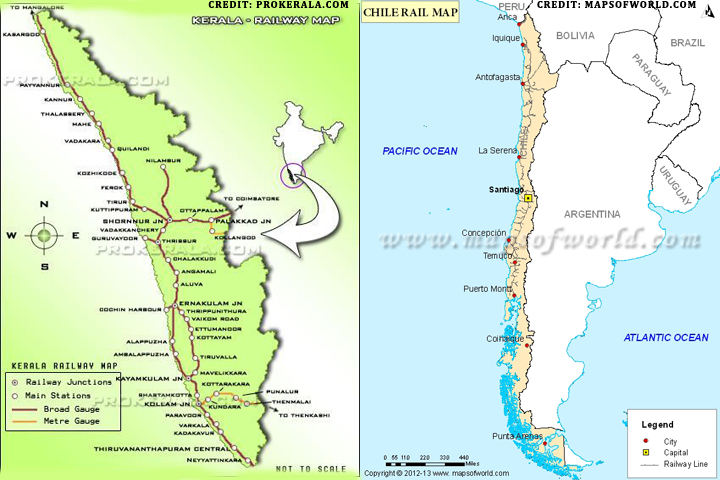
Two long coasts, one structural problem: On the western edges of two continents lie Kerala and Chile, separated by oceans and culture but bound by geography. Both are long, narrow territories pressed between sea and mountains. Both have settlement patterns that stretch north to south rather than radiate outward from a single megacity. And both face the same fundamental question in the 21st century: how do you move people efficiently when urban life is continuous, land is scarce, and roads have reached their physical and political limits?
For decades, transport planning in India assumed Kerala was an exception to urban India because it was “rural.” Chile, likewise, was seen as a country where air travel and highways could substitute for rail because of its length and low population density outside the central valley. Those assumptions are now collapsing under new data and lived reality. Kerala’s Economic Survey 2025–26 and Chile’s rail investments since 2024 reveal a shared truth: linear societies require linear mass transit. Without it, congestion, inequality, and economic inefficiency become permanent.
The Indian Economic Survey 2026 redrew urban Kerala
The Indian Economic Survey 2025–26 did something quietly revolutionary for Kerala. Using satellite-based spatial analysis through the GHSL-DEGURBA methodology, it stopped asking whether a place was legally a “town” or a “village” and instead asked how people actually live. The result was staggering: Kerala’s functional urbanisation rate is 82.6%.
This is not a marginal revision. For decades, policy, planning, and politics operated on the belief that Kerala was only 47.7% urban. That assumption shaped everything from funding formulas to transport priorities. The new figure does not merely correct a statistical error; it exposes a structural misdiagnosis that has persisted for a generation.
The 526 “villages” that aren’t villages
The survey identifies 526 settlements officially classified as villages that are, in functional terms, urban. Nearly 9.63 million people live urban lives—working in services, using urban infrastructure, commuting daily—while being governed as rural populations under panchayats.
These are not migrants waiting to move to cities. They already live in the city, but the city has grown around them rather than pulling them inward. This distinction matters. Migration-based urbanisation produces dense hubs. Kerala’s urbanisation has produced continuity.
When census towns and peripheral growth areas are included, the picture becomes undeniable: Kerala is overwhelmingly urban, but in a form that Indian planning frameworks were never designed to handle.
A city without a centre
Most Indian states follow a hub-and-spoke model. Mumbai dominates Maharashtra. Bengaluru dominates Karnataka. Chennai dominates Tamil Nadu. Vast rural hinterlands feed these hubs, and transport planning naturally prioritises radial highways and suburban rail converging on a core.
Kerala has no such core. Instead, it resembles what planners call a “Desakota” model—a village-city continuum where urban and rural functions are interwoven across space. From Thiruvananthapuram in the south to Kasaragod in the north, there is scarcely a stretch of empty land. Schools, hospitals, workshops, offices, and retail are distributed continuously along the coast and midlands.
Kerala is not a collection of towns. It is effectively a 600-kilometre linear metropolis.
When everyone lives everywhere
This spatial form produces a unique mobility challenge. In a hub-and-spoke city, most people travel toward a centre in the morning and away in the evening. In Kerala, everyone lives everywhere and works everywhere. Daily travel patterns are multi-directional and constant throughout the day.
The result is a paradox: even without megacities, congestion is intense. Roads are busy not because of sudden surges but because of permanent demand. This congestion is often misdiagnosed as a failure of traffic management or enforcement. In reality, it is structural.
Why roads cannot solve Kerala’s congestion
Conventional wisdom suggests widening highways. In Kerala, this is both physically and socially destructive. Dense settlement means any significant widening requires demolishing homes, shops, clinics, and religious structures that define community life. Each kilometre of highway expansion triggers years of litigation, protest, compensation disputes, and political backlash.
Even where widening succeeds, induced demand quickly fills the space. More cars appear because travel becomes temporarily easier. Congestion returns, but land is permanently lost. Roads in Kerala are not just transport corridors; they are social spines. Treating them as expandable infrastructure misunderstands their role.
Congestion as dead capital
The Economic Survey introduces a crucial concept: congestion turns urban land into “dead capital.” When time costs rise unpredictably, productivity falls. A shop loses customers who cannot reach it. A professional refuses to take up a job because commuting is unbearable. A hospital struggles to serve patients on time.
In an 82.6% urban state, congestion is not an inconvenience; it is an economy-wide tax. The more Kerala grows without changing its transport backbone, the more value is destroyed invisibly every day.
The state-metro idea
In this geography, high-speed or semi-high-speed rail is not a prestige project. It is survival infrastructure. The idea long discussed in Kerala—a 200 kmph semi-high-speed rail corridor running north–south—needs to be understood not as a train, but as a “State Metro.”
Unlike city metros designed for dense cores, a state metro connects multiple urban nodes distributed along a line. It treats the entire state as one labour market.
Under such a system, a 12-hour Thiruvananthapuram–Kasaragod journey becomes 3.5 hours. Kannur becomes commutable from Ernakulam. Talent no longer has to migrate southward or abroad to find opportunity. Economic activity decentralises without spreading congestion.
Rail versus highways: Land logic
Rail has another decisive advantage in Kerala’s context: land efficiency. An elevated rail viaduct occupies a fraction of the footprint of an eight-lane highway. Where highways slice through communities, rail passes above them.
This enables Transit-Oriented Development. Stations spaced every 25–30 kilometres become vertical hubs—clusters of offices, housing, and services built upward rather than outward. Land that was previously “dead” due to congestion becomes productive again through accessibility.
The RRTS secision of 2026
In January 2026, the Kerala Cabinet gave in-principle approval for a 583-kilometre Regional Rapid Transit System (RRTS) along high-density corridors. The specifications are telling: a top speed of 200 kmph, an average operational speed of around 135 kmph, and stations every 25–30 kilometres.
This is not about replacing local travel. It is about redefining regional mobility. The RRTS model explicitly rejects the “one person, one car” logic that has failed Kerala. It assumes shared, high-capacity movement as the default for an urbanised society.
A new identity for Kerala
The 82.6% urbanisation figure forces a reckoning. Kerala is no longer a landscape of green villages punctuated by towns. It is India’s first truly urban state, but one without a single dominant city. Its nervous system must therefore be linear, fast, and mass-based.
The question is no longer whether Kerala needs high-speed rail. The real question is whether an 82.6% urban state can survive without it.
Chile: The other long country
Chile offers a revealing parallel. Like Kerala, Chile stretches north to south along a narrow strip, hemmed in by the Pacific Ocean on one side and mountains on the other. Like Kerala, its population and economic activity are distributed along a longitudinal axis rather than concentrated in a single point.
For decades, Chile relied heavily on roads and air travel. Rail was fragmented, slow, and often reserved for freight, especially in the north. Passenger rail in the south existed but lagged behind modern standards.
January 2024: A signal change
In January 2024, Chile launched its fastest passenger rail service to date, operating between Santiago and Curicó. Covering approximately 195 kilometres, the service reaches speeds of up to 160 kmph, making it the fastest in South America.
This is not yet a full north–south high-speed line. But symbolically and structurally, it marks a turning point. Chile acknowledged that modern rail is not a luxury reserved for Europe or East Asia; it is a practical response to linear geography.
Modernisation over monumentality
Chile’s approach has been pragmatic. Rather than attempting an immediate, continuous high-speed line from the far north to the far south—an enormously expensive undertaking—it focused on modernising key central routes where demand is highest.
The new BMU trains offer WiFi, reclining seats, and onboard cafes. These features matter not just for comfort but for changing public perception. Rail is no longer a slow, second-class option; it becomes competitive with driving and flying for medium distances.
Limits and lessons
Chile’s rail network remains incomplete. The far north is still dominated by freight rail. Southern passenger services require major upgrades. Proposals for a high-speed line between Santiago and Valparaíso exist but face cost and political hurdles.
Yet the lesson is clear: Chile has accepted that its linear structure demands rail investment. Roads alone cannot carry the economic and social load of a stretched urban corridor.
Kerala and Chile compared
Kerala’s population density is far higher than Chile’s, especially along its coastal belt. This makes the economic case for rail even stronger. Where Chile justifies 160 kmph services over 195 kilometres, Kerala envisions 200 kmph services over nearly 600 kilometres with far more intermediate demand.
Both regions face similar constraints: mountains on one side, sea on the other, limited space for highways, and rising environmental costs. Both are discovering that rail is not about speed alone; it is about spatial justice.
Mobility as economic equaliser
In linear urban systems, rail equalises opportunity. It allows people to live where housing is affordable while accessing jobs where productivity is highest. It prevents overconcentration in a single core while avoiding sprawl.
Kerala’s long-standing achievements in health and education created human capital spread across the state. Without fast connectivity, that capital is underutilised. Chile’s central valley faces a similar challenge: economic potential exists beyond Santiago but remains partially locked by travel time.
Environmental arithmetic
Both Kerala and Chile are climate-vulnerable. Kerala faces floods and coastal erosion. Chile faces droughts and seismic risks. Expanding highways increases emissions, impermeable surfaces, and long-term environmental costs.
Rail, especially electrified rail, offers a lower-carbon alternative that aligns mobility with climate resilience. In dense linear regions, this alignment is not optional; it is arithmetic.
Governance catch-up
One of Kerala’s hidden challenges is governance mismatch. Urban life under rural institutions creates planning paralysis. Rail projects force coordination across jurisdictions, cutting through fragmented governance structures.
Chile, with its more centralised planning tradition, has been able to move faster on pilot corridors. Kerala’s challenge is political coherence, not technical feasibility.
From debate to inevitability
For years, Kerala’s rail discussions were framed as debates—cost versus benefit, environment versus development, speed versus necessity. The Economic Survey’s 82.6% figure ends that debate. The state’s form has already changed. Infrastructure must follow.
Chile’s incremental but decisive shift shows that waiting for perfection is unnecessary. Start where demand is highest. Build credibility. Expand.
The nervous system metaphor
Cities function like organisms. Roads are muscles; rail is the nervous system. In a linear metropolis, signals must travel fast and reliably from end to end. Without that system, coordination fails, no matter how strong individual parts may be.
Kerala has built the organs of an urban state—education, health, human development. It now needs the nerves.
The final question revisited
Kerala and Chile, on opposite sides of the globe, are answering the same question in different ways. Chile has begun modernising its spine. Kerala stands at the threshold of doing the same on a larger, denser scale.
The question is no longer whether high-speed or semi-high-speed rail is desirable. For an 82.6% urban, 600-kilometre-long state, the real question remains stark and unavoidable:
Can it survive without it?