What once seemed unthinkable—America being perceived as an unstable or coercive actor by its closest allies—is now openly discussed in European boardrooms, pension funds, and ministries
For more than seven decades after the Second World War, American power rested on a remarkably durable tripod: Wall Street, the US dollar, and the military–industrial complex. These three pillars reinforced one another in a self-sustaining loop. Financial markets in New York set global benchmarks for capital allocation. The dollar served as the world’s reserve currency, lubricating global trade and finance. The US military, unmatched in reach and spending, underwrote a security architecture that encouraged allies to accept American leadership and American rules. Together, they created what appeared to be an unassailable system.
Yet power structures age even when they look strong. Beneath the surface of America’s financial dominance, the foundations have been quietly shifting. The United States has increasingly transitioned from a manufacturing-driven economy to a service-heavy one, dominated by media, marketing, technology platforms, finance, and speculative capital flows. While these sectors generate high profits and global influence, they do not anchor supply chains or trade relationships in the same way manufacturing once did. The world has noticed the difference.
At the same time, geopolitical behavior under Donald Trump has injected a new variable into the system: political risk emanating not from emerging markets, but from the United States itself. What once seemed unthinkable—America being perceived as an unstable or coercive actor by its closest allies—is now openly discussed in European boardrooms, pension funds, and ministries. The recent dumping of US Treasuries by European institutions is not an isolated financial transaction. It is a symptom of a deeper realignment in global trust.
The hollowing out of the American economic engine
Breakdown of the architecture of American power; finance, force, and the fragility beneath
America’s post-war economic supremacy was built on factories, logistics, and the physical movement of goods. Steel, automobiles, aircraft, machinery, and consumer products tied foreign economies to American production networks. Over the past four decades, however, the United States systematically offshored manufacturing in pursuit of lower costs and higher margins. What replaced it was a services-led model that prioritized financial engineering, intellectual property, branding, and platform monopolies.
This shift created extraordinary wealth for a narrow segment of society and cemented Wall Street’s dominance over the real economy. But it also weakened America’s role as the workshop of the world. By 2024, China accounted for roughly 15 percent of global goods exports, dwarfing US manufacturing output in both scale and integration. More importantly, China embedded itself deeply into trade networks across Africa, Southeast Asia, and Europe, offering infrastructure, financing, and industrial capacity rather than just capital markets.
Services exports may generate dollars, but they do not create the same strategic dependencies as factories, ports, and supply chains. A country can switch software providers or marketing agencies far more easily than it can reconfigure its industrial base. As China deepened its manufacturing and trade relationships in 2025, the contrast became stark: America sold narratives and financial products, while China sold roads, machines, and industrial ecosystems.
This divergence has long-term consequences for power. Manufacturing anchors trust through repetition and necessity. Services rely on confidence, regulation, and perceived stability. Once trust erodes, services are far more vulnerable to sudden shifts.
Wall Street’s global reach and its hidden vulnerability
Wall Street remains the beating heart of the global financial system. US capital markets are deep, liquid, and innovative. Treasury bonds have long been treated as the ultimate risk-free asset, the benchmark against which all other securities are measured. This status allowed the United States to run persistent trade deficits and accumulate enormous debt without triggering the kind of crises that would devastate other countries.
But Wall Street’s dominance rests on belief as much as balance sheets. Investors buy US debt not only because of yield, but because of faith in American institutions, rule of law, and political continuity. When those assumptions are questioned, even subtly, the entire system becomes more fragile.
Trump’s return to aggressive, unpredictable rhetoric has reintroduced a level of uncertainty that markets dislike but have so far tolerated. Tariffs are announced and withdrawn. Alliances are questioned publicly. Legal norms are attacked rhetorically. While markets may shrug in the short term, long-term institutional investors—pension funds, sovereign funds, insurance pools—think in decades, not quarters. For them, political risk is cumulative.
The critical shift underway is not about immediate losses or gains. It is about the reclassification of US assets from “politically neutral” to “politically contingent.” Once that line is crossed, even partially, Wall Street’s aura of inevitability begins to fade.
The Dollar’s privilege and its exposure
Dollar dominance has been America’s greatest strategic advantage. Because global trade, energy markets, and financial settlements are dollar-denominated, demand for dollars remains structurally high. This allows the United States to borrow cheaply, sanction adversaries effectively, and export inflation abroad when necessary.
Yet this privilege depends on restraint. When financial dominance is wielded too overtly as a political weapon, it incentivizes alternatives. Over the past decade, de-dollarization efforts were largely associated with BRICS nations such as China and Russia—countries already positioned outside the Western financial order and therefore willing to bear the costs of experimentation.
What is new, and far more consequential, is the entry of America’s allies into this dynamic. When Europe begins to treat dollar assets as politically risky, the signal is unmistakable. The dollar does not lose dominance overnight, but its unquestioned centrality begins to erode.
Trump’s policies have accelerated this process. Threats, tariffs, and public warnings aimed at allies blur the line between partnership and coercion. The more the dollar is perceived as an instrument of pressure rather than a neutral medium, the stronger the incentive to diversify reserves, even at some financial cost.
Trump’s “tough guy” strategy: short-term theatre, long-term damage
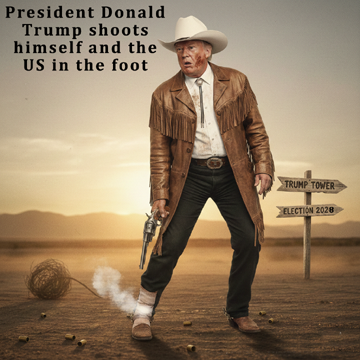
Donald Trump’s geopolitical style is performative and confrontational. Tariffs are framed as strength. Chaos is reframed as leverage. Allies are treated as transactional counterparts rather than strategic partners. In domestic politics, this approach resonates with audiences that equate aggression with leadership.
Strategically, however, it is deeply self-defeating. Trust is not built through intimidation, especially among advanced economies with alternatives. The effects of such behavior are not immediate. Markets rarely collapse on cue. Instead, the damage accumulates quietly, manifesting years later in altered trade routes, new institutions, and diversified reserve holdings.
China understands this dynamic well. It does not need to confront the dollar directly. It only needs to offer stability, predictability, and patience while others alienate their partners. Every tariff threat and public rebuke nudges allies to hedge their exposure. Every diplomatic slight encourages exploration of alternatives.
Trump’s strategy may generate headlines, but it also accelerates the slow pivot away from American centrality.
Greenland, NATO, and the fracturing of the transatlantic compact
One of the most revealing aspects of the current rupture lies in Europe’s reaction to US behavior on issues such as Greenland and NATO. Statements suggesting coercive leverage over Greenland touched a raw nerve in Europe, particularly in Denmark. They reinforced a perception that the United States increasingly disregards European sovereignty when it conflicts with American interests.
Simultaneously, NATO’s call for a 10 percent increase in defense contributions has landed heavily on European economies already strained by inflation, energy transitions, and social spending. Many European states rely heavily on international institutions and trade flows to sustain their fiscal balance. Being asked to shoulder higher defense costs by a partner running chronic trade deficits and ballooning debt has sharpened resentment.
The transatlantic relationship was once anchored in shared values and mutual respect. Increasingly, it is framed by Europeans as asymmetrical, transactional, and coercive. This shift in perception matters enormously because alliances are sustained by legitimacy, not just force.
The treasury sell-off: A small number, a huge signal
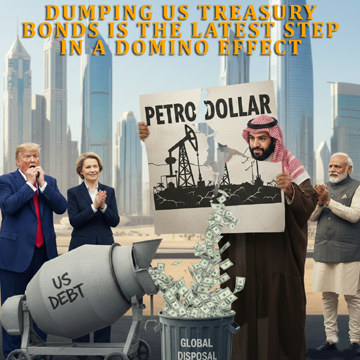
Against this backdrop, the decision by European pension funds to dump nearly $8.9 billion in US Treasuries takes on outsized significance. In purely quantitative terms, the amount is trivial relative to America’s total debt. But markets are driven by marginal signals, not absolutes.
A Danish pension fund sold approximately $100 million, while Sweden’s government-backed pension fund AP7 offloaded an extraordinary $8.8 billion. Together, they accounted for almost all of their US Treasury exposure. The stated reasons were not yield, duration, or currency risk. They were political: concerns over rule of law, political instability, and US foreign policy behavior under Trump.
This framing is unprecedented. European pension funds have historically treated US Treasuries as sacrosanct—risk-free, apolitical, and suitable for long-term holdings. Breaking this taboo represents a psychological rupture far larger than the financial transaction itself.
When political risk redefines “safe assets”
The most striking aspect of this episode is the explicit acknowledgment that US assets can no longer be assumed politically neutral. For decades, political risk was something investors associated with emerging markets, authoritarian regimes, or unstable democracies. The United States was the benchmark against which others were judged.
That benchmark is now being revised. When institutions tasked with safeguarding retirement savings decide that political instability outweighs financial return, the implications ripple far beyond bond markets. It suggests a redefinition of what “safe” means in a fragmented world.
This does not imply an imminent collapse of the dollar or a mass exodus from US assets. But it does suggest that diversification away from dollar dominance is becoming respectable, even prudent, among allies.
Europe’s red line and the limits of financial coercion
By dumping Treasuries despite explicit warnings from Trump, European institutions sent a clear geopolitical message: financial dominance has limits. Even allies will resist when pressure crosses into coercion. This is a critical development because American power has long relied on the assumption that allies would absorb discomfort in exchange for security and stability.
Europe’s move signals that this bargain is under renegotiation. Trust, once broken, is difficult to restore. And trust, more than yield, underpins reserve currency status.
As a bloc, the European Union holds approximately $1.6 trillion in US debt—more than Japan. Any coordinated or even gradual reallocation of these holdings would have profound implications for global finance, even if executed cautiously over time.
De-Dollarization moves from the periphery to the core
Until recently, de-dollarization was framed as a project of dissatisfied outsiders. Russia sought insulation from sanctions. China sought strategic autonomy. These efforts were viewed in Washington as manageable, even inevitable.
Europe’s entry into this conversation changes everything. When core allies begin hedging against dollar risk, the process moves from the periphery to the center of the global system. It becomes structural rather than ideological.
This does not mean the euro or yuan will replace the dollar overnight. It means the monopoly weakens. And in finance, monopolies are valued precisely because they are assumed permanent.
Inflation, confidence, and America’s domestic reckoning
Declining global trust in US assets carries domestic consequences. Reduced foreign appetite for Treasuries would eventually force the United States to finance its deficits at higher costs. That pressure could feed inflation, constrain fiscal policy, and intensify political polarization.
Ironically, the very behaviors framed as defending American strength may accelerate the erosion of its economic privileges. The ability to run deficits without consequence is not a birthright. It is a function of trust.
The quiet strengthening of alternatives
While America generates noise, China quietly builds alternatives. Trade corridors, payment systems, regional banks, and bilateral agreements reduce reliance on any single currency or market. None individually threaten the dollar. Collectively, they provide optionality.
This is the essence of long-term strategy: not confrontation, but redundancy.
The cost of confusing power with pressure
The dumping of US Treasuries by European pension funds is not a financial crisis. It is something subtler and potentially more dangerous: a visible crack in the architecture of trust that has sustained American dominance.
Power exercised without restraint breeds resistance. Financial privilege wielded as leverage invites alternatives. The dollar will not fall tomorrow, or next year. But its unquestioned supremacy is no longer guaranteed.
When allies begin to hedge politically, the die is indeed cast—not for immediate collapse, but for gradual transformation. History rarely announces turning points with crashes and sirens. More often, it whispers through decisions like these, taken quietly, justified soberly, and noticed only in hindsight. What is unfolding is not the end of American power, but the end of its monopoly on global trust. And that distinction will shape the world far more profoundly than any tariff or warning ever could.