
Consulting firm McKinsey & Company, in its early 2000s India growth reports, highlighted that India’s job creation during that phase was employment-elastic—each percentage point of GDP growth translated into meaningful job additions. The economy was not just growing; it was hiring
India has lived through at least two distinct phases in recent memory when employment was abundant enough to give workers genuine choice. The first was between 1991 and 1998, immediately following economic liberalisation. The second came during the high-growth years between 2004 and 2010. In both periods, employment generation was strong across manufacturing, services, trading, construction, and white-collar professions. Jobs were not hidden behind algorithms or locked inside portals. They were printed in black and white, openly, aggressively, and in massive numbers.
The “WANTED” sections of leading newspapers during those years were not token appendages. They were fat, intimidating supplements running into 50 to 60 pages on weekends. Employers competed for talent, not the other way around. Fresh graduates, diploma holders, engineers, accountants, sales executives, technicians, and clerks often applied to multiple firms and negotiated pay. The economy was absorbing people at scale.
That labour absorption was not accidental. It coincided with broad-based growth—industrial expansion, infrastructure creation, banking deepening, import-export growth, and a still-human-driven services sector. Consulting firm McKinsey & Company, in its early 2000s India growth reports, highlighted that India’s job creation during that phase was employment-elastic—each percentage point of GDP growth translated into meaningful job additions. The economy was not just growing; it was hiring.
The Internet arrives—Slowly at first
India’s engagement with the Internet began modestly. The launch of VSNL’s dial-up Internet service in 1995–96 marked the first real gateway, but adoption was slow. Internet cafés, squealing modems, and hourly billing meant digital tools supplemented traditional processes rather than replacing them. Recruitment still happened through newspapers, walk-ins, references, and physical interviews.
This gradualism mattered. Technology augmented human labour instead of displacing it. A factory still needed supervisors, accountants, clerks, logistics managers, and maintenance staff. A trading firm still needed purchase officers and sales coordinators. Banks still hired armies of clerks and probationary officers. The labour market expanded organically.
Online job portals: Efficiency without net job creation
The late 1990s and early 2000s saw the digitisation of recruitment. Naukri.com, launched in March 1997 by Sanjeev Bikhchandani under Info Edge, was a pioneering platform. TimesJobs followed in 2004, backed by the Times Group. LinkedIn Jobs arrived in 2005, integrating professional networking with recruitment.
These platforms transformed how jobs were matched—but not how many jobs existed. Consulting firm Deloitte, in its workforce digitisation studies, has repeatedly pointed out that recruitment technology improves efficiency and reduces friction but does not create employment by itself. In fact, by lowering hiring costs and increasing screening automation, it often allows companies to do more with fewer people.
By the mid-2000s, job portals flourished because the economy was still expanding. The illusion of abundance continued. But structurally, something had begun to change: companies were becoming leaner, technology-driven, and increasingly intolerant of excess labour.
2004–2010: The last broad-based hiring boom
The period between 2004 and 2010 stands out as India’s last genuinely inclusive employment cycle. IT services expanded rapidly, construction boomed, telecom exploded, retail chains multiplied, and banking deepened. The government’s own Economic Surveys from that period showed strong employment elasticity, especially in urban services and construction.
Even consulting firm reports from Accenture and PwC during those years highlighted India as a rare economy where growth was still labour-absorbing, unlike China’s capital-intensive manufacturing model. Campus placements were strong. Lateral hiring was constant. Migration from small towns to cities accelerated because jobs were actually waiting.
But this phase, too, masked emerging fragilities. Much of the job growth was informal, contractual, or dependent on credit expansion. Productivity gains increasingly came from technology adoption rather than manpower expansion.
Post-2010: Growth without jobs
From around 2012–13 onward, the warning signs became impossible to ignore. India’s GDP continued to grow, but job creation slowed sharply. By 2015, the employment market had visibly shrunk across sectors. Newspaper job supplements withered. Online portals became crowded with applicants chasing fewer openings. The power equation flipped decisively in favour of employers.
This phenomenon—often described as “jobless growth”—has been documented extensively. The World Bank, in multiple India Development Updates, has noted that India’s growth since the mid-2010s has been increasingly capital- and technology-intensive. The International Labour Organization (ILO), in its Global Employment Trends and India Employment Diagnostic reports, has repeatedly flagged India’s inability to generate sufficient quality jobs for its growing workforce.
Government data supports this grim picture. The Periodic Labour Force Survey (PLFS), conducted by the National Statistical Office, shows persistently high unemployment among youth, especially educated youth. Labour force participation rates remain low by global standards, indicating a large pool of discouraged workers who have stopped actively seeking jobs.
Taxation, compliance, and the quiet exit of small employers
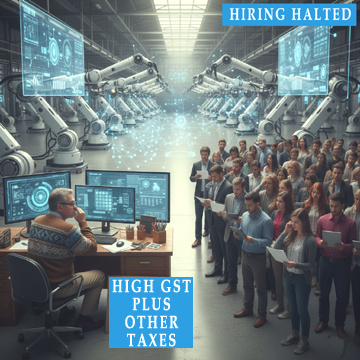
One of the less discussed contributors to shrinking employment is the rising compliance and taxation burden on small and medium enterprises (SMEs). Consulting firm KPMG, in its assessments of India’s GST implementation, has acknowledged that while formalisation has long-term benefits, the short-term impact has been the closure or downsizing of many small firms that were historically large employers.
Small manufacturers, traders, logistics operators, and service providers once absorbed millions of semi-skilled and skilled workers. As compliance costs rose and margins shrank, these firms automated, outsourced, or simply shut down. Large corporations did not replace these lost jobs at the same scale.
The result is an economy where large firms grow revenues without proportional hiring, while small firms—the traditional job engines—struggle to survive.
Technology obsolescence and the speed of redundancy
The acceleration of Internet-based solutions after 2005, and especially after 2010, fundamentally altered the labour market. Entire job categories disappeared within years. Clerical roles, data entry jobs, travel agents, front-desk executives, and middle-management coordination roles were either automated or compressed.
McKinsey Global Institute, in its widely cited reports on automation and the future of work, estimates that a significant percentage of current jobs in India are at risk of partial or full automation. The problem is not automation per se, but the speed at which skills become obsolete. Workers are displaced faster than they can be reskilled.
India’s skilling ecosystem has not kept pace. Government programmes such as Skill India have struggled with quality, relevance, and employer linkage, as acknowledged in government evaluation reports themselves.
The gig economy illusion
One of the most visible symbols of India’s employment distress is the sight of college graduates working as delivery riders for hyperlocal platforms. These jobs use Internet technology extensively—but they do not represent sustainable employment for educated youth.
Multilateral agencies, including the World Bank and ILO, have cautioned against overstating the benefits of the gig economy. While such platforms provide income smoothing, they do not offer job security, social protection, career progression, or skill accumulation. Government labour data increasingly classifies such workers as self-employed or informally employed, masking true unemployment.
A young graduate delivering food is not evidence of job creation; it is evidence of labour market failure.
The paradox of shortage amid surplus
Perhaps the most troubling aspect of India’s employment crisis is the coexistence of unemployment with acute skill shortages. Hospitals are understaffed. There is a shortage of competent doctors, trained nurses, lab technicians, and paramedical staff. The healthcare workforce gap has been highlighted repeatedly by the World Health Organization and India’s own National Health Profile.
The same paradox exists in manufacturing, construction, education, and even IT. Employers complain they cannot find “employable” candidates, while millions remain jobless. Consulting firms such as EY and PwC have termed this a “capability mismatch crisis”—where degrees proliferate but practical competence declines.
This mismatch reflects deep failures in India’s education and vocational training systems. Degrees have become signals, not skills.
Unused labour and the hidden unemployment crisis
Official unemployment figures alone understate the problem. India has one of the world’s lowest labour force participation rates, particularly among women. According to government data and World Bank analysis, hundreds of millions of working-age Indians are neither employed nor actively seeking work.
This unused labour force represents lost economic potential on a massive scale. The ILO has repeatedly warned that demographic dividends can easily turn into demographic liabilities if productive employment is not created.
A structural, not cyclical, crisis
India’s employment problem is no longer cyclical; it is structural. The disappearance of fat job supplements from newspapers is not nostalgia—it is evidence. The economy has shifted toward efficiency, automation, and consolidation without building new labour-absorbing engines.
Consulting firm reports, multilateral agency assessments, and government data all point to the same conclusion: India is producing workers faster than it is producing meaningful work. Without reforms that revive labour-intensive manufacturing, empower small enterprises, rationalise compliance, and radically overhaul education and skilling, the gap will continue to widen.
The Internet did not destroy jobs by itself. But policy inertia, skill mismatch, and unbalanced growth ensured that technology’s gains were captured without distributing opportunity. Until that changes, the half-page job section will remain the most honest indicator of India’s employment reality.