
The contiguous coastal strip that spans southern Bangladesh and western Myanmar offers potent economic and strategic leverage for trade, shipping, and investment. Yet, realizing this potential confronts formidable challenges ranging from infrastructural deficits to political instability
Bangladesh and Myanmar are at a strategic crossroads of South and Southeast Asia. In recent years, both nations have sought to deepen trade ties and enhance economic cooperation in a bid to leverage geography, expand markets, and link regional economic blocs. Their engagements reflect an evolving focus on connectivity, trade facilitation, cross-border infrastructure, and economic integration that reaches beyond bilateral relations into broader frameworks such as ASEAN, SAARC, BIMSTEC, and BCIM (Bangladesh–China–India–Myanmar) corridors.
At the heart of these ambitions lie geographic realities — not least the Bay of Bengal and the contiguous coastal strip that spans southern Bangladesh and western Myanmar — which offer potent economic and strategic leverage for trade, shipping, and investment. Yet, realizing this potential confronts formidable challenges ranging from infrastructural deficits to political instability.
This article explores these dynamics and highlights how Bangladesh, Myanmar, and even India are positioning themselves to harness geographic advantages for economic growth and regional connectivity.
Bangladesh Initiatives: Anchoring growth through FTZs and connectivity
Bangladesh’s economic strategy places significant emphasis on trade zones, foreign investment, export expansion, and regional integration.
Chattogram FTZ and Anwara Plan
One of the most ambitious initiatives is the proposed 400-acre Free Trade Zone (FTZ) in Anwara, Chattogram, designed to attract foreign direct investment (FDI) and stimulate exports. Located near the deep-water port of Chattogram — Bangladesh’s principal maritime gateway — the Anwara FTZ is envisioned as a magnet for international developers and operators. Major global players, including logistics and shipping firms like Maersk, have shown interest in participating in its development, recognizing the strategic value of a large, well-positioned economic zone that can facilitate integrated manufacturing, logistics services, and export processing. This FTZ is part of a broader strategy to strengthen Bangladesh’s role in regional and global value chains by offering competitive infrastructure and incentives for export-oriented industries.
The Chattogram initiative dovetails with Bangladesh’s existing suite of export processing zones and industrial parks, further enhancing the country’s economic diversification and employment prospects.
Bilateral Border FTZ Proposals
Beyond its own zones, Bangladesh has been in discussions with Myanmar on developing bilateral free trade zones along their border. These proposed zones are not just about bilateral trade — they are also envisioned as bridges linking the SAARC (South Asian) market with ASEAN (Southeast Asian) economies.
The logic is simple: Bangladesh serves as a gateway from South Asia to Southeast Asia, and Myanmar — as an ASEAN member — provides access in the other direction. A contiguous trade corridor could facilitate the movement of goods, services, and investment across a combined market of hundreds of millions of consumers and producers. Combined with plans like the BCIM Economic Corridor, which seeks to link Bangladesh, China, India, and Myanmar through multimodal infrastructure, such FTZs could transform the regional economic landscape.
Myanmar’s Role: Gateway to Southeast Asia and existing SEZs
Myanmar’s geographic position gives it natural advantages as a hub connecting South and Southeast Asia.
Gateway to ASEAN: Myanmar’s membership in ASEAN positions it as a bridge for trade and investment flows between the Indian subcontinent and Southeast Asia. For Bangladesh, access through Myanmar opens pathways to regional markets that remain relatively untapped. Conversely, Bangladesh represents an important route for Myanmar to reach into South Asia. This reciprocal-potential forms the basis for proposals like bilateral FTZs and enhanced logistics corridors.
Existing Zones and Economic Strategy: Myanmar has already established Special Economic Zones (SEZs) such as the Thilawa SEZ, developed in partnership with international investors. These zones are central to Myanmar’s growth strategy, attracting FDI, nurturing export-oriented industries, and facilitating industrial diversification.
However, challenges persist. Connectivity from Myanmar’s SEZs to neighboring economies remains constrained by inadequate road and rail networks, limited inland logistics capacity, and political instability associated with the country’s internal conflicts. Addressing these gaps is critical not only for bilateral cooperation with Bangladesh but also for enhancing Myanmar’s own economic integration with South Asia and ASEAN markets.
Key Trade Corridors: BCIM, BIMSTEC, and Beyond
BCIM Economic Corridor: The Bangladesh–China–India–Myanmar (BCIM) Economic Corridor is a proposed multimodal route designed to link the eastern Indian subcontinent with Southeast Asia and China. It aims to integrate road, rail, water, and air networks to facilitate trade, investment, and people-to-people exchange across the region. If fully realized, the BCIM corridor could significantly reduce logistical costs and transit times for goods moving between South Asia and Southeast Asia, offering an alternative to long, circuitous routes that bypass the immediate region.
BIMSTEC Integration Efforts: Both Bangladesh and Myanmar are members of the Bay of Bengal Initiative for Multi-Sectoral Technical and Economic Cooperation (BIMSTEC), a regional group that includes Bangladesh, India, Myanmar, Sri Lanka, Thailand, Bhutan, and Nepal. BIMSTEC works to foster economic integration across multiple sectors including trade, transport, energy, and tourism, seeking to bridge the economic spaces of South and Southeast Asia. Participation in BIMSTEC frameworks complements bilateral engagements and provides institutional support for connectivity initiatives.
Challenges to trade expansion
Border infrastructure deficits: One of the most significant constraints on Bangladesh–Myanmar trade is the lack of robust infrastructure at border crossings. Many border posts suffer from poor road conditions, inefficient customs facilities, and limited warehousing and logistics capacity. These factors drive up transaction costs, delay cargo movements, and deter private sector engagement. Without substantial upgrades in physical infrastructure and trade facilitation systems, broader ambitions for corridor development and FTZ effectiveness will remain stunted.
Political and security dynamics: Political instability, especially in Myanmar’s Rakhine State, has introduced volatility into bilateral relations. The Rohingya crisis, cross-border refugee movements, and concerns about arms smuggling have complicated cooperation and undermined trust, injecting security considerations into economic planning.
Furthermore, Myanmar’s internal conflicts have, at times, impeded safe and consistent trade flows along key routes, deterring foreign investors and complicating logistics planning.
The Bangladesh–Myanmar contiguous coastline
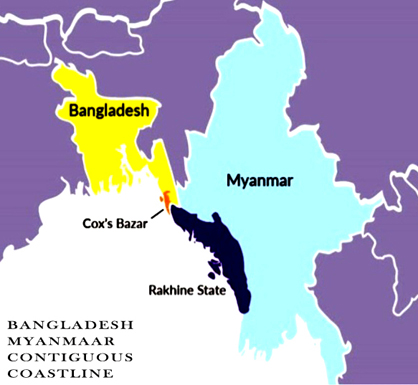
To understand broader geostrategic opportunities, it is essential to highlight the contiguous coastline shared by Bangladesh and Myanmar.
Bangladesh’s coastline along the Bay of Bengal extends roughly 580–720 kilometers depending on measurement methodology, encompassing the country’s entire southern maritime edge. Much of this coast falls in the southwest around Chattogram and Cox’s Bazar. Bangladesh’s coastline is a vital economic and ecological asset, hosting major ports, fishing communities, and mangrove ecosystems.
Beyond Bangladesh’s coast, Myanmar’s western littoral along the Bay of Bengal stretches about 2,227 km as part of its overall national coastline. What is key for Bangladesh–Myanmar interactions is that the coastal region of their border — near the mouth of the Naf River — provides a continuous maritime interface where both countries’ territorial waters touch the Bay of Bengal. This contiguous maritime space creates a natural platform for cooperation in shipping, fisheries, port development, and maritime logistics.
Strategic significance of the contiguous coast
The contiguous coastal strip offers several strategic and economic opportunities:
• Maritime Trade and Shipping: The Bay of Bengal is a busy sea lane that connects the Indian Ocean to Southeast Asia. A contiguous coastal stretch gives both nations direct access to these global sea routes, benefiting export-oriented sectors and attracting investments in port infrastructure.
• Blue Economy Potential: Both countries can collaborate on sustainable fisheries, offshore energy exploration, tourism development (e.g., coastal attractions like Cox’s Bazar and Ngapali Beach), and marine logistics hubs.
• Logistics and Corridor Development: Coastal connectivity supports proposals for maritime-land corridors that can complement road and rail links under BCIM and BIMSTEC frameworks, offering multimodal transport options.
• Cross-Border Maritime Cooperation: A shared coastal space provides opportunities for joint initiatives in maritime security, search and rescue operations, environmental protection, and regulation of fishing and coastal resource management.
Business environment opportunities
The contiguous Bangladesh–Myanmar coastline is a good possibility for business development for several reasons:
- Ports and Maritime Infrastructure
Enhancing port capacity on both sides of the border could turn the region into a hub for transshipment and regional trade. Bangladesh’s ports of Chattogram and Mongla already handle the majority of its international trade, and potential upgrades combined with Myanmar’s ports (like Sittwe) can ease connectivity to Southeast Asia. Wikipedia - Trade and Investment in FTZs
Joint or complementary free trade zones near coastal areas could lower barriers for manufacturing, logistics, and export processing. Such zones can attract foreign investors looking for access to both South Asian and Southeast Asian markets. - Fisheries and Marine Resources
Together, Bangladesh and Myanmar share rich fishing grounds in the Bay of Bengal. Collaborative ventures in aquaculture, seafood processing, and export markets could unlock shared value. - Tourism and Services
The coastal belt includes destinations like Cox’s Bazar — one of the world’s longest natural beaches — and Myanmar’s Ngapali Beach. Joint tourism packages and infrastructure investments can promote cross-border tourism growth.
Can India leverage this coastline through foreign policy?
Yes — and it is already doing so through several foreign policy frameworks rooted in its Neighborhood First Policy, Act East Policy, and maritime initiatives for the Indian Ocean Region.
Strategic Maritime Engagement
India views the Bay of Bengal as a critical strategic space, pivotal to its broader Indo-Pacific outlook. The region is vital for energy imports, shipping lanes, and maritime security. India actively engages regional partners, including Bangladesh and Myanmar, through naval exercises, cooperative patrols, and maritime domain awareness initiatives to secure a stable maritime environment.
Regional Connectivity Projects
India has invested in connectivity projects that link northeastern India to Southeast Asia via Myanmar — such as the Kaladan Multi-Modal Transit Transport Project which connects the Indian hinterland through Sittwe Port to the Indian Northeast. These initiatives enable India to diversify its access routes and reduce reliance on traditional pathways.
Economic and Diplomatic Engagement
Through platforms like BIMSTEC and bilateral partnerships, India promotes infrastructure development, trade facilitation, and regulatory harmonization in the Bay of Bengal region. These frameworks help integrate transport networks and enable smoother cross-border trade.
Security and Stability Emphasis
India’s approach also emphasizes security cooperation, ensuring that the maritime and border spaces are stable enough for economic activities. In a region marked by complex security dynamics — including insurgencies, refugee movements, and illicit trade — collaborative security dialogues are integral to enabling commerce.
Importance of Geography
The evolving Bangladesh–Myanmar relationship highlights the importance of geography in shaping economic opportunity. Bangladesh’s pursuit of strategic FTZs like Anwara and its discussions with Myanmar on border FTZs point to a deeper vision of economic integration that spans South Asia and Southeast Asia. Myanmar’s existing zones and access to ASEAN markets complement Bangladesh’s ambitions, while regional frameworks like BCIM and BIMSTEC provide connective tissue for broader integration.
The Bangladesh–Myanmar contiguous coastal region on the Bay of Bengal is not merely a geographic fact but a strategic asset — one that presents compelling possibilities for trade, investment, and connectivity. Its rich maritime access, combined with shared economic potential, offers fertile ground for collaboration, from port infrastructure and logistics to fisheries and tourism.
For India, this coastal corridor lies within a broader maritime canvas where diplomatic, economic, and security policies intersect to shape the future of the Indian Ocean Region. Through initiatives that strengthen connectivity, enhance infrastructure, and promote regional cooperation, India — alongside Bangladesh and Myanmar — can help unlock the promise of this coastline as a vibrant space for commerce, strategic engagement, and shared prosperity.

