
Netaji’s vision for India’s freedom was sharply at odds with that of Mohandas Karamchand Gandhi and his closest political successors like Jawaharlal Nehru
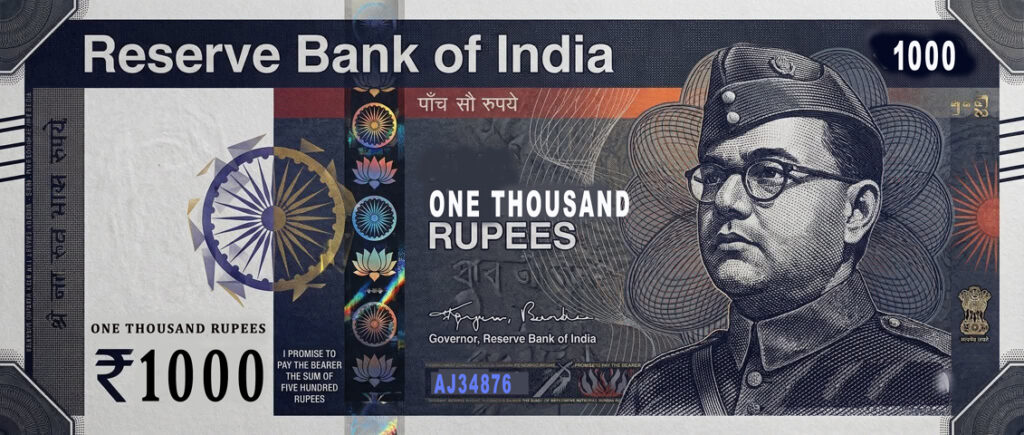
Among the many defining figures in India’s struggle for independence, Netaji Subhas Chandra Bose stands out for his uncompromising nationalism, charismatic leadership, and willingness to take revolutionary measures. History remembers him as the leader who sought to liberate India through armed struggle against the British, ultimately forming the Indian National Army (INA). And yet, in India’s post-colonial political settlement, Bose never became the first Prime Minister; that mantle fell to Jawaharlal Nehru, a leader deeply associated with non-violent resistance and the Indian National Congress’s prevailing worldview. The question then arises: was it the natural outcome of India’s freedom struggle that Bose did not become the first Prime Minister? Could the Indian national movement have unfolded differently, leading to Netaji’s leadership of post-colonial India?
To answer this, we must examine not just Bose’s life and vision, but the political culture of the Congress leadership, the nature of British India’s political negotiations, and the broader patterns of support, cooperation, conflict, and betrayal — both real and perceived — among these major actors.
Netaji’s life epitomized confrontation with colonial power. Born in 1897 in Cuttack, he passed the Indian Civil Service examinations in London, only to resign and dedicate himself entirely to the nationalist cause. By the 1920s and 1930s he had emerged as a formidable figure within the Indian National Congress, challenging the established leadership. Bose represented a bold new generation of Indian nationalists who rejected gradualism and accommodation.
His vision for India’s freedom was sharply at odds with that of Mohandas Karamchand Gandhi and his closest political successors like Jawaharlal Nehru. While Gandhi’s method of non-violent civil disobedience (Satyagraha) sought to undermine British legitimacy through mass participation and moral pressure, Bose believed that violence — if necessary — was a legitimate tool of liberation. Gandhi himself never wavered from his strict adherence to non-violence, famously rejecting Bose’s more militant outlook. This ideological difference deepened over time into concrete political friction.
In the 1930s, Bose’s rise within the Congress was dramatic. He was elected Congress President in 1938 and again in 1939. His elections reflected a strong support base within the organization, particularly among younger and more radical nationalists. Yet, his policies and assertive leadership style generated deep unease among the Congress high command, especially Gandhi and his inner circle. Gandhi once remarked privately that Bose was too impulsive and authoritarian in his approach. The chasm widened further in the 1939 Tripuri session of the Congress — a meeting that became a political turning point.
At the Tripuri session, Bose faced intense opposition orchestrated by Gandhi’s supporters. Though he had secured the Congress presidency, Gandhi’s camp effectively undermined his authority, leaving him politically isolated within the party. Facing sustained opposition, Bose resigned from the presidency and eventually left the party altogether. This episode is often cited as the moment when the most viable internal challenger to Gandhi and Nehru was sidelined by his own colleagues. It underscores the deep institutional resistance within the Congress to Bose’s leadership, his ideology, and his willingness to challenge the existing power structure.
With Europe engulfed in war in 1939, Bose saw an opportunity where others saw peril. Frustrated with the Congress’s unwillingness to push for immediate independence and critical of appeasing British war efforts (the Congress ministries resigned en masse in 1939 to protest Indian involvement in the war), Bose chose a radical course: he escaped house arrest in India and made his way to Germany. There, he sought Axis support for India’s liberation. Later he travelled to Japan, where he took command of the Indian National Army, composed initially of Indian prisoners of war and expatriates, with the goal of invading India and triggering a mass uprising.
By late 1944, the INA was fighting alongside Japanese forces in campaigns such as Imphal and Kohima. Although militarily unsuccessful, the INA’s campaigns electrified Indian public opinion. Many Indians saw in Bose’s efforts a bold challenge to the British Empire — the first time that a disciplined Indian force had openly confronted British arms. When the INA collapsed along with Japan’s defeat in 1945, Bose’s fate became shrouded in mystery, with the official narrative asserting that he died in a plane crash in Taiwan.
Throughout this period, the Congress leadership maintained a cautious distance from Bose and the INA. Gandhi and Nehru were publicly critical of any alliance with fascist powers, and privately they were wary of Bose’s authoritarian inclinations. The Congress was focused on achieving independence through negotiations, constitutional reform, and mass civil resistance within the framework of non-violence. When World War II ended and the INA officers were put on trial by the British in late 1945, the Congress leadership did not strongly advocate for their release. Instead, the public outcry that followed — especially among students, workers, and ordinary soldiers — became a spontaneous movement that embarrassed the British and helped build momentum for Indian independence.
Here lies a critical point of contention: many nationalists then and now argue that the Congress could — and should — have fought for the INA officers’ release and reclaimed Bose’s legacy more aggressively. Public sentiment at the time was deeply sympathetic to the INA; widespread protests erupted across Indian cities. This popularity was a direct repudiation of the Congress’s reluctance to embrace the INA cause fully.
Likewise, the Congress’s record on other revolutionaries is often critiqued. Bhagat Singh, Rajguru, Sukhdev, and other young revolutionaries of the 1920s and early 1930s are widely celebrated today as martyrs. Yet at the time, Congress leaders did not make sustained efforts to secure their release or intervene effectively on their behalf. Bhagat Singh’s execution in 1931 elicited regret and sorrow among many within the Congress, but there was no vigorous campaign by the party leadership to save him. Gandhi’s own interactions with Bhagat Singh’s ideology were ambivalent; while he admired the courage of young revolutionaries, he remained committed to non-violence and was cautious about endorsing their methods.
Critics argue that this selective activism — robust mass movements for civil disobedience on one hand and tepid support for revolutionary actions on the other — reflected a broader political conservatism within the Congress leadership. A senior Congress leader of the time might have feared that full endorsement of violent resistance would damage the moral basis of the national movement, alienate vital support from moderates, or provide the British with justification for repression.
It is important, however, not to oversimplify the Congress stance as sheer betrayal. Many leaders did admire Bhagat Singh and other revolutionaries. Jawaharlal Nehru, in particular, wrote passionately about Bhagat Singh’s sacrifice in “The Discovery of India.” Their failure to mobilize institutional support for him before his execution, or for INA officers after 1945, reflected not only ideological disagreements but also the constraints and complexities of political calculation under colonial rule. The Congress was negotiating not just with crowds and opinion but with an entrenched imperial state capable of brutal repression.
Despite these tensions, the Indian independence movement succeeded in 1947 — though not through one single strategy or leader. Gandhi’s moral leadership, Nehru’s statesmanship, Bose’s militaristic nationalism, the Akalis’ agrarian mobilizations, the Communists’ grassroots activism, and Muslim League’s political bargaining all shaped the end of the Raj. The diverse strands of resistance together created a political environment in which British withdrawal became inevitable.
But why, then, did independent India emerge under Nehru rather than Bose? Several interlocking factors explain this outcome.
First, the Congress was the dominant political organization with deep roots, broad mass membership, and international legitimacy. At the time of independence, the Congress controlled large parts of Indian political life across regions and communities, whereas Bose’s forward organizations — like the INA — were militaristic and lacked the institutional infrastructure to assume civilian governance.
Second, Bose’s association with Axis powers complicated his political legitimacy in the eyes of many within India and abroad. Even if his intentions were purely nationalist, his tactical alignment with fascist regimes made many leaders — in and out of India — wary. In contrast, Gandhi and Nehru’s commitment to democratic norms and non-violence resonated with the emerging post-war international order.
Third, Bose’s untimely disappearance in 1945 meant he was absent at the critical moment of transition. By the time India gained independence in 1947, Bose was neither present nor leading any active political constituency within India. Nehru, already a senior Congress leader, became the natural choice for prime minister not because he was inherently superior, but because he was present, politically embedded, and acceptable to a broad coalition.
Fourth, the Congress leadership viewed post-colonial governance as requiring far more than militant nationalism; it would require institution building, constitutionalism, diplomacy, economic planning, and managing communal tensions. Nehru’s secular, democratic vision aligned with this complex task in a way Bose’s militaristic legacy did not.
From this historical vantage, it seems fair to conclude that it was not the natural outcome — given the political culture and balance of forces — that Bose would become the first Prime Minister. India’s freedom struggle was too plural, too contested, and too internally divided for any single vision to dominate. The Congress leadership, in spite of its flaws and missteps, commanded the organizational heft and ideological coherence needed to lead the nascent republic.
Some may argue that if the Congress had supported Bose more fully — embracing his vision, his alliances, and his military efforts — Indian independence might have looked very different. But this counterfactual depends on assuming that armed struggle was not just viable but preferable to non-violence, and that Bose’s alliances would have yielded genuine sovereignty without moral compromise. The historical record does not convincingly demonstrate that such a scenario would have been sustainable.
What is incontestable, however, is that Bose’s marginalization within the Congress was a moment of profound political discord that continues to shape debates about India’s freedom narrative. His sidelining in 1939, the lack of vigorous institutional support for the INA and other revolutionaries, and the post-war political ascendancy of Gandhi and Nehru’s philosophy all point to a national movement defined by competing visions rather than unity of purpose.
To view Bose’s absence from India’s first prime ministership as betrayal might capture the emotional resonance of many nationalists’ discontent. But historically, it reflects the complex interplay of ideology, political power, international context, institutional structures, and individual choices that shaped the transition from colonial rule to sovereign statehood.
In the final analysis, independence was not the achievement of a single person or a single method. It was the composite realization of multiple struggles — some peaceful, some forceful — over decades of colonial domination. In that mosaic of resistance, Bose remains a towering figure; but the arc of history carried India’s society and polity toward a leadership that prioritized constitutional democracy over revolutionary militarism. In that sense, the outcome was natural not because it was inevitable, but because it was rooted in the social, political, and moral currents that defined India’s long march to freedom.

