
We have become experts at normalising humiliation, inconvenience, mediocrity, and neglect. We behave like illiterate buffoons not because we lack degrees or exposure, but because we lack resistance and common decency
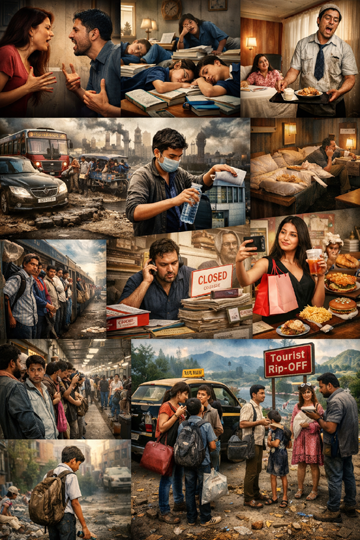
Today, more divorces come from heightened inability to live with each other. If one part of the couple is willing to accept momentary loss or defeat or is willing to compromise on mental or physical comfort for the other part’s happiness or comfort only then can a marriage work. Otherwise, if people pat themselves on the back saying that they are too competitive to suffer the pain of marriage, the word they are looking for is ‘selfish’ not ‘competitive’.
It starts from early upbringing. If parents teach children to win all the time and never back down in a discussion – to make them high flying IIT and IIM graduates with no loss in their track record then they will be creating monsters unfit for family life. This kind of attitude of encouraging trash in society is found everywhere now.
What is most alarming about contemporary Indian society is not the visible decay in systems, services, relationships, or civic life. It is the quiet acceptance of that decay. We have become experts at normalising humiliation, inconvenience, mediocrity, and neglect. We behave like illiterate buffoons not because we lack degrees or exposure, but because we lack resistance. We have trained ourselves to absorb poor treatment silently, to rationalise dysfunction, and to confuse endurance with virtue. The rot is not accidental; it is cultivated, reinforced at home, celebrated in institutions, and sustained by our refusal to call it out.
The collapse of personal relationships, particularly marriages, is a useful starting point because it mirrors everything else. More divorces today stem not from moral decline but from an inability to live with another human being without treating life as a zero-sum contest. Marriage, at its core, is a repeated exercise in voluntary loss. Someone has to back down in an argument. Someone has to accept discomfort so the other can feel secure. Someone has to let go of ego for the sake of peace. When both partners are trained to “win” every interaction, the institution collapses under the weight of permanent competition. Yet instead of calling this selfishness, we rebrand it as ambition, competitiveness, self-respect, or knowing one’s worth. Words are polished, reality is not.
This pathology begins early. Parenting in urban India has increasingly become a factory process designed to produce résumé-perfect adults rather than humane citizens. Children are taught to never concede, never apologise, never lose, never pause. Every debate must be won. Every argument must end in dominance. The goal is clear: IIT, IIM, foreign degrees, high salaries, zero blemishes on the track record. What is never taught is how to live with others, how to absorb temporary loss, how to compromise without feeling defeated, how to care without calculating returns. The result is a generation of socially maladjusted adults who may excel at spreadsheets and PowerPoint slides but fail spectacularly at relationships, teamwork, empathy, and community life. We are manufacturing monsters and applauding ourselves for it.
This same attitude bleeds seamlessly into public life. Hospitality, for instance, has become a masterclass in gaslighting. Whether it is a five-star hotel or a budget airline, the experience is uniformly degrading. Rooms shrink while prices rise. Flights are delayed without explanation. Service staff are undertrained, underpaid, visibly resentful, and often unhygienic, yet customers are expected to smile gratefully for the privilege of being ignored. Apologies are delivered not through accountability but through grovelling scripts that mistake humiliation for sincerity. There are no processes, no ownership, no consequences. Worst of all, we have redefined hospitality by equating loud grins, folded hands, and joint-family aesthetics with world-class service, while ignoring basic hygiene, efficiency, and respect. This confusion would be funny if it were not so widespread.
Our relationship with air and water is equally revealing. We no longer preserve; we merely correct after damage is done. Instead of protecting rivers, lakes, aquifers, and forests, we sell air purifiers and water filters. Instead of outrage at deforestation occurring at an alarming pace, we discuss which bottled water brand tastes better. We live in a vat of poison and call it development. Children grow up believing that clean air comes from machines and clean water comes in plastic, completely disconnected from nature, ecology, or sustainability. This is not ignorance; it is engineered amnesia. When survival becomes a retail product, citizens stop asking political questions and start comparing specifications.
Food culture has suffered a similar fate. We no longer understand what is good for our bodies because no one taught us how to eat, cook, or live well. Parents obsessively teach children how to earn more, but almost never how to nourish themselves. Cooking is considered optional, health is outsourced to supplements, and wisdom is replaced by branding. Young people cannot identify fresh vegetables or seasonal produce, but they can pronounce imported cheese names flawlessly. Excess sugar, chemicals, and additives are acceptable as long as the packaging looks premium and the price tag is high enough to provoke envy. Consumption has replaced nourishment, and stupidity is actively taught as aspiration.
Education, supposedly our pride, is perhaps the most hollowed-out domain of all. We are no longer teaching children to think; we are teaching them to perform intelligence. Accents matter more than ideas. Polish matters more than curiosity. Imported syllabi are revered even when they are contextually irrelevant. Management education has devolved into jargon competitions, with PowerPoint slides masquerading as thought. There is little original thinking, little design innovation, and almost no intellectual courage. Students learn how to sound smart, not how to be insightful. They learn how to sell ideas, not how to generate them. This creates adults who can impress rooms but cannot solve problems.
Daily commuting exposes the lie of material success most brutally. Whether one travels in a Mercedes or a crowded bus, the misery is largely the same. Broken roads, endless traffic jams, aggressive driving, zero civic sense, and constant stress ensure that the workday begins in exhaustion. The wealthy may sit in air-conditioned bubbles, but they still lose hours of life to chaos. What is remarkable is not the dysfunction, but the silence. Very few people complain in writing. Fewer still follow up. Collective resignation has replaced collective action. We curse privately and comply publicly.
Domestic tourism offers another instructive contrast. Kashmir, Goa, Himachal Pradesh—different landscapes, identical problems. Cab mafias operate openly. Hotel prices are inflated without justification. Liquor monopolies thrive. Tourists are treated as prey rather than guests. For the same budget, international destinations offer better infrastructure, better service, and far less harassment. Yet instead of demanding reform, we blame crowds, seasons, or fate. The idea that domestic tourism could be dignified, efficient, and ethical seems almost radical.
Primary schooling, the foundation of any society, has become a grotesque marketplace. Parents in their mid-30s routinely pay ₹8–10 lakh a year for schools that deliver indifference, intimidation, and zero accountability. Teachers are overworked, parents are anxious, children are stressed, and administrators are unapproachable. Meanwhile, genuinely good schools with committed teachers charging ₹1–2 lakh are ignored because they lack aggressive marketing. Advertising, not education, determines reputation. The tragedy is that educated parents willingly participate in this charade, mistaking price for quality and branding for substance.
Mobility and mass transit further demonstrate institutional apathy. Public transport is overcrowded, unreliable, and poorly maintained. App-based cabs are expensive, unpredictable, unsafe, and often unhygienic. Reaching anywhere on time increasingly requires luck rather than planning. There is no process, no consistency, and no accountability. The system fails daily, yet the outrage is fleeting. We complain to friends, not to authorities. We adapt to dysfunction instead of demanding reliability.
Customer service, once a differentiator, has become an endurance test. Problems are no longer solved; they are “closed.” Tickets are generated, templates are sent, calls are transferred endlessly until the customer gives up. The underlying message is clear: your time, money, and dignity do not matter. The customer can suffer quietly or disappear. This culture thrives because it faces no resistance. Companies have learned that persistence, not quality, determines outcomes. Wear the customer down long enough, and silence will follow.
None of this is new. What is new is our collective silence. We adjust, move on, and call it normal. We wear resilience like a badge of honour while quietly surrendering standards. We confuse tolerance with maturity and adjustment with wisdom. In doing so, we allow mediocrity to harden into permanence. Societies do not collapse overnight; they decay gradually when citizens stop insisting on dignity.
At its core, this is not a crisis of resources, talent, or intelligence. It is a crisis of character. We have trained ourselves to endure instead of improve, to adapt instead of reform, to compete instead of cooperate. We reward selfishness and call it strength. We reward compliance and call it patience. Until we relearn the value of inconvenience in the short term for dignity in the long term—whether in marriages, parenting, education, or civic life—nothing will change.
The uncomfortable truth is that systems reflect citizens. If we accept trash, we will be served trash. If we stop writing complaints, stop demanding accountability, stop teaching children how to lose gracefully and live responsibly, then no reform, policy, or election will save us. A society that normalises humiliation eventually forgets what respect feels like. And once that happens, even excellence, when it appears, feels suspicious rather than aspirational.
The choice before us is simple but painful. We can continue adjusting to dysfunction and teaching our children to do the same, or we can reclaim discomfort as a tool for reform. That means calling out poor service, demanding processes, rewarding substance over shine, teaching compromise as strength, and rejecting the myth that winning always matters. Civilisation is not built by those who endure everything silently. It is built by those who refuse to accept that decay is destiny.