
For businesspeople, entrepreneurs, professionals and investors who travel frequently, the Indian passport’s low number of visa free countries translates into time, opportunity, and flexibility. Visa applications, embassy appointments, repeated documentation and long wait times are common frustrations that can affect business efficiency and lifestyle

In recent years, there has been a noticeable increase in the number of Indians — particularly high-net-worth individuals (HNWIs) and skilled professionals — who are either acquiring foreign citizenship or securing long-term residency status abroad. According to official data presented in the Indian Parliament, over 2 lakh Indians renounced their Indian citizenship in each of the past several years (2022-2025), totaling nearly 1 million over five years — a trend that is drawing attention in policy and public discourse.
1. Global mobility and passport power
One of the central drivers for wealthy Indians seeking alternative passports is mobility. The Indian passport ranks relatively low on global indexes such as the Henley Passport Index — allowing visa-free or visa-on-arrival travel to only around ~58 countries — far fewer than passports from the United States, European Union states, Canada, Singapore, and others that permit entry to 180+ countries visa-free.
For businesspeople, entrepreneurs, professionals and investors who travel frequently, this difference in passport power translates into time, opportunity, and flexibility. Visa applications, embassy appointments, repeated documentation and long wait times are common frustrations that can affect business efficiency and lifestyle. Equivalent foreign passports significantly ease these barriers.
2. Investment-linked residency and citizenship programs
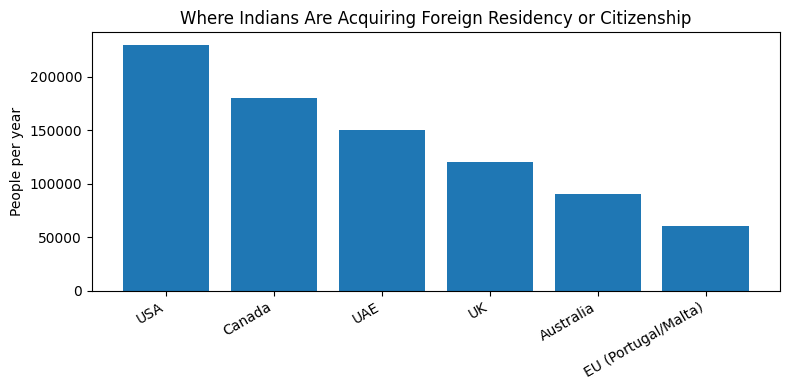
Across the globe, various countries offer residency or citizenship by investment (RCBI) or golden visa programs. Countries such as the UAE (particularly Dubai), Portugal, Malta, Cyprus, and also major Western economies like the United States, Canada, Australia, and some EU states have created structured paths for wealthy foreigners — including Indians — to acquire residency or citizenship in exchange for investment in real estate, business, or government bonds.
For example:
- UAE Golden Visa: Offers long-term residency (5-10 years) and is extremely popular among affluent Indians due to proximity, business opportunities, tax benefits, and cosmopolitan lifestyle.
- US EB-5 and Canadian programs: Provide pathways to permanent residency and, eventually, citizenship; they are especially appealing for families seeking global education and security.
- European options: European residencies or citizenships grant access to the entire Schengen area, benefiting travel, business engagements and cross-border lifestyle choices.
Collectively, these programs allow financially secure Indians to diversify their global footprint — including investment, education and business diversification — in ways that the Indian regime does not readily allow.
3. Access to education and healthcare
Education for children and access to world-class healthcare are major motivators. Many affluent Indian families choose to relocate or secure foreign citizenship/residency so their children can attend universities in countries like the US, UK, Canada, Australia or parts of Europe with fewer restrictions on work during and after education.
Parallelly, individuals and families seek environments where advanced medical care is easily accessible and reliable, without long waiting times or the need for high out-of-pocket expenses. This becomes a long-term consideration in migration decisions.
4. Tax optimization and financial strategy
Tax considerations and financial planning also play a role, albeit often a nuanced one. Many jurisdictions that attract wealthy migrants provide favorable tax regimes — such as no personal income tax, limited capital gains tax, and advantageous inheritance planning — which can be appealing for managing family wealth.
India’s tax system, though competitive in many respects, has complexities in outbound remittances, capital controls and estate planning that some wealthy Indians find restrictive when managing global assets.
5. Quality of life: Pollution, infrastructure and public services
Beyond economics and policy, quality of life factors are repeatedly cited by migrants in interviews, surveys, and opinion pieces. Congestion, pollution (air and water), infrastructure challenges, perceived crime rates, and urban stressors are real and recurring themes in why individuals — including substantial numbers of officers, professionals, and entrepreneurs — choose to settle abroad.
Even affluent Indians who could afford premium lifestyle options domestically sometimes find the systemic quality of public services abroad — from road connectivity to sanitation to healthcare responsiveness — more aligned with their aspirations.
6. Policy constraints: No dual citizenship allowed
India’s lack of formal dual citizenship forces emigrants who wish to become citizens of another country to renounce Indian citizenship. This policy decision, embedded in the Indian Citizenship Act, pushes many long-term migrants to choose foreign citizenship once settlement becomes permanent, as only Overseas Citizen of India (OCI) status — a visa-free travel card — is offered without full civic rights.
This legal landscape is a structural reason why individuals nearing or achieving permanent residency abroad opt for full citizenship, rather than maintain only OCI status.
Which passports and residency routes being sought?
The nationality or residency destinations sought by wealthy Indians have some clear patterns:
1. Western Countries
- United States: Through employment pathways (H-1B visas), family and investor routes (EB-5), offering robust civil liberties, economic opportunity, strong institutions, and educational excellence.
- Canada: Points-based skilled immigration, family sponsorship, and robust welfare systems make it a popular choice.
- Australia & New Zealand: Attract professionals with skilled worker visas and pathways to citizenship.
In 2023 alone, Indians topped the list for citizenship acquisitions among OECD countries, with approximately 2.25 lakh Indians becoming citizens of OECD nations — more than any other country of origin.
2. Gulf and Middle Eastern hub options
- United Arab Emirates: Dubai and Abu Dhabi offer golden visas (5-10 years) that allow investors, entrepreneurs, and highly skilled workers — including their families — to live, work, and establish businesses. Proximity to India, cultural connections and business links make the UAE one of the most sought destinations.
3. European rationalized access routes
- Portugal, Malta, Cyprus: Citizenship or long-term residency via investment programs provide pathways to EU mobility, appealing to families and globally mobile entrepreneurs.
These trends are shaped by the pull factors created by host country policies that explicitly seek global talent and wealth and the push factors of Indian economic and social landscapes.
Indian visa numbers for foreigners dipping
While outbound mobility choices by Indians are increasingly highlighted, the inbound side — tourists and business visitors coming into India — shows contrasting trends.
1. Foreign tourist arrivals remain below potential
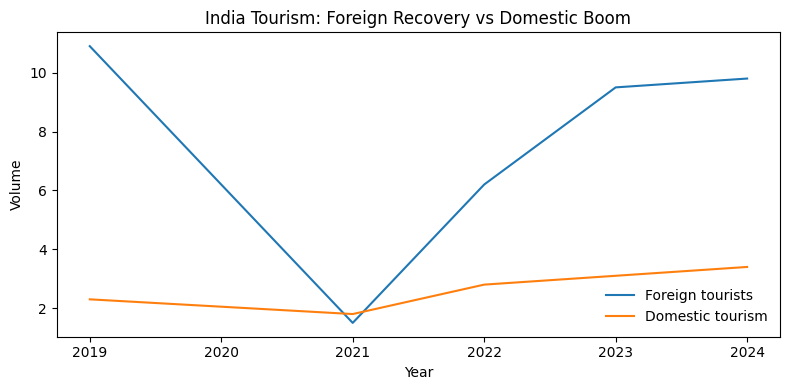
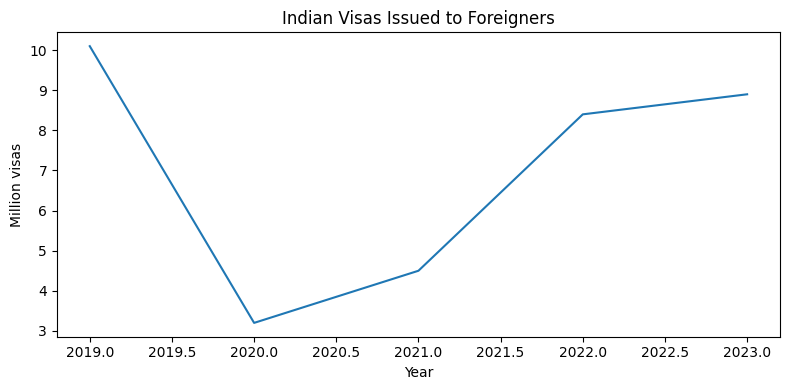
According to tourism data, although India’s inbound tourism has recovered from COVID lows, it still lags behind many global peers and — at least until 2023 — remained below the pre-COVID figures for foreign tourist arrivals.
India received around 9.52 million foreign tourists in 2023, a figure that, while growing, is many times smaller than countries like France (~100 million) or Thailand (~28 million).
2. Cumbersome visa processes
A recurring concern among foreign visitors and travel industry insiders is that India’s visa process is often seen as cumbersome and bureaucratic, involving complex forms, unclear documentation requirements, and limited online support channels. This can discourage repeat visitors or first-time tourists who find alternative destinations more welcoming and easier to visit.
Personal accounts and travel community discussions frequently highlight frustration over Indian visa systems, including difficulty in accessing clear pricing structures or navigating repetitive document requirements.
3. Safety, cost, and competitiveness
Issues such as safety perceptions — particularly concerning solo women travelers — high relative costs (GST and service charges), chaotic infrastructure in certain destinations, and competitive offerings from focused global tourism markets like Southeast Asia further deter some visitors.
Countries such as Thailand, Vietnam, Malaysia and Sri Lanka have been actively promoting tourism with simplified visa regimes, aggressive marketing, and budget-friendly packages, enhancing their appeal over India in some segments.
4. Marketing and international outreach
India’s tourism promotional budget and strategic global marketing efforts, according to some industry experts, have been less aggressive compared with peer destinations investing heavily in digital campaigns, regional partnerships, and on-ground tourism offices internationally.
Combined, these factors make India less competitive in capturing international tourists’ attention than it perhaps could be given its natural and cultural wealth.
High-ticket tourism to India declining vs. low-cost tourism rising
Within the inbound tourism narrative, there’s a perceived shift:
1. Lower-budget tourists and backpackers
India continues to attract budget-conscious travelers — including backpackers, gap-year students, spiritual seekers, and long-stay visitors — drawn by relatively lower costs on the ground, cultural depth, and unique experiences.
This contrasts with high-ticket luxury tourism (e.g., business travel, boutique resort stays, premium experiential tourism), which has not grown at scale commensurate with global trends in luxury tourism.
2. Domestic tourism boom
To offset the slower rebound in international travel, domestic tourism has surged sharply in India. In parts of 2025, states like Rajasthan and Madhya Pradesh saw strong domestic visitor numbers, even as foreign arrivals declined modestly nationally — suggesting that the tourism sector’s energy is currently coming more from Indian travelers than foreign ones.
Domestic tourists are usually more price-sensitive and contribute to low-cost, volume-driven tourism rather than high-ticket luxury stays.
3. Price competitiveness and local costs
Gradually rising accommodation costs, expensive tourist taxes (like GST), and the comparative cost of imported products and services in India can make longer, high-end stays less competitive compared with Southeast Asian or Middle Eastern alternatives that offer high quality at similar or lower prices.
People from war-torn, poor countries seeking asylum at or migrating to India
India’s approach to asylum seekers and refugees is distinctive because the country has no formal domestic refugee law and is not a signatory to the 1951 Refugee Convention or its 1967 Protocol. This complicates the refugee classification and legal status process.
1. Refugee movements from neighbouring regions
Historically, India has hosted various groups fleeing conflict or persecution, including:
- Rohingya from Myanmar — with tens of thousands documented in India, though treated as undocumented migrants under Indian law.
- Afghan refugees — tens of thousands remain in cities like Delhi, often registered with UNHCR.
- Sri Lankan Tamils and Tibetan refugees — longstanding communities from earlier displacement episodes.
These groups move for safety, escape from conflict, persecution, or instability, often seeking asylum or sanctuary despite India’s complex legal framework for refugees.
2. Lack of formal asylum framework
Because Indian law does not formally separate asylum seekers from other categories of foreigners, individuals seeking refuge must often register with UNHCR offices in India and navigate an ad-hoc system of permissions. This contrasts with countries that have clear asylum adjudication laws and social protection.
Indians are fleeing to safer, welfare-centric nations
While some people flee poverty in other countries toward India or safety, a reverse dynamic is also visible: Indians — especially skilled and financially secure — increasingly choose to move to countries perceived as safer, cleaner, more stable, welfare-oriented and more citizen-centric.
1. Public services and social safety nets
Countries such as Canada, many European states, Australia, New Zealand and parts of Scandinavia are often cited as providing robust public services, universal healthcare, free or subsidized education, and comprehensive welfare systems. These systems reduce daily uncertainties and enhance family planning — from childcare to retirement. This pull of welfare-centred states is a powerful incentive.
2. Security and clean environment
Relative crime rates, air and water quality, urban safety, and environmental standards are factors quoted by migrants as part of quality-of-life considerations. Many Indians moving abroad specifically mention the desire for cleaner cities, reliable infrastructure and safer neighborhoods for raising children.
3. Economic and professional opportunities
Abroad, skilled Indians often find opportunities for career progress that offer clearer merit pathways, competitive remuneration, and structured professional mobility in global industries, making long-term settlement abroad both viable and rewarding.
A complex interplay of push and pull factors
The trends described above — wealthy Indians seeking alternative passports, foreign tourist arrival challenges, migration and refugee flows, and Indians seeking welfare-centric states abroad — are not isolated phenomena. Rather, they reflect a complex interplay of policy environments, global mobility dynamics, quality-of-life considerations, economic aspirations, and structural incentives.
On one side, Indian migrants — from high-net-worth individuals to young professionals — are making strategic decisions based on global opportunities, passport power, and personal or family aspirations. On the other, inbound tourism and foreign engagement with India are shaped by international perceptions of ease, safety, infrastructure, and competitiveness.
At the same time, India’s role in hosting asylum seekers from conflict zones highlights humanitarian currents that challenge legal and policy frameworks, even as Indian nationals seek greater opportunities abroad.
Understanding these trends in nuanced detail — rather than as single-sided narratives — is essential for policymakers, businesses, families, and citizens alike as India navigates its place in an increasingly mobile and interconnected world.