At the core of this dysfunction lies a deeper misconception about population, livelihoods, and geography. For decades, dominant economic thinking has promoted the idea that fewer people should be engaged in farming. This creates a flaw in basic public policy design

Debasish Roy, CEO, Royalle Corporation (www.royalle.in)
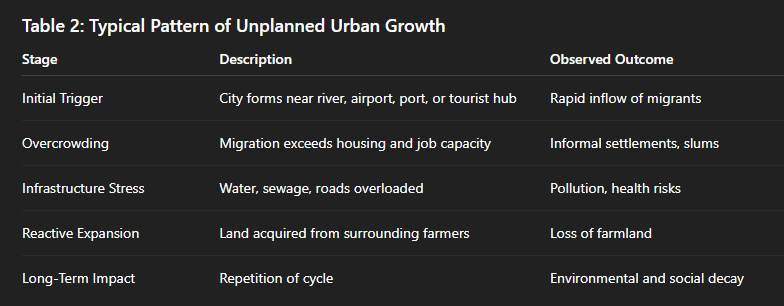
The global pattern of unplanned town planning is mostly a set of knee jerk reactions. Allow a city to develop beside either a river bank, a large international airport or a huge tourist spot all of which provide sustainance, economics for extending family life. Then allow the city to be overcrowded with people from surrounding districts and villages coming over to the city and finding places to stay like vermin. Allow sewage and supply lines to get clogged then extend the city by acquiring more land from farmers around that city. This mindless machine of town planning is self-defeating and toxic to clean and healthy life.
Economists promote mechanised farming and feel proud that less people feed the population if the percentage engaged in farming is less. This is shown as a sign of progress. I feel this is wrong.
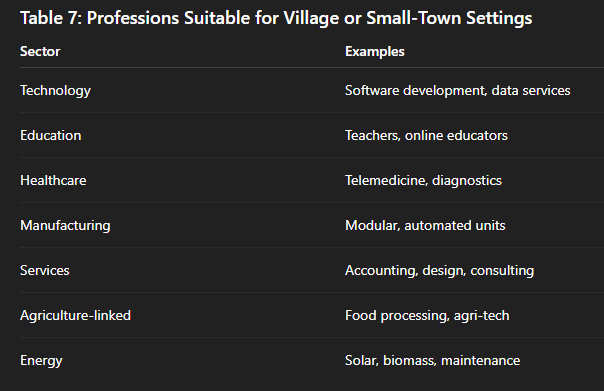
A high percentage of the total population of a nation, engaged in farming should neither be shameful for the farmer nor for the calculating economists. Instead of crowding the cities looking for employment people should stay in villages with all the infrastructure and employment opportunities at their access, now that we have the use of the internet. People living in villages are equated with People engaged in agriculture. This is again wrong. Villages and cities should house all kinds of professions.
Across continents and political systems, modern urbanisation has followed a disturbingly similar and deeply flawed pattern. Cities rarely grow through deliberate, long-range planning rooted in ecology, livelihoods, and human well-being. Instead, most expand through a series of knee-jerk reactions to immediate economic opportunity. A settlement emerges beside a river that promises water and trade, near an international airport that connects it to global capital, or around a major tourist attraction that offers employment and informal income. These geographic advantages act as magnets. What begins as organic growth soon degenerates into unchecked overcrowding as people from surrounding districts and villages pour into the city in search of survival. The result, as documented repeatedly by global consulting firms and multilateral agencies, is a toxic cycle of congestion, environmental degradation, infrastructure collapse, and social alienation.
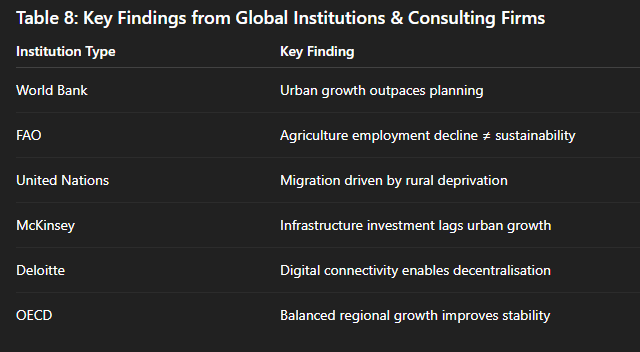
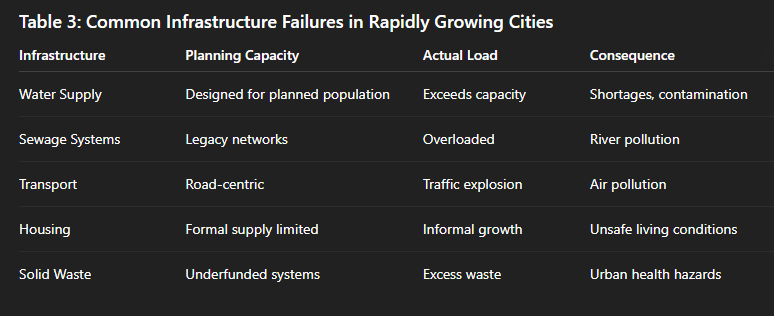
Reports by McKinsey Global Institute on urbanisation repeatedly note that most cities in Asia, Africa, and Latin America grow faster than their ability to plan. Infrastructure investments consistently lag population growth by decades. Water supply networks are extended without upgrading sewage systems. Roads are widened while public transport remains an afterthought. Informal settlements mushroom along drains, railway lines, riverbanks, and airport peripheries. These patterns are not accidental; they are systemic outcomes of treating cities as infinite absorbers of rural distress rather than as carefully balanced ecosystems.
The World Bank’s Urban Development reports describe how cities are allowed to densify beyond carrying capacity before authorities respond by acquiring more land from surrounding farmers. This expansion is presented as “development,” yet it merely shifts the problem outward. Agricultural land is consumed, food systems weaken, groundwater tables drop, and former farmers are pushed into the same urban labour markets that were already saturated. The machine keeps running, consuming land, water, and human dignity in equal measure, while producing cities that are increasingly hostile to clean air, safe water, and healthy family life.
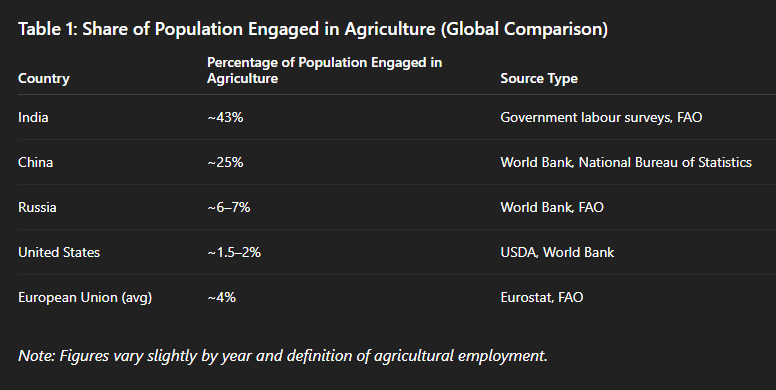
At the core of this dysfunction lies a deeper misconception about population, livelihoods, and geography. For decades, dominant economic thinking has promoted the idea that fewer people should be engaged in farming. Mechanised agriculture, economists argue, allows a small percentage of the population to feed the rest, freeing labour for industry and services. Consulting firms often celebrate this shift as a marker of progress. Indeed, global data shows that the share of population engaged in agriculture has declined steadily across most economies. In India, approximately 43 percent of the workforce is still engaged in agriculture according to government labour surveys. In China, the figure has fallen to around 25 percent, reflecting decades of industrialisation and urban migration. In the United States, less than 2 percent of the population works directly in farming, while Russia’s agricultural workforce is estimated in the mid-single digits based on World Bank and FAO datasets.
Yet this statistical triumph masks a profound social and spatial failure. Being engaged in farming has come to be treated as shameful, backward, or inefficient—both for farmers themselves and for the economists who calculate productivity in purely numerical terms. Multilateral organisations such as the FAO have repeatedly warned that reducing the number of people in agriculture does not automatically produce food security, sustainability, or social stability. On the contrary, excessive concentration of population in cities often weakens food resilience, increases supply-chain vulnerability, and disconnects people from land, water, and seasonal rhythms essential for long-term ecological balance.
The assumption that villages are merely reservoirs of agricultural labour further compounds the problem. In public discourse and policy design, “village” is equated with “farmer,” while “city” is equated with professionals, services, and opportunity. This binary thinking is not supported by history or data. Before industrial centralisation, villages housed artisans, traders, teachers, healers, administrators, and manufacturers. Even today, government reports from India’s Ministry of Rural Development and similar agencies worldwide highlight the diversity of non-farm employment already present in rural areas—construction, logistics, education, healthcare, renewable energy, and digital services among them.
Despite this evidence, policy continues to funnel opportunity toward cities, forcing people to migrate rather than enabling them to remain where they are. The United Nations’ World Urbanization Prospects show that urban populations are growing not because cities are inherently more productive, but because rural regions are systematically deprived of infrastructure, credit, healthcare, education, and digital connectivity. Migration, in this context, is not choice; it is compulsion.
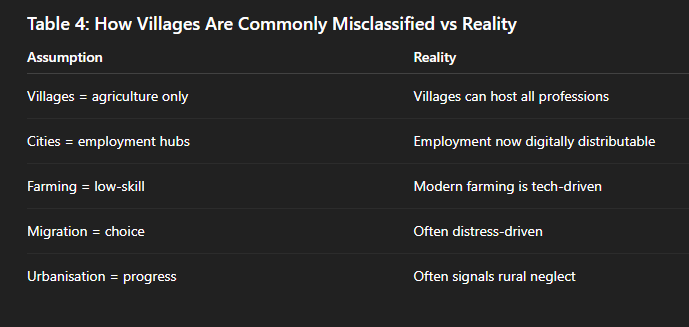
Consulting firm analyses increasingly acknowledge this failure. Deloitte’s studies on smart infrastructure argue that digital connectivity has fundamentally altered the logic of geography. Work is no longer bound to physical proximity in the way it once was. The internet, cloud computing, remote services, and decentralised manufacturing allow economic activity to be distributed rather than concentrated. Yet town planning frameworks remain stuck in a 20th-century mindset, assuming that employment must cluster in megacities and that people must follow jobs rather than the other way around.
The consequences of this mismatch are visible everywhere. Cities become overcrowded beyond design limits. Sewage systems clog because they were built for half the current population. Rivers turn into open drains, a phenomenon documented in environmental audits across South Asia and Africa. Air quality deteriorates as traffic multiplies faster than road capacity. Housing becomes unaffordable, pushing migrants into informal settlements that lack legal protection, sanitation, or safety. Government reports consistently show that urban poverty is rising even as cities generate more GDP.
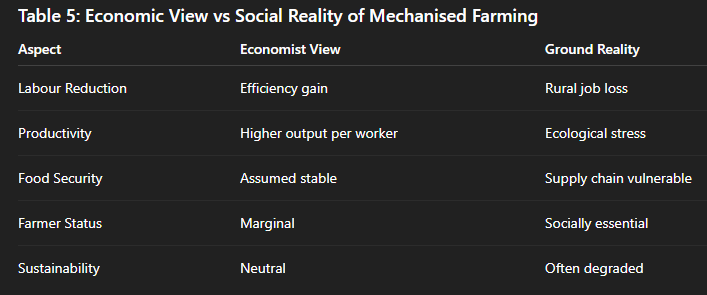
At the same time, villages hollow out. Young people leave, local markets shrink, schools close, and healthcare becomes inaccessible. Agricultural land is either abandoned or consolidated into large holdings that prioritise export crops over local food security. Multilateral development banks have noted that this pattern increases inequality both within cities and between regions, creating political instability and social resentment.
The tragedy is that this outcome is not inevitable. The same global data that charts the failures of urban overconcentration also points to an alternative path. Countries that have invested in rural infrastructure—roads, broadband, healthcare, education, and decentralised energy—show lower distress migration and more balanced growth. Government pilots in several nations demonstrate that when villages are provided with reliable internet, financial services, and local employment opportunities, people choose to stay. They build businesses, educate their children, and contribute to the economy without burdening already strained cities.
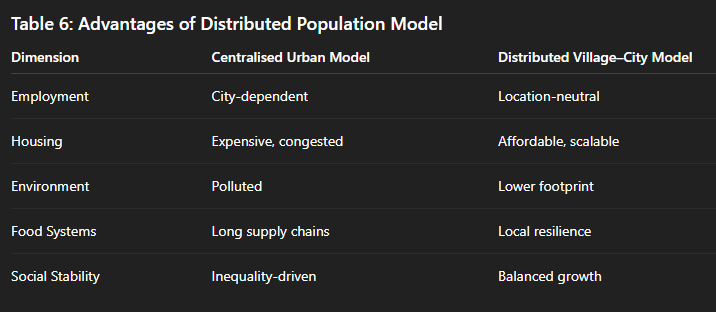
The idea that villages and cities should house all kinds of professions is not radical; it is pragmatic. A software developer does not need to live next to a polluted river or an overcrowded airport. A teacher, healthcare worker, designer, consultant, or data analyst can function from a small town or village if connectivity and basic services exist. Even manufacturing, once thought inseparable from urban clusters, is increasingly decentralised through automation and modular production systems, as highlighted in global manufacturing outlooks by consulting firms.
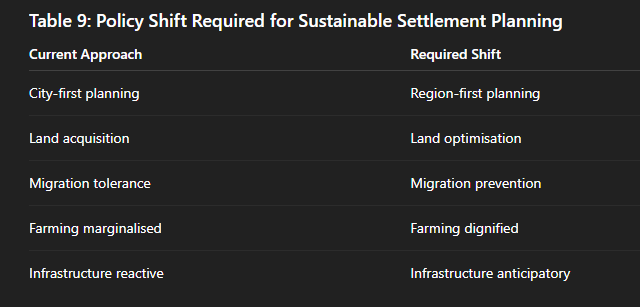
What is required is a shift in planning philosophy. Instead of treating villages as subsets of agriculture and cities as subsets of opportunity, planners must recognise that both are sets capable of housing diverse livelihoods. Agriculture itself should be viewed not as a residual occupation for those left behind, but as a technologically advanced, knowledge-intensive profession integrated with food processing, logistics, research, and sustainability services. This integration is explicitly recommended in FAO and OECD reports on future food systems.
Unplanned urbanisation is ultimately self-defeating. It destroys the very advantages that made cities attractive in the first place—clean water, economic opportunity, cultural vibrancy, and social mobility. By continuously expanding outward through land acquisition rather than inward through efficiency and balance, cities become engines of environmental damage and human stress. Meanwhile, villages are denied the chance to evolve into modern, livable settlements that can absorb population growth without ecological collapse.
Global experience, data, and institutional knowledge now converge on a simple truth: development cannot be achieved by crowding people into fewer and fewer urban spaces while emptying the countryside. The future lies in distributed habitation, where villages and cities alike offer dignity, opportunity, and sustainability. With digital infrastructure dissolving distance, the old logic of forced migration has lost its economic justification. What remains is a policy failure—one that can be corrected if planners, economists, and governments are willing to abandon outdated assumptions and design human settlements around life rather than numbers.
Until that shift occurs, the world will continue to produce cities that choke on their own growth and villages that fade into neglect—two sides of the same planning failure, endlessly repeating itself in the name of progress.