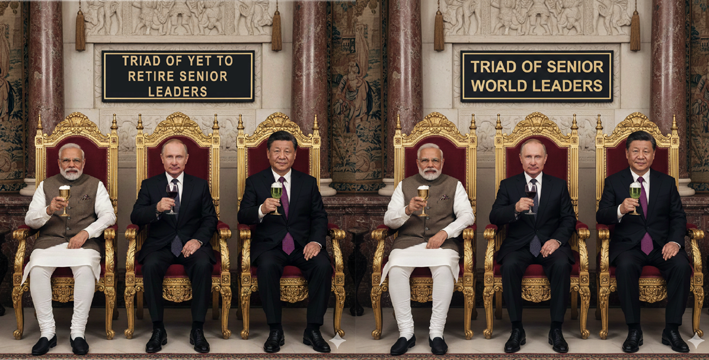
Despite differences in their individual characteristics, all three leaders, Vladimir Putin of Russia, Narendra Modi of India and Xi Jinping of China, share a dangerous common trait, none has named, groomed, or empowered a clear successor who has been publicly acknowledged as one
I. Three Lives, Three Histories: How They Rose to Power
Vladimir Putin: A Survivor of the Soviet Collapse
Born in 1952 in post-war Leningrad, Putin grew up in a communal apartment, shaped by scarcity and the Soviet security mindset. He joined the KGB early, serving in East Germany during the final decade of the Cold War. The collapse of the USSR left deep scars, and his rise through St. Petersburg’s administration eventually led Boris Yeltsin to appoint him Prime Minister in 1999.
Key elements of Putin’s rise:
- Childhood in Soviet austerity
- Training in the KGB—discipline, secrecy, hierarchy
- Witnessing the Soviet collapse, fueling his belief in a strong state
- Rapid climb through the security and administrative structure
- Becoming President at age 47 in 1999
Putin’s identity is defined by resilience, fatalism, and a structural distrust of Western power.
Narendra Modi: The Outsider Who Became India’s Most Dominant Politician
Born in 1950 in Vadnagar, a small town in Gujarat, Modi’s upbringing was modest. His early years selling tea have become part of his political identity, symbolizing grassroots authenticity. As a young man, he joined the Rashtriya Swayamsevak Sangh (RSS), a cadre-based nationalist organization. Skilled at organization and public communication, he rose through the Bharatiya Janata Party (BJP) ranks.
His move from party organizer to Chief Minister of Gujarat in 2001 marked the beginning of his executive career. By 2014, he led the BJP to the first full majority in Indian national politics in three decades.
Key elements of Modi’s rise:
- Childhood defined by economic struggle
- Discipline and ideological grounding in the RSS
- Long years of organizational work
- Transformation of Gujarat into a business-friendly state
- National rise fuelled by charisma, communication mastery, and electoral strategy
Modi’s identity is built upon self-reliance, personal austerity, nationalism, and a mass-mobilizing charisma.
Xi Jinping: The Revolutionary Princeling-Turned-Reformer
Xi Jinping was born in 1953 into privilege as the son of Xi Zhongxun, a respected revolutionary. But the Cultural Revolution upended his childhood—his father was purged, the family was humiliated, and Xi was sent to a rural village for hard manual labor as part of Mao’s “re-education” program.
He re-entered the party through perseverance, gradually climbing the ranks as a governor, provincial leader, and eventually a member of the Politburo Standing Committee. In 2012, he became General Secretary of the Chinese Communist Party, and in 2018, he removed presidential term limits, positioning himself as China’s most powerful leader since Mao.
Key elements of Xi’s rise:
- Childhood in a revolutionary elite family
- Trauma of the Cultural Revolution
- Provincial governance experience in Fujian, Zhejiang, and Shanghai
- Mastery of CCP internal politics
- Centralization of power through anti-corruption campaigns
Xi’s identity is shaped by ideological commitment, party loyalty, historical mission, and an almost imperial sense of national rejuvenation.
II. Personality, leadership style, and governing philosophy
Vladimir Putin: The Strategist of Control
Putin’s personality blends caution, calculation, and a deep sense of historical grievance. His style is:
- Authoritarian but pragmatic
- Security-obsessed
- Emotionally restrained
- Highly controlled and strategic
He sees politics primarily through the lens of power balance—military strength, geopolitical space, and national sovereignty.
Putin believes:
- The world is hostile without strength.
- Russia must reclaim status lost after 1991.
- Centralization ensures national stability.
Narendra Modi: The Communicator-in-Chief
Modi’s style is rooted in charisma, communication, and public mobilization. He is:
- Emotionally expressive
- Highly disciplined and personally austere
- Skilled in storytelling and symbolism
- Focused on development, nationalism, and strong leadership imagery
He sees politics as a relationship between leader and people, emphasizing:
- Mass connection
- National pride
- Transformation through economic development
- Centralized decision-making but through democratic legitimacy
Modi’s popularity rests on his ability to project strength while speaking the language of aspiration.
Xi Jinping: The Party-First Ideologue
Xi’s personality is steady, disciplined, hierarchical, and ideological. He is:
- Reserved and serious
- Formal in communication
- Deeply committed to the Communist Party
- Focused on order, discipline, and national unity
He sees politics as:
- A long-term historical mission
- A process of restoring Chinese greatness
- A system where the Party must control all aspects of life
Xi believes that China’s destiny requires:
- A strong, centralized state
- Ideological purity
- Technological self-reliance
- Strategic assertiveness abroad
III. Three Nations Under Three Different Worlds
Russia Under Putin
Russia today is an authoritarian state with:
- A shrinking population
- A resource-dependent economy
- High military spending
- Fierce nationalism
- Limited political pluralism
Putin has restored state power but at the cost of political openness and economic diversification.
India Under Modi
India is a:
- Vibrant electoral democracy
- Fastest-growing major economy
- Young demography with massive potential
- Emerging technological and strategic power
Modi’s governance mixes:
- Strong central leadership
- Digital state capacity
- National security focus
- Economic modernisation
India remains pluralistic, noisy, and competitive—its institutions ensure continuity beyond any single leader.
China Under Xi
China is a controlled, one-party state with:
- Massive industrial capacity
- Rapid technological growth
- A slowing population
- Rising state intervention
- Increasing international assertiveness
Under Xi, China has become more ideological, more centralised, and more globally ambitious.
IV. Three Leaders, No Clear Successor: A Global Risk
Despite their differences, all three leaders share a dangerous common trait:
None has named, groomed, or empowered a clear successor.
Putin
- Has reshaped Russia’s political system around his personal authority.
- Possible successors are unknown or politically weak.
- Any transition could trigger elite struggle or instability.
Modi
- The BJP has strong institutions, but Modi’s dominance overshadows all other leaders.
- No heir-apparent is visible with comparable national appeal.
- India’s democracy ensures continuity, but the BJP’s future direction remains uncertain.
Xi Jinping
- Removed term limits and consolidated power.
- No second-in-command is evident.
- Succession is the most sensitive issue within the CCP; instability cannot be ruled out.
V. What Happens When They Leave?
The absence of succession planning could reshape global politics:
Russia
A post-Putin struggle could push Russia:
- Toward radical nationalism
- Toward elite fragmentation
- Or toward cautious reform
India
A post-Modi India will remain democratic and stable, but political direction may shift toward:
- Coalition governments
- New leadership styles
- More institutional consensus
China
A post-Xi China is the greatest uncertainty:
- Will the next leader maintain Xi’s centralization?
- Or will internal pressures force economic and political adjustments?
- Succession disputes could destabilize the CCP if not managed perfectly.
VI. Final Analysis: Three Leaders, Three Legacies
Putin, Modi, and Xi are not just political leaders—they are products of unique national histories:
- Putin is the restorer of the state after Soviet collapse.
- Modi is the outsider who reshaped Indian politics through mass appeal.
- Xi is the princeling who centralized power to complete the “Chinese rejuvenation.”
They are:
- Strong
- Determined
- Historically conscious
- Ideologically driven in different ways
And yet, their greatest shared weakness lies in their refusal to cultivate equally strong successors.
As they enter their mid-70s, the global order they helped create rests on uncertain foundations. The coming decade will not just test Russia, India, and China—it will test the world’s ability to absorb a transition from personalized power to something more institutional, balanced, and predictable.
To understand the future, we must first understand the men themselves—how they rose, what shaped them, and how their countries evolved under their leadership.
I. Three Childhoods, Three Histories, Three Paths to Power
Vladimir Putin: The Spy Who Rebuilt the State
Putin’s story begins in a Leningrad communal apartment during the harsh post-World War II Soviet recovery. Born in 1952, he came of age in a USSR where political discipline, state security, and personal toughness were prized. His recruitment into the KGB marked the beginning of a career steeped in secrecy, hierarchy, and strategic calculation.
His political rise was unconventional:
- Deputy Mayor of St. Petersburg under Anatoly Sobchak
- Head of the FSB
- Appointed Prime Minister by Boris Yeltsin in 1999
- Acting President on December 31, 1999
By 2000 he was elected President, promising to restore Russian stability after the chaos of the 1990s. Putin’s worldview is shaped by the Cold War, the collapse of the Soviet Union—which he famously called “the greatest geopolitical catastrophe of the 20th century”—and an unwavering belief in centralized authority.
Narendra Modi: The Grassroots Organizer Who Rose to the Top
Modi’s journey contrasts sharply with Putin’s. Born in 1950 in Vadnagar, Gujarat, Modi came from a modest family. His early years selling tea at a railway station—an origin story now deeply embedded in India’s political folklore—defined him as an outsider to elite politics.
His rise was strictly political and organizational:
- Joined the Rashtriya Swayamsevak Sangh (RSS) as a young volunteer
- Became a full-time pracharak, building grassroots networks
- Appointed Chief Minister of Gujarat in 2001
- Led the state into an era of rapid infrastructure-heavy economic growth
- Became Prime Minister in 2014 after the BJP secured a sweep unseen in decades
Modi’s worldview is shaped by nationalism, development politics, and a belief in strong, charismatic leadership backed by mass public mobilization.
Xi Jinping: The Princeling Who Survived Revolution
Xi Jinping’s life began in privilege but quickly descended into struggle. Born in 1953 to Xi Zhongxun, an early revolutionary hero, he became a victim of Mao’s Cultural Revolution when his father was purged. As a teenager, Xi was sent for “re-education” to a rural village in Shaanxi Province.
Over time, he leveraged both suffering and family legacy to climb the CCP ranks:
- Local posts in Hebei and Fujian
- Party Secretary of Zhejiang
- Party Chief of Shanghai
- Elevated to the Politburo Standing Committee
- Became General Secretary of the CCP in 2012
Xi’s worldview is steeped in the inseparability of party and state, the trauma of national humiliation, and the belief that China must “reclaim its rightful place” as a great global power.
II. Comparing Their Leadership Styles
Putin: The Strategic Autocrat
Putin embodies state survivalism. His leadership relies on centralization, military strength, a disciplined elite, and control over information. He perceives the West as both competitor and threat. Putin’s Russia emphasizes sovereignty above all else, leading to conflicts in Georgia (2008), Crimea (2014), Ukraine (2022–).
Modi: The Populist Nationalist
Modi combines strongman charisma with electoral democracy. He maintains overwhelming public support through a blend of nationalism, welfare expansion, digital state capacity, and high-visibility reforms. Modi uses democratic legitimacy—but often applies centralized governance—to project authority.
Xi: The Ideological Party-Builder
Xi is a fusion of Maoist political centralization and Confucian hierarchical governance. Under his rule, China has seen:
- The abolition of presidential term limits
- Crackdowns on internal dissent
- Aggressive foreign policy (South China Sea, Taiwan)
- Mass industrial upgrading through programs like Made in China 2025
He is both chairman and CEO of China Inc.
III. The Nations They Lead: Contrasts in People, Economics, and Ambition
Russia: A Military Power with a Shrinking Economy
Russia’s economy is heavily dependent on natural resources. Its population is declining, and sanctions have strained its fiscal flexibility. However, its military, nuclear capability, and energy leverage give it disproportionate global influence.
Culturally, Russians are state-centric, historically accustomed to strong centralized authority. This sustains Putin’s long tenure.
India: A Young Democracy with Explosive Growth
India is the world’s fastest-growing major economy, with a population surpassing China and a booming technology, services, and manufacturing landscape. Its greatest advantages are:
- A young workforce
- Deep democratic roots
- Global diaspora influence
- Strategic partnerships with the US, Japan, Europe, and the Middle East
Its complexity—linguistic, cultural, religious—means strong federal institutions remain essential.
China: A Demographic Crisis Inside a Manufacturing Superpower
China’s economic engine is enormous—20% of global manufacturing output. But it faces:
- A rapidly ageing population
- Declining birth rates
- Rising debt
- Slowing growth
- Geopolitical pushback
The Chinese people show strong pride in national achievements, which legitimizes the CCP but also creates rising expectations.
IV. Will These Countries Fade After Their Leaders Depart?
This is the central question.
1. Russia After Putin
Russia faces real risks:
- A power vacuum in an over-centralized political system
- Elite fragmentation
- Economic decline
- Territorial disputes and frozen conflicts
Will Russia fade? Possibly—but history suggests Russia always reconstitutes itself as a major power. The deeper question is whether the next leader will be more moderate or more hardline.
2. India After Modi
India is structurally very different from Russia and China. Its institutions—parliament, courts, federal system, media, bureaucracy—have survived dozens of leadership transitions.
After Modi, India may shift:
- To a more coalition-based politics
- To a more decentralized economy
- To a more institutional, less personality-driven governance style
But India will not fade. Its demographics, growth, and geography guarantee long-term influence.
3. China After Xi Jinping
China without Xi could go one of two ways:
Scenario A: Continuity
A new CCP leader maintains Xi’s centralization and assertive foreign policy.
Scenario B: Controlled Reform
The party loosens control, allowing economic restructuring and diplomatic recalibration.
But China’s demographic decline is severe. Unless reversed or compensated by productivity gains, China’s long-term power will plateau.
V. The Potential Successors: Will New Nations Replace These Three Giants?
Let’s examine possible candidates.
1. Taiwan
A technology superpower (semiconductors) with strategic importance. But its geopolitical vulnerability limits its ability to become a global power.
2. Australia
Geography, resources, and alliance networks make Australia a rising strategic player in the Indo-Pacific. But population size restricts its global scale.
3. Turkey
A historical empire, strategically located between Europe and Asia. Its military size, industrial growth, and diplomatic activism make it a candidate for greater influence—if its internal economic volatility stabilizes.
4. Israel
A global leader in defence technology, cybersecurity, and innovation. But domestic political fractures and regional conflict limit its ability to project power.
5. Brazil
The strongest candidate among new major powers due to:
- Size
- Resources
- Demographics
- Regional dominance
Under stable leadership, Brazil could become a top-five global economy.
6. Argentina
Potentially powerful due to fertile land and natural resources. Historically held back by political instability and economic mismanagement.
7. South Africa
A diplomatic heavyweight but facing internal challenges such as electricity shortages, unemployment, and economic stagnation.
Mob rule by smaller nations?
None of these countries individually can replace Russia, India, or China. But collectively, they represent a more distributed future—a multipolar world with “middle powers” exerting increasing influence.
VI. A New Global Chapter Within a Decade
When Putin, Modi, and Xi eventually exit the political stage, the world will undergo a rebalancing:
- Russia may shrink but retain military relevance.
- China will remain powerful but face internal constraints.
- India is poised to continue rising regardless of who leads next.
- Middle powers (Turkey, Brazil, Australia, Israel) will shape regional politics more intensely.
- The West will still remain an anchor of technological and financial power.
The post-strongman world will not be defined by the fall of nations, but by the diffusion of power. Instead of three commanding leaders, expect:
- 8–12 influential middle powers
- More regional blocs
- Greater technological competition
- Less predictable geopolitics
Final Thought
Putin, Modi, and Xi represent the final generation of 20th-century style leaders—shaped by war, revolution, poverty, and ideology. The next generation will be shaped by AI, climate stress, inequality, and hyper-connectivity. And in that world, no single leader or nation may ever dominate the global order the way Russia, India, and China have under these three men.