
Data from fertility and health apps such as Clue, which track ovulation and sexual activity, consistently show New Year’s Day outperforming Valentine’s Day, Christmas, and summer holidays in terms of logged sexual encounters

For generations in India, sexuality has followed a predictable rhythm. Weddings, festivals, vacations, and long family gatherings traditionally marked moments when intimacy quietly increased behind closed doors. Sex, while rarely spoken about openly, was woven into social calendars shaped by religion, ritual, and family life. Yet as 2026 begins, a subtle but significant shift is emerging: New Year’s Day—once associated with hangovers, resolutions, and recovery—is increasingly becoming a peak moment for sexual intimacy, overtaking traditional “festival sex.” This is not merely a Western import or a fleeting urban trend. It reflects deeper changes in how Indians relate to time, rest, desire, and themselves.
Globally, January 1 has already earned a reputation as the most sexually active day of the year. Data from fertility and health apps such as Clue, which track ovulation and sexual activity, consistently show New Year’s Day outperforming Valentine’s Day, Christmas, and summer holidays in terms of logged sexual encounters. Experts argue that this phenomenon has little to do with grand romance and everything to do with psychology, physiology, and relief. New Year’s Day offers something rare in modern life: a pause. No work deadlines, no family obligations demanding performance, no expectations of gifts or gestures. In that pause, desire has room to breathe.
ALSO READ: Summer sex or winter action? New way to divide couples with climate

In India, where work hours are long and emotional labor is intense, this pause is particularly potent. Most people are off work on January 1. Offices are closed, phones ring less, and the future—however uncertain—has not yet begun to demand obedience. According to Dr Charis Chambers, chief medical officer at Clue, the popularity of January 1 for sex reflects something fundamental about how bodies and minds respond to rest. When stress hormones drop and sleep increases, libido often follows. Desire, it turns out, thrives not on champagne or candlelight but on safety, stillness, and unstructured time.
Sex and relationship psychotherapist Gigi Engle adds another layer to this understanding with the concept of “survival mode.” Much of adult life is spent coping—managing responsibilities, finances, expectations, and social roles. Desire is often the first casualty. On New Year’s Day, survival mode briefly switches off. There are fewer demands, fewer obligations, and more physical closeness with partners. In India, where even weekends are often crowded with errands, family visits, and social duties, this temporary suspension of responsibility can feel almost luxurious. Sex, in this context, becomes less about performance and more about connection.
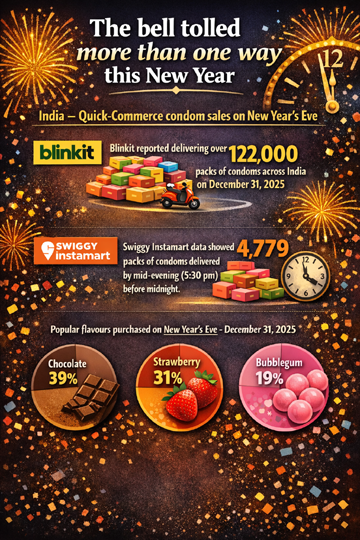
This helps explain why New Year’s intimacy often surpasses Valentine’s Day. Valentine’s Day, despite its romantic branding, is loaded with pressure. There are expectations to plan, impress, spend, and perform romance correctly. For many couples, especially in conservative or semi-conservative Indian settings, Valentine’s Day also carries social anxiety—judgment from family, surveillance from society, and a lingering sense of doing something slightly forbidden. Pressure, as psychologists repeatedly remind us, is a well-known desire killer. New Year’s Day, by contrast, arrives quietly. It does not demand romance; it allows it.
Interestingly, this global pattern has measurable biological consequences. In the UK, September is the most common birth month, with September 26 holding the distinction of being the most frequent birthday for two decades. This date falls roughly 39 weeks after Christmas Day, another intimacy spike. The data confirms what people rarely admit: sexual behavior follows calendars of rest, not romance. If similar patterns are emerging in India, they may quietly reshape birth trends over the next decade, especially in urban and semi-urban areas where contraception and family planning are more widely used.
Yet it is important to acknowledge that New Year’s Day is not universally joyful or erotic. For many, it is emotionally loaded—a time of reflection, anxiety, or dread about the year ahead. Gigi Engle emphasizes that stress does not look the same for everyone, and neither does desire. Feeling unsexy on January 1 does not make anyone abnormal or broken. In fact, the larger lesson of New Year sexuality is not obligation but permission: permission to rest, to feel, or to opt out entirely. Desire cannot be forced, and expecting it on command defeats the very conditions that allow it to emerge.
ALSO READ: Summer sex or winter action? New way to divide couples with climate
This brings us to a more provocative idea gaining traction in 2026: what if New Year’s resolutions focused not on discipline but on pleasure? Every January, people vow to drink less, exercise more, work harder, and behave better. These resolutions often fail because they are rooted in self-denial. A growing number of sex educators and writers are proposing an alternative: resolutions that quietly but profoundly improve sexual lives. Not through gimmicks or extreme experimentation, but through honesty, courage, and small behavioral shifts.
The first of these shifts is deceptively simple: stop having polite sex. Polite sex is sex agreed to out of duty, routine, or fear of conflict. It maintains harmony but slowly extinguishes desire. In long-term Indian relationships—particularly marriages—polite sex is common and rarely questioned. Yet resentment, which polite sex breeds, is one of the least sexy emotions imaginable. Good relationships do not automatically produce good sex, and maintaining peace at the cost of pleasure is a poor long-term strategy.
Closely related is the resolution to say what you want—out loud. Not through hints, jokes, or silent disappointment, but through clear communication. In a culture where sexual expression is often indirect or taboo, this can feel deeply uncomfortable. Voices wobble, words feel awkward, and fear of judgment looms large. Yet nothing kills desire faster than lying next to someone, silently wishing they would do something differently. Communication does not ruin intimacy; it makes it possible.
Alongside this comes a radical but necessary practice: stop faking it. Pretending to enjoy sex that does not satisfy you helps no one. It trains partners into repeating the same unfulfilling patterns and ensures boredom becomes permanent. As 2026 begins, there is little reason to carry forward the same sexual routines that defined 2025. Growth requires honesty, even when it disrupts comfort.
Another deeply ingrained habit worth questioning is the need to be “good.” Good girlfriend, good wife, good date, good girl. In India especially, women are often socialized to prioritize harmony, modesty, and male comfort over their own desire. Yet the people having the most fulfilling sex lives are rarely those trying hardest to impress. They are comfortable asking for more. They are a little selfish, a little greedy, and unapologetic about their pleasure. Popular culture icons like Samantha from Sex and the City resonate precisely because they embody this freedom—knowing what they want and refusing to apologize for it.
This honesty must extend to dating choices as well. Sexual curiosity matters. If someone does not occupy your thoughts when they are absent, chemistry is unlikely to magically appear months later. Compatibility is important, but so is desire. The idea that one must choose between emotional connection and sexual attraction is a false binary. In reality, sustainable relationships require both.
Receiving pleasure is another overlooked skill. Many women, and men too, are generous lovers but deeply uncomfortable being desired. Compliments are brushed off, attention is deflected, and vulnerability is avoided. Yet allowing someone to want you is powerful. It requires trust and presence. Accepting desire rather than deflecting it can transform sexual dynamics in profound ways.
Initiation is another area ripe for reframing. The belief that men must always initiate sex persists strongly in Indian society. This script limits both partners. Initiating does not make someone less feminine or desirable. On the contrary, enthusiasm is intoxicating. Subtle gestures, confidence, and directness can coexist beautifully with softness and grace.
Equally important is abandoning the idea of sex as a performance. Worrying about appearance, technique, or evaluation pulls attention out of the body and into the mind. Great sex requires embodiment, not self-surveillance. Most partners are far less critical than we imagine. Presence, not perfection, is what creates intensity.
Flirting, too, deserves revival, even in long-term relationships. Sex does not have to be scheduled or negotiated like a chore. Teasing, eye contact, playful messages, and small gestures of desire keep erotic energy alive. They remind partners that attraction still exists beyond routine.
Perhaps the most confronting resolution is this: stop blaming low libido when the real issue is the relationship. Hormones matter, but they are not the only factor. Medical science now offers numerous treatments for hormonal and physiological changes. Yet sometimes, desire fades not because of biology but because enthusiasm, consistency, and mutual wanting have disappeared. Ambivalence is exhausting. Desire thrives where it is reciprocated loudly and clearly.
Porn, often demonized, also deserves a more nuanced conversation. Used openly and consciously, it can inspire dialogue and exploration. Used secretly or compulsively, it creates distance and shame. Like most tools, its impact depends on honesty.
Finally, touching without a goal may be the most powerful resolution of all. In a world obsessed with outcomes, allowing touch to exist without expectation—back rubs, hand-holding, closeness—builds safety and intimacy. It reminds partners that connection itself is valuable, not just orgasm.
All of this unfolds against the backdrop of India’s unique sexual landscape. Global studies consistently rank India as one of the least promiscuous countries in the world, with an average of around three sexual partners per lifetime, compared to a global average of nine. Cultural norms around marriage, fidelity, and modesty play a significant role in shaping this reality, though self-reporting bias must be acknowledged. People in conservative societies often under-report sexual activity due to stigma.
At the same time, platform-specific data from dating and infidelity apps paints a more complex picture. Recent reports highlight rising engagement in extramarital affairs in cities like Kanchipuram, Delhi-NCR, Jaipur, and other Tier-2 regions. These trends do not necessarily indicate widespread promiscuity but rather changing relationship dynamics, increased autonomy, and evolving attitudes toward monogamy.
The rise of New Year’s sex in India should be understood within this broader context. It is not evidence of a sexual revolution in the sensational sense, but of something quieter and more profound: people reclaiming moments of rest, agency, and intimacy in lives dominated by pressure. It suggests that desire does not need spectacle. It needs space.
As 2026 unfolds, the most meaningful sexual shift may not be about numbers, partners, or frequency. It may be about courage—the courage to rest, to speak honestly, to prioritize pleasure, and to remain curious. The best sex of one’s life is rarely about technique. It is about presence, vulnerability, and the willingness to evolve. And perhaps, quietly and unexpectedly, New Year’s Day has become the perfect symbol of that truth.
ALSO READ: Summer sex or winter action? New way to divide couples with climate