
The NDA-BJP government achieves quite spectacularly with out-of-Budget notifications, making the annual budget irrelevant and unexciting. The Barbara Broccoli Tubby Bro franchise is similar. It is more hype and less script, getting further and further away from the real-life war situations it was supposed to portray
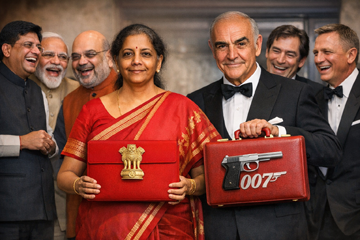
The NDA-BJP government achieves spectacularly with out of Budget notifications. The Barbara Broccoli Tubby Bro franchise is similar. It is more hype and less script, getting further and further away from the real life war situations it was supposed to portray
The Curse of the Eternal Franchise: Some things refuse to end. They do not die natural deaths; they simply age badly in public. James Bond 007 is one such institution. The Indian Union Budget is another. Both began as revolutionary interventions in their respective worlds. Bond redefined cinematic masculinity, espionage, and style. The Indian Budget once genuinely shaped the country’s economic destiny. Yet today, both survive less on relevance and more on ritual. We watch them not with excitement but with resignation, already certain that the latest version will be inferior to the previous one.
This is not nostalgia speaking. It is structural decay. Bond films and Indian Budgets suffer from the same affliction: the inability to surprise, constrained by legacy, terrified of backlash, and addicted to spectacle over substance. Each new iteration promises reinvention. Each delivers a watered-down remix. The franchise continues because it must, not because it should.
Once Upon a Time, They Mattered
There was a time when a new Bond film felt like an event. Connery’s Bond was dangerous, Dalton’s Bond was raw, and even early Brosnan had menace wrapped in charm. Similarly, there was a time when the Indian Budget genuinely altered the economic landscape. The 1991 budget did not merely announce numbers; it changed India’s trajectory. It liberalised, deregulated, and forced the country to confront reality.
Those moments were disruptive. They angered people. They broke conventions. They took risks.
That is precisely what modern Bond films and modern Budgets refuse to do.
From Disruption to Comfort Food
Modern Bond films are carefully curated products designed to offend no one while pretending to challenge everything. The Indian Budget follows the same template. It is no longer a tool of economic transformation; it is an annual content drop. The objective is not reform but narrative management.
Both now function as comfort food for institutions. Bond reassures the British film industry that the franchise still has “global relevance.” The Budget reassures markets, rating agencies, and television studios that nothing radical will happen this year either.
The result is predictability disguised as sophistication.
The Illusion of Change
Every Bond reboot announces a “darker,” “grittier,” or “more realistic” tone. Every Budget announces a “visionary,” “forward-looking,” or “transformational” framework. Yet strip away the adjectives, and the core remains untouched.
Bond still saves the world in roughly the same way. The Budget still shuffles tax slabs, renames schemes, and announces allocations that will not be fully spent. Cosmetic surgery is mistaken for evolution.
Change is simulated, not enacted.
Legacy as a Prison
Bond is trapped by his own mythology. He cannot abandon Aston Martins, shaken martinis, or the silhouette of masculine dominance, even when these symbols no longer fit the world. The Indian Budget is similarly imprisoned by fiscal orthodoxy, legacy subsidies, and institutional inertia. It cannot fundamentally rethink taxation, welfare delivery, or state capacity because doing so would require political courage.
Both are haunted by their own past greatness. Every attempt to innovate is weighed against “what Bond is supposed to be” or “what a Budget is supposed to sound like.” Innovation becomes incremental, fearful, and bureaucratic.
The Tyranny of the Opening Scene
Modern Bond films spend enormous energy on the opening sequence—an explosive chase, a gravity-defying stunt, a global spectacle designed for trailers. The rest of the film struggles to justify that opening. The Indian Budget mirrors this perfectly. The speech opens with lofty rhetoric: Amrit Kaal, demographic dividend, green growth, digital transformation.
The opening paragraph is designed for headlines. The remaining details are quietly mediocre.
The spectacle consumes the substance.
Villains Everywhere, Responsibility Nowhere
Bond always needs a villain. In older films, the villain represented real anxieties—Cold War paranoia, corporate greed, or nuclear annihilation. Today’s villains are abstract, confused, and interchangeable. Likewise, the Budget identifies convenient enemies: global headwinds, geopolitical tensions, pandemics, climate change.
These are real challenges, but they are also useful shields. They explain away underperformance without demanding accountability. When everything is blamed on external forces, nothing needs to change internally.
The Death of Risk-Taking
What Bond once did fearlessly—seduction, danger, moral ambiguity—it now approaches with legal disclaimers. What the Indian Budget once did boldly—cut subsidies, reform taxes, dismantle monopolies—it now tiptoes around. Risk-taking has been replaced by risk management.
This is fatal for both. Bond without danger is just a travel documentary with explosions. A Budget without risk is merely an accounting exercise.
Style Over Story
Modern Bond films look stunning. Locations are exotic, cinematography immaculate, and action choreographed with mathematical precision. Yet something essential is missing: narrative urgency. Similarly, the Budget is visually impressive in its PowerPoint avatars—charts, dashboards, portals, and mission-mode frameworks.
The aesthetic has improved. The soul has not.
Both mistake polish for progress.
The Inflation of Supporting Casts
Bond films now suffer from overcrowding: too many allies, too many subplots, too many callbacks. The Budget suffers the same fate with schemes. Every year introduces new missions, renamed initiatives, layered incentives, and overlapping authorities.
Complexity increases while effectiveness declines. The audience is overwhelmed, not enlightened.
The Fear of Offending Everyone
Bond now walks on eggshells, terrified of offending modern sensibilities while still clinging to outdated tropes. The Budget is equally cautious, attempting to please farmers, middle classes, corporates, states, and global investors simultaneously.
The result is dilution. When you try to please everyone, you excite no one.
Marketing Masquerading as Vision
Bond films are marketed as cultural statements. Budgets are marketed as civilisational milestones. Neither lives up to the promise. Marketing has replaced imagination.
The audience senses this immediately. Viewers and citizens alike approach the release not with anticipation but with cynicism.
Ritual Without Meaning
Watching Bond has become a ritual. Listening to the Budget has become a ritual. We do it because it is part of the calendar, not because it moves us. The day after, life resumes unchanged.
Rituals without meaning eventually turn hollow.
The Role of the Media Cheerleaders
Bond critics and economic commentators play parallel roles. Both soften disappointment with intellectual gymnastics. A mediocre Bond film is praised for “subtext” and “reinvention.” A mediocre Budget is praised for “pragmatism” and “fiscal restraint.”
Criticism is blunted. Expectations are lowered. Mediocrity is normalised.
The Problem of Scale
Bond is now too big to fail. The Budget is too big to disrupt. Scale has become the enemy of creativity. Every decision must pass through layers of risk assessment, brand protection, and institutional conservatism.
Small, sharp ideas die in committee.
When Nostalgia Becomes the Product
Bond increasingly sells nostalgia—callbacks, musical cues, iconic poses. The Budget increasingly sells continuity—policy stability, long-term vision, incrementalism. Nostalgia is safe. It is also stagnant.
A society cannot move forward by constantly looking backward.
The Illusion of Seriousness
Daniel Craig’s Bond was serious, brooding, and self-aware. The Budget is serious, technocratic, and jargon-heavy. Seriousness is mistaken for depth.
But seriousness without imagination is just heaviness.
The Audience Has Changed, the Script Hasn’t
The world Bond inhabits has transformed. Espionage today is digital, bureaucratic, and morally ambiguous. The Indian economy has transformed too—urbanised, informal, aspirational, unequal. Yet both franchises rely on outdated scripts.
The mismatch grows more obvious with each iteration.
When Longevity Becomes a Liability
Longevity is usually celebrated. But when institutions outlive their ability to adapt, longevity becomes a liability. Bond’s long history prevents radical reinvention. The Budget’s long tradition prevents radical honesty.
Ending, or at least pausing, might be healthier than endless continuation.
The Missed Opportunity of Reinvention
Bond could have become something radically new—smaller, smarter, more intimate. The Budget could have become a strategic document rather than a theatrical event. Both missed the opportunity.
They chose safety over significance.
Why We Still Show Up
Despite everything, we still watch Bond films. We still listen to the Budget. Habit is powerful. So is hope. We keep believing that maybe this time, something will click.
That hope is increasingly irrational.
The Tragedy of Predictable Decline
The saddest part is not that Bond films and Budgets are bad. It is that their decline is predictable. You can almost script the disappointment. That is the hallmark of institutional decay.
Surprise is gone. Courage is gone.
What Would Redemption Look Like?
Redemption would require letting go. Letting go of legacy, fear, and the need to please everyone. Bond would need to risk alienating fans. The Budget would need to risk angering voters.
Both would need to rediscover why they mattered in the first place.
Until Then, the Franchise Continues
Until that happens, the cycle will repeat. New Bond. New Budget. Same disappointment. Same debates. Same excuses.
And the same conclusion, muttered quietly but widely shared:
The older ones were better.
Not because the past was perfect, but because it dared to matter.