
UPI transformed everyday banking by allowing instant account-to-account transfers through mobile devices without requiring complicated bank details. What began as a domestic convenience has evolved into the world’s largest real-time payment ecosystem
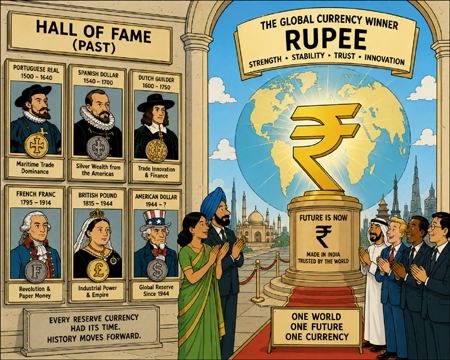
The global economy has revolved around a single dominant reserve currency. From the Portuguese Real to the Spanish Dollar, the Dutch Guilder, the French Franc, the British Pound and finally the American Dollar, history suggests that economic leadership has never been permanent. Every dominant financial power appeared invincible during its peak, accumulated immense wealth, shaped international trade in its own image and eventually encountered structural challenges that weakened its monetary dominance. Today, discussions about the future of the U.S. dollar, the emergence of digital payment systems such as India’s Unified Payments Interface (UPI), and the gradual diversification of global reserves have become increasingly common among economists and policymakers.
India’s remarkable rise in digital payments has added a new dimension to this conversation. UPI has evolved from being a domestic payment innovation into a globally recognized digital public infrastructure. While UPI alone cannot determine the future of international reserve currencies, its international expansion demonstrates India’s growing technological influence and its ability to shape financial ecosystems beyond its borders.
At the same time, comparisons are increasingly being drawn between today’s United States and previous reserve currency powers. Such comparisons deserve careful examination. History often provides valuable lessons, but it rarely repeats itself in exactly the same form. Modern financial markets, central banking, global trade, military alliances, technological innovation and digital finance have transformed the world in ways that make simple historical analogies insufficient.
Understanding these developments requires examining both India’s digital transformation and the long historical evolution of reserve currencies.
India’s digital payments revolution spills over to the world
Few financial innovations have spread as rapidly as India’s Unified Payments Interface. Introduced in 2016, UPI transformed everyday banking by allowing instant account-to-account transfers through mobile devices without requiring complicated bank details. What began as a domestic convenience has evolved into the world’s largest real-time payment ecosystem.
Today, UPI operates in ten countries including Singapore, the United Arab Emirates, France, Mauritius, Nepal, Bhutan, Qatar, Sri Lanka, Cambodia and Greece. The addition of France, Cambodia and Greece marks an important milestone because it extends India’s payment infrastructure into Europe as well as Southeast Asia.
The system’s success lies in its simplicity. Users scan a QR code, authenticate the payment and receive immediate confirmation. There are no lengthy settlement delays, expensive merchant terminals or complicated payment gateways.
The international partnerships have also been carefully designed. Singapore’s PayNow network is connected with UPI, allowing faster cross-border transfers between the two countries. Cambodia’s KHQR framework similarly enables seamless QR-code interoperability. NPCI International has reportedly onboarded more than two million merchants worldwide, enabling Indian travelers to make purchases without relying heavily on foreign cash or expensive international card networks. Cross-border mobile transactions have already crossed 1.48 million, reducing exchange costs and hidden banking fees.
Domestically, UPI processes over 660 million transactions every day, making it the largest real-time payment system globally by transaction volume. This extraordinary scale demonstrates not only India’s digital capability but also the confidence that millions of users have placed in the platform. Beyond commerce, India has increasingly promoted its Digital Public Infrastructure model internationally. More than twenty-three countries have reportedly signed cooperation agreements to study or adapt aspects of India’s digital ecosystem, including digital identity, payment infrastructure and data-sharing frameworks.
Unlike many proprietary payment platforms controlled by private corporations, India’s model combines public infrastructure with private innovation. Banks, fintech companies and technology firms compete on top of a common digital platform rather than building isolated payment ecosystems.
This architecture has attracted considerable global attention because it reduces costs while encouraging competition and financial inclusion. Countries seeking affordable digital payment infrastructure increasingly view India’s experience as a practical model rather than merely a technological curiosity. Yet digital payment leadership and reserve currency leadership are not identical. Payment infrastructure facilitates commerce, while reserve currency status depends upon a much wider set of economic, financial, legal and geopolitical conditions.
Five centuries of reserve currencies – the tale of the teller
Looking across approximately five hundred years of financial history reveals an interesting sequence of dominant reserve currencies. The Portuguese Real dominated during Portugal’s maritime expansion. It was followed by the Spanish Dollar, then the Dutch Guilder, the French Franc, the British Pound and finally the American Dollar after the Second World War.
Supporters of the historical reserve currency cycle often observe that each dominant currency enjoyed an average lifespan approaching one century. Although the exact duration varies depending on methodology, the broad pattern suggests that monetary leadership eventually shifts alongside economic leadership.
Portugal provides an early example. During the Age of Discovery, roughly two-thirds of Portuguese income reportedly came from maritime trade. Portugal controlled lucrative sea routes linking Europe with Asia and Africa. Instead of building a broad industrial economy, however, much of its prosperity depended upon controlling strategic shipping routes and collecting trading revenues.
Eventually, Dutch merchants developed more efficient commercial networks and maritime capabilities. As trade patterns shifted, Portugal’s financial dominance gradually faded.
Spain’s experience followed a somewhat different path. The Spanish Empire extracted enormous quantities of silver from the Americas, importing thousands of tonnes of precious metals into Europe. Initially this created extraordinary wealth. However, easy access to precious metals reduced incentives to strengthen domestic manufacturing. Inflation increased while government borrowing expanded. Confidence eventually weakened, and Spain’s financial influence declined.
The Dutch Republic succeeded through commercial innovation, banking sophistication and efficient financial markets. Amsterdam became one of the world’s leading financial centers, illustrating how institutional strength could complement commercial success.
France’s experience demonstrated another risk. During the French Revolution, confiscated Church property became the backing for newly issued paper currency known as assignats. The money supply expanded dramatically within only a few years. Excessive issuance undermined confidence, inflation accelerated and purchasing power declined sharply.
Each of these historical cases differs in important respects. Military conflict, technological change, governance failures, fiscal policy and international competition all contributed to the eventual decline of monetary dominance. No single explanation adequately accounts for every transition.
Nevertheless, several recurring themes emerge repeatedly: excessive debt, fiscal imbalance, declining competitiveness, loss of industrial leadership, weakening investor confidence and changing patterns of international trade.
These historical experiences provide useful context for evaluating more recent reserve currency transitions.
The British Pound’s demise and the rise of the U.S. dollar
The British Pound represented the world’s dominant reserve currency during the nineteenth century and the early decades of the twentieth century. Britain’s industrial revolution, naval supremacy, colonial trade networks and sophisticated financial markets placed London at the center of global finance.
At one stage, approximately sixty percent of global foreign exchange reserves were held in pounds sterling. International trade contracts, commodity pricing and government borrowing frequently relied upon British financial institutions.
However, maintaining global leadership became increasingly expensive.
The First World War fundamentally altered Britain’s fiscal position. Government debt increased dramatically relative to national output. Financing wartime expenditures required substantial borrowing, while economic reconstruction imposed additional burdens after the conflict.
The interwar period proved especially difficult. Britain faced slower economic growth, industrial competition from the United States and changing patterns of global investment.
Financial historians often note that the bond market increasingly questioned Britain’s long-term fiscal capacity. Investors gradually shifted toward U.S. financial assets as American industrial production, capital markets and economic scale expanded.
The Second World War accelerated this transition. By 1944, the Bretton Woods system formally established the U.S. dollar as the central pillar of the international monetary order, with the dollar convertible into gold at a fixed exchange rate.
Britain did not suddenly disappear as a financial center. London remains one of the world’s leading financial hubs today. However, sterling’s role as the primary reserve currency diminished substantially over subsequent decades.
Today, the pound constitutes only a relatively small percentage of official global reserves compared with its historical dominance.
The British example demonstrates that reserve currency transitions often unfold gradually over several decades rather than through sudden collapse.
Importantly, Britain’s decline coincided with the emergence of another exceptionally large industrial economy capable of providing deep financial markets, stable institutions and international liquidity. Reserve currency succession therefore depended not only upon Britain’s weaknesses but also upon America’s extraordinary strengths.
This distinction remains important when evaluating present-day discussions surrounding the U.S. dollar.
Is the American dollar entering a downslide phase?
Concerns regarding America’s fiscal position have become increasingly prominent in recent years. Public debt has risen substantially, annual budget deficits remain large and interest payments on government debt continue to increase.
Observers frequently point out that U.S. government debt exceeds $39 trillion. Rising interest rates have also increased the cost of servicing this debt, with annual interest payments reaching historically high levels.
Another widely discussed trend involves the composition of global foreign exchange reserves. According to data from the International Monetary Fund, the dollar’s share of allocated global reserves has gradually declined over the past two decades, although it remains by far the world’s largest reserve currency.
At the same time, many central banks have increased gold purchases. Several emerging economies have also sought greater diversification in reserve holdings and payment arrangements.
China has reduced portions of its holdings of U.S. Treasury securities over time while simultaneously promoting greater international use of the renminbi. Other countries have experimented with bilateral trade settlement in local currencies.
These developments have encouraged speculation that the dollar may eventually experience the same trajectory as previous reserve currencies.
However, important differences should also be recognized.
The United States continues to possess the world’s deepest government bond market, highly liquid financial institutions, relatively transparent legal systems, globally influential technology companies and unmatched military capabilities.
Most international commodities remain denominated in dollars. Global banking systems continue to depend heavily upon dollar liquidity. International investors still regard U.S. Treasury securities as among the safest and most liquid financial assets available.
Reserve currency status therefore depends upon confidence rather than debt alone.
History demonstrates that high debt levels may weaken confidence over time, but confidence also depends upon institutional quality, economic productivity, political stability and the availability of credible alternatives.
The future of the dollar will likely depend as much upon whether another economy develops equivalent financial depth and global trust as upon America’s own fiscal challenges.
India’s rise, the Rupee and the future international monetary order
India’s economy has expanded rapidly over recent decades, with gross domestic product increasing significantly alongside improvements in infrastructure, manufacturing, services and digital technology. Foreign exchange reserves remain substantial, while India’s current account deficit has generally remained manageable compared with many emerging economies.
UPI represents one visible component of this transformation. Digital payments worth trillions of dollars annually reflect growing domestic formalization and financial inclusion rather than merely technological sophistication.
As India’s economic influence expands, some analysts argue that greater international use of the rupee could naturally follow.
Several factors support this possibility.
India is among the world’s fastest-growing major economies. Its demographic profile remains relatively favorable compared with many aging developed countries. Manufacturing initiatives, logistics improvements and expanding export capabilities may gradually increase international demand for the rupee.
If more bilateral trade is settled directly in rupees, dependence upon intermediary currencies could gradually decline.
However, reserve currency status requires much more than economic growth.
Global reserve currencies require deep and highly liquid government bond markets, unrestricted capital movement, strong legal protections for investors, macroeconomic stability, confidence in monetary institutions and willingness among foreign governments to hold substantial financial assets denominated in that currency.
The Indian rupee has not yet achieved those conditions at the scale necessary to rival the dollar.
Some commentators reference the 1985 Plaza Accord, during which coordinated international action contributed to significant appreciation of the Japanese yen relative to the U.S. dollar. This episode illustrates that major currency realignments are indeed possible under specific international circumstances.
Nevertheless, exchange-rate movements depend upon numerous variables including productivity, inflation, interest rates, capital flows, trade balances and central bank policy. Large historical movements do not automatically predict similar future outcomes between different currency pairs.
Gold also deserves attention within this discussion. Throughout history, periods of uncertainty regarding reserve currencies have often coincided with stronger investor demand for gold. Central banks continue to regard gold as a strategic reserve asset because it carries no sovereign credit risk.
Ultimately, the evolution of the international monetary system is unlikely to produce an abrupt replacement of one currency by another. Instead, the world may gradually move toward a more diversified system in which several major currencies—including the dollar, euro, renminbi and potentially the rupee over time—play larger international roles alongside increasingly sophisticated digital payment networks. India’s UPI illustrates how technological leadership can strengthen a nation’s global economic influence. Whether such technological success eventually contributes to greater international acceptance of the rupee will depend upon broader institutional, financial and economic developments. History certainly offers valuable lessons from previous reserve currency transitions, but it also reminds us that every era introduces new forces that reshape the global economy. The emergence of digital public infrastructure, changing geopolitical alignments, central bank reserve diversification and the continued evolution of international finance suggest that the coming decades may witness a gradual rebalancing rather than a sudden revolution. In that evolving landscape, India’s growing digital capabilities and expanding economic scale position it as an increasingly influential participant in shaping the future architecture of global finance.